Elon Musk Bought Twitter for $44.6 Billion? 17 Smarter Ways to Waste It

Musk's $44.6B Twitter acquisition sparks a "waste" debate, reflecting the deeper logic of the attention economy and capital flows.
The article starts from a satirical commentary on Musk's $44.6 billion Twitter acquisition and explores the product and platform logic behind the deal. The original author teases the massive acquisition with "17 better ways to waste," arguing that social media's consumption of attention is the core contradiction. It further analyzes the product paradox of the attention economy—how high dwell-time design brings side effects for user health and discussion quality—and compares investment directions in AI and open source, emphasizing that capital flows determine future tech tools and communication platforms. Finally, it notes that content creators can learn from its approach of contrasting concrete numbers with abstract costs, but must add in-depth analysis to leave long-term value.
When "Wasting" Becomes an Art: Starting from Musk's $44.6 Billion
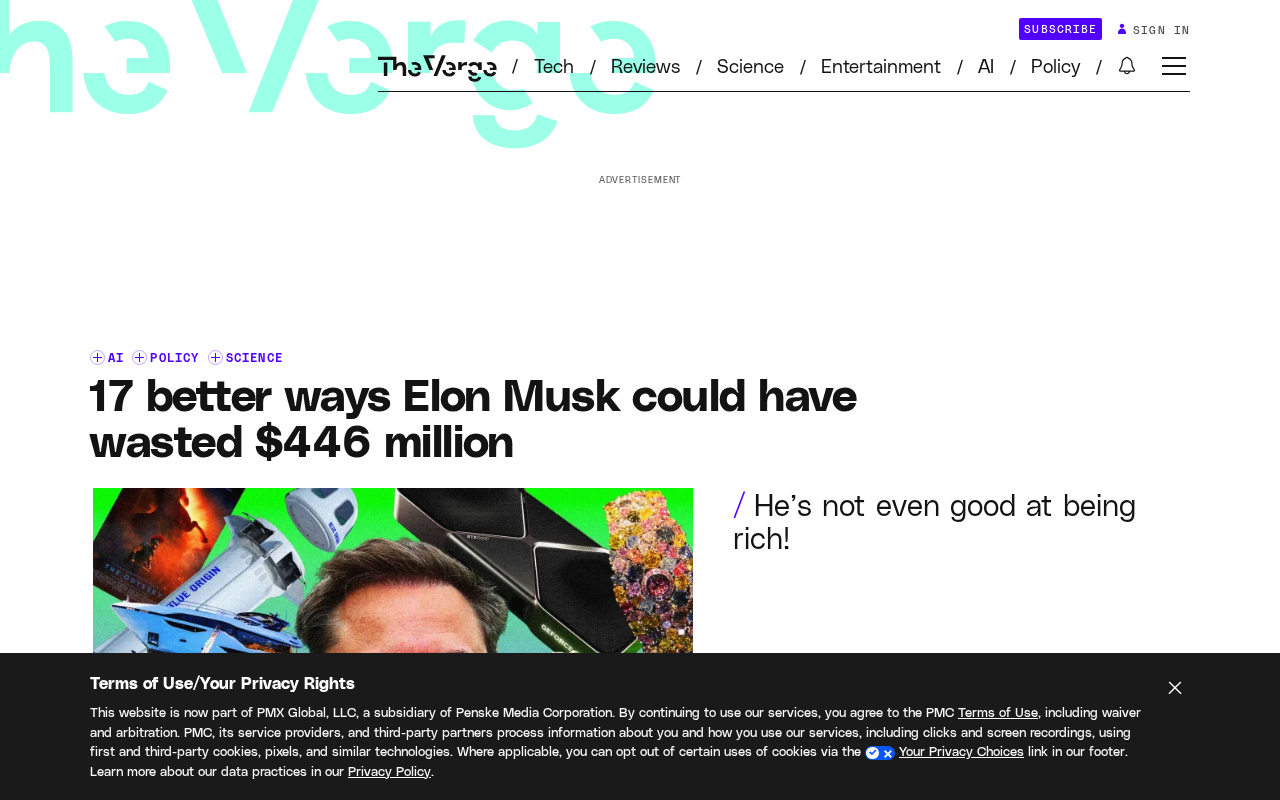
Spend too much time on social media and your brain gets roasted by a crowd of attention-grabbing lunatics—that's how many people genuinely feel while scrolling their feeds. But if you happen to be the person who spent $44.6 billion to buy the platform, the problem might be a bit more than just "roasted brain." A recent opinion piece from rss, 17 better ways Elon Musk could have wasted $446 million, uses this angle to poke fun at Musk's massive acquisition of Twitter (now X). The title itself is a giant piece of irony: if you're going to waste money anyway, why not pick 17 more "respectable" ways to do it?
As AI and tech observers, let's step back from the emotion and talk about the deeper logic of product, platform, and attention behind this deal.
$44.6 Billion for an "Attention Black Hole"?
The core argument of the original piece is sharp: if social media can "fry the brains" of ordinary people, what exactly does the person controlling the platform get? After the acquisition, Musk repeatedly emphasized free speech and product iteration, but from the outside, X's controversies have never stopped. The author's use of the word "waste" isn't purely about financial returns—it's more like saying this money could have solved more practical problems instead of buying a megaphone that amplifies emotion and division.
What's worth noting is that the context in which the article was published carries a strong social-media expressive style—short, sarcastic, laced with personal emotion. This itself proves the platform's power to shape public discussion: even an article criticizing the platform borrows the platform's tone.
The "Better Ways to Waste" Hide Expectations for Products
The "17 better ways" in the title aren't listed one by one in the abstract, but the subtext is clear: rather than dumping money into equity in a social platform, invest in directions that deliver definite value. For the tech industry, this kind of teasing can be turned into serious product thinking.
The Product Paradox of the Attention Economy
The core metric for social products is user dwell time, and the "brain being roasted" described at the start of the original piece is precisely a side effect of high dwell time. As platform design gets better and better at capturing attention, the healthy boundary between users and products becomes blurred. Musk's acquisition once made many people hope for "decentralization" or "algorithmic transparency," but the reality is that any platform, once it scales, can hardly escape the gravity of the attention economy.
The attention economy is an economic framework that treats human attention as a scarce resource, first proposed by Herbert Simon in 1971 and later developed by figures such as Michael Goldhaber. Its core logic: in an environment of information overload, attention becomes a scarcer asset than information itself; platforms attract user attention through free content and then package and sell it to advertisers. Recommendation algorithms, infinite scrolling, notification pushes, and other designs in social products are essentially attention-capture mechanisms. This explains why "high dwell time" is both a sign of product success and a source of cognitive burden for users—the platform's objective function is not naturally aligned with users' long-term well-being.
Open Source and AI: Another "Money-Burning" Direction
If you put that $44.6 billion into AI and open-source tools, the story might be completely different. Training large models, supporting open-source communities, building developer ecosystems—these directions are also extremely expensive, but what they produce are reusable technological assets. The original piece doesn't elaborate on these options, but its "waste" framing precisely reminds us: where capital flows determines what tools we use and what platforms we communicate on in the next decade.
The cost structure of large-model training deserves elaboration: taking a GPT-4-level model as an example, a single training run is estimated to cost tens of millions to around a hundred million dollars; adding data cleaning, compute clusters, talent teams, and repeated experiments, total investment can reach hundreds of millions or more. But unlike acquiring a social platform, the output of such investment is reusable technological assets—model weights, training frameworks, toolchains, and developer ecosystems. Open-source communities (such as Hugging Face and the PyTorch ecosystem) further amplify the public nature of these assets: one company's investment can lower the barrier to entry for the entire industry. This is exactly the subtext of the original piece's "waste" framing: capital flows determine the shape of technological infrastructure, and infrastructure has long-cycle externalities.
From Ranting to Inspiration: What Content Creators Can Learn
This short piece is worth paying attention to not because it gives answers, but because it raises a good question: when we criticize a big platform, what do we actually want? A healthier discussion environment, or more transparent algorithms? For AI/tech content creators, this is also a rich vein of topics.
The original piece's sarcastic style reminds us that tech commentary doesn't always have to be bland and balanced. Contrasting a concrete number ($44.6 billion) with abstract costs (attention, quality of public discussion) makes the argument more impactful. At the same time, it exposes a limitation: emotional expression spreads easily, but only in-depth analysis leaves long-term value.
The sarcastic style in tech commentary is not merely an emotional release but a rhetorical strategy: creating a cognitive gap through extreme contrast ($44.6 billion vs. 17 better uses) and forcing readers to re-examine default assumptions. This style is common in tech media as "counterfactual reasoning"—imagining what would happen if resources flowed in another direction. For creators, the key is whether serious analysis can follow the sarcasm: numbers provide impact, but only by breaking down cost structures, stakeholders, and alternatives can a rant be turned into shareable insight. Otherwise, emotional expression easily falls into the trap of "wide reach but shallow retention."
Conclusion: Whether It's a Waste Depends on the Yardstick
Whether Musk wasted $44.6 billion depends on what ruler you use—financial returns, public influence, or technological legacy. The original piece chooses humor to defuse seriousness, and we can choose to keep asking about the real costs of the platform economy after the humor. After all, what's scarier than "waste" is that we've grown accustomed to it.
One-line Summary
Musk's $44.6 billion Twitter acquisition sparks a debate over "waste," reflecting the deeper logic of the attention economy and capital flows.
Paragraph Summary
The article starts from a satirical commentary on Musk's $44.6 billion acquisition of Twitter and explores the product and platform logic behind the deal. The original author teases the massive acquisition with "17 better ways to waste," pointing out that social media's consumption of attention is the core contradiction. The article further analyzes the product paradox of the attention economy—high dwell-time design brings side effects for user health and discussion quality—and compares investment directions in AI and open source, emphasizing that capital flows determine future tech tools and communication platforms. Finally, it notes that content creators can learn from its expressive approach of contrasting concrete numbers with abstract costs, but must add in-depth analysis to leave long-term value.
Related articles
 Tech Frontiers
Coldframe: A Honeypot Disguised as a Supermarket Freezer Controller
Coldframe is a honeypot disguised as Danfoss AK-SM 800A and Dixell XWEB freezer controllers, built as a single Python file that detects CVE-2025-41450 attempts and is identified as real devices on Shodan.
 Tech Frontiers
GRFNet: A Lightweight PyTorch Model Designed for Multichannel Time-Series Classification
GRFNet is a lightweight PyTorch model for multichannel time-series classification, originating from EEG decoding research. With only 3,847 parameters, it is based on the ROCKET architecture, combining random convolution kernels with learnable spatial filters, supports arbitrary input lengths, and will soon be evaluated on the PhysioNet dataset.
 Tech Frontiers
CUDA-Accelerated Rocket League Simulator: A Player-Made Hardcore Experiment
A Reddit post shows a "100% Accurate" Rocket League simulator accelerated with CUDA. We analyze its technical context, CUDA's value in game physics simulation, and the significance and limitations of such community projects.