Elorian Releases Its First AI Model Glimpse: Reasoning With Images, Not About Images

Elorian releases its first model Glimpse, featuring vision-native reasoning and claiming to surpass GPT-6 Astra on chart reasoning tasks.
Elorian released its first AI model, Glimpse, proposing a "vision-native reasoning" architecture that keeps reasoning in image form rather than translating it into text tokens, avoiding the loss of spatial and numerical information in traditional VLMs. It claims to surpass GPT-6 Astra on scientific chart reasoning and short video description tasks. If validated, it could challenge the mainstream "visual encoder + language model" paradigm, though third-party reproduction is still lacking.
When AI Is No Longer Just "Looking at Images and Describing Them"
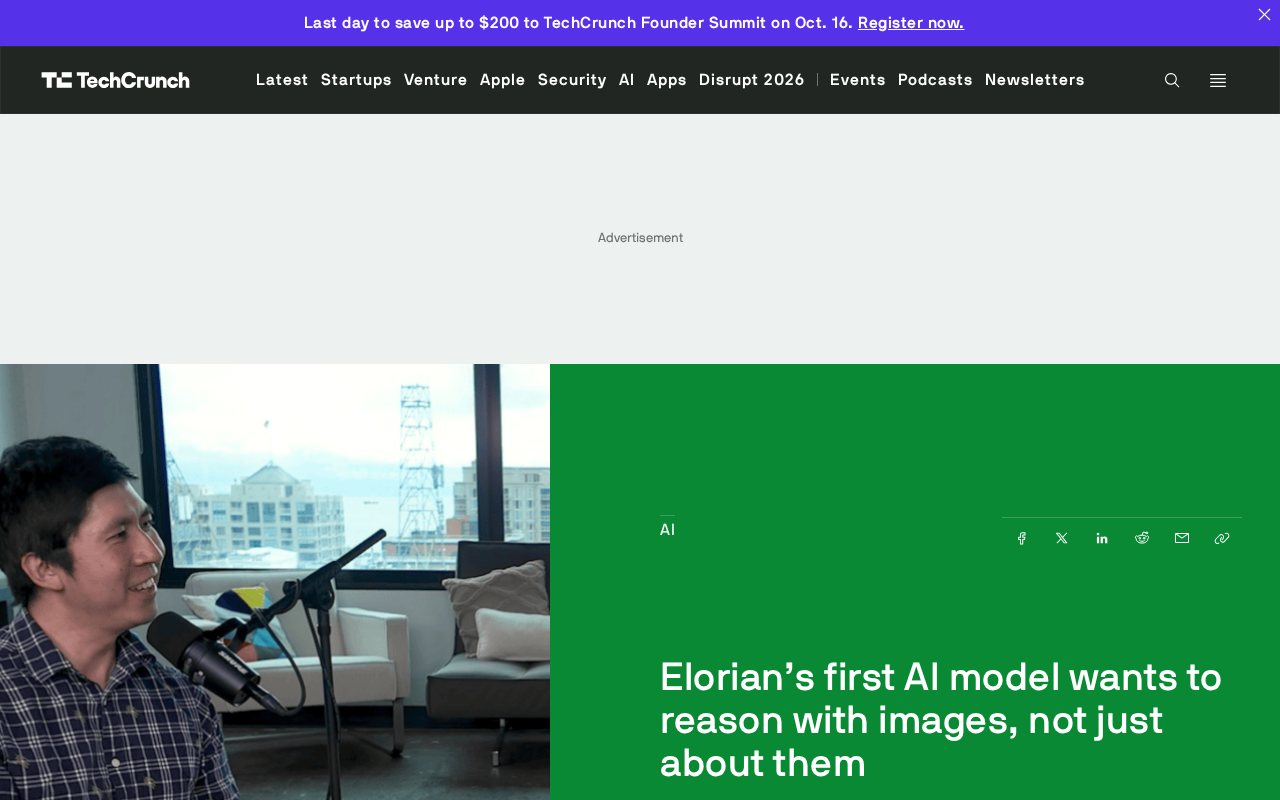
Most multimodal models process images by essentially translating visual signals into language and then using a language model to understand them. Elorian believes this approach is misguided.
The newly entered AI company has released its first model, Glimpse, with a very clear positioning: using images directly as the medium for reasoning, rather than reducing images to text before thinking. In one sentence, its ambition is — not reasoning "about images," but reasoning "with images."
This distinction sounds subtle, but in tasks like scientific chart parsing and short video description, it could mean a fundamental difference at the architectural level.
What Exactly Glimpse Does Differently
The typical pipeline of a traditional vision-language model (VLM) is: an image passes through a visual encoder to become a set of feature vectors, then is mapped through a projection layer into the token space of a language model, and finally the language model performs reasoning and generation. In this process, the image is more like "input data," and the language module is always the one actually doing the reasoning.
Glimpse's approach is different. Elorian describes it as a "vision-native reasoning" architecture — the intermediate representations in the reasoning process remain in visual form rather than being translated into text tokens early on. The direct benefit is that spatial relationships, numerical trends, structural proportions, and other information in charts are not lost during the "image-to-text" compression process.
This is an architectural choice worth watching. The performance bottlenecks of current mainstream multimodal models often lie precisely in the tokenization loss of visual information.
A visual encoder is the core component in multimodal models that converts images into numerical features, typically composed of a convolutional neural network (CNN) or a vision Transformer (ViT). It slices an image into patches or regions, extracts high-dimensional feature vectors patch by patch, and turns the image into a machine-computable form for the first time. The projection layer then takes on the "translation" role, using a trainable multilayer perceptron or linear mapping to align these visual feature vectors with the token embedding space of the language model, so the language model can "read" the image information. The key loss in this entire pipeline is that the projection process is lossy compression: the continuous, high-dimensional spatial information of the image is forced into the discrete, low-dimensional language token space, and geometric relationships and numerical precision are easily lost at this point. What Glimpse tries to bypass is precisely this conversion chain from visual features to language tokens.
Benchmark Tests: Surpassing GPT-6 Astra
According to evaluation data released by Elorian, Glimpse surpasses GPT-6 Astra on both scientific chart reasoning and short video description tasks, and also achieves competitive results on other visual reasoning tasks.
It should be noted that these data come from Elorian's own evaluation system and have not yet been independently reproduced by third parties. But even with that discount, the first model from a new startup being able to match one of the strongest current multimodal systems on specific tasks itself shows that the "vision-native reasoning" path deserves serious consideration.
Scientific chart reasoning is a task that especially highlights architectural differences. Chart understanding requires the model to simultaneously handle geometric spatial relationships, numerical magnitude comparisons, and semantic annotations, and a pure language reasoning pipeline is naturally strained in these dimensions.
Scientific chart reasoning is a high-difficulty benchmark for evaluating multimodal models. Typical tasks include reading the slope of a line chart trend, comparing the relative heights of bar charts, parsing the clustering structure of scatter plots, and performing multi-step numerical inference by combining legends and axes. It is difficult because the answer often depends on precise spatial positions and numerical proportional relationships, rather than simple object recognition or commonsense question answering. Short video captioning requires the model to capture action sequences, scene transitions, and causal relationships within limited frames, and generate coherent natural language descriptions. The common feature of these two tasks is that the visual information itself carries most of the evidence needed for reasoning, and language serves only as the output form rather than the medium of thought. When a pure language reasoning pipeline handles such tasks, it needs to first convert the chart or frame sequence into textual descriptions and then infer based on the text, so information loss and error accumulation become more severe.
What Vision-Native Reasoning Means
If Glimpse's approach proves viable, its impact on multimodal AI could be reflected at several levels:
- Improved information fidelity: skipping the lossy "image-to-text" compression makes the visual information in the reasoning chain more complete
- Possibilities for new tasks: some visual tasks that are difficult to describe precisely in language (such as complex layout analysis and fine-grained spatial reasoning) may see breakthroughs
- Intensified architectural competition: the mainstream VLM paradigm of "visual encoder + language model" will face challenges from the vision-native route
Of course, there is still a long way from a single model's benchmark lead to a widely validated paradigm. The amount of information Elorian has released so far is limited, and key indicators such as the model's technical details, training data composition, and inference efficiency have yet to be disclosed.
Multimodal refers to a model's ability to simultaneously process and relate information from multiple modalities, such as text, images, audio, and video. The current mainstream multimodal architecture can be summarized as the concatenation paradigm of "visual encoder + language model": the visual module is responsible for perception, the language module is responsible for reasoning and generation, and the two are connected through a projection layer. The implicit assumption of this paradigm is that language is the universal carrier of reasoning, and other modalities must ultimately be "translated" into language before they can be deeply processed. Vision-native reasoning challenges this assumption, arguing that reasoning can take place directly within the visual representation space, with language serving only as an optional output interface. If this route holds, the design logic of multimodal models will shift from "language-centric" to "task-modality-centric," and the core of architectural competition will also shift from language model scale to the quality of cross-modal representations and reasoning efficiency.
Signals Worth Watching
As a new company, Elorian chose to propose a differentiated proposition at the architectural level with its first product, rather than following the existing paradigm with fine-tuning optimizations — this strategy itself is worth noting. Now that the AI model race has reached this point, the marginal returns of pure scale stacking are diminishing, and architectural innovation has again become a variable.
Whether Glimpse can truly open a new path of "reasoning with images," or whether it is only a local advantage on benchmarks, depends on subsequent independent evaluations and real-world application performance. But at least it has raised the right question: For the next step in multimodal AI, is it time to rethink the role of images in reasoning?
One-line Summary
Elorian releases its first model Glimpse, featuring a vision-native reasoning architecture and claiming to surpass GPT-6 Astra on tasks such as chart reasoning.
Paragraph Summary
Elorian released its first AI model, Glimpse, proposing a "vision-native reasoning" architecture that advocates keeping the reasoning process in image form rather than translating it into text tokens, thereby avoiding the loss of spatial relationships and numerical information caused by "image-to-text" conversion in traditional VLMs. According to its own evaluation, Glimpse surpasses GPT-6 Astra on scientific chart reasoning and short video description tasks, and is also competitive on other visual reasoning tasks. If this route proves viable, it could challenge the current mainstream "visual encoder + language model" paradigm, improve information fidelity, and open up possibilities for new tasks. However, the evaluation data have not yet been independently reproduced by third parties, and key information such as the model's technical details, training data, and inference efficiency remains undisclosed.
Related articles

Workbuddy for Absolute Beginners: How a Desktop AI Agent Fits Into Real Workflows
A beginner's guide to the Workbuddy desktop AI agent: installation, claiming credits, file management, and building automated workflows—compared with CodeX for fit and cost, helping professionals shift from AI question-askers to AI managers.

OpenAI's New Agent Stack: Computer Use, Decisions API, and Ultra-Fast Workflows
OpenAI Dev Day unveiled a new agent stack: Computer Use outperforms humans, Decisions API delivers ultra-low-latency classification via Luna, Agents API opens the same Computer Use capabilities, and GPT-6.1 Sol costs only one-seventh of Astra. Core updates, benchmark data, and developer insights.

Liang Wenfeng Open-Sources DeepInfo Inference Framework, Takes On U.S. Ban
DeepSeek open-sources its DeepInfo inference framework after its models, featuring GPU/CPU cross-pipelining, small-model prediction with large-model verification, and full Huawei Ascend and NVIDIA chip support—facing the U.S. federal ban head-on. This article analyzes its significance for AI deployment and open-source strategy.