EmbeddedSass for .NET: A Sass Compilation Solution Without Node.js Dependencies

EmbeddedSass for .NET enables native Sass compilation without Node.js via the official Embedded Sass Protocol.
EmbeddedSass for .NET leverages the official Embedded Sass Protocol to let .NET developers compile Sass/SCSS natively without relying on Node.js. By communicating with the Dart Sass compiler via protobuf-based inter-process communication, it delivers full Sass feature parity while integrating seamlessly into MSBuild pipelines, ASP.NET Core middleware, and Blazor projects. Though still early-stage, it fills a critical gap in the .NET ecosystem.
Why .NET Developers Should Pay Attention to EmbeddedSass
In modern frontend and full-stack development, Sass (Syntactically Awesome Style Sheets), as a superset of CSS, has long been the industry standard for building maintainable stylesheets. Features like variables, nesting, mixins, and modularization dramatically improve style management efficiency in large-scale projects.
Sass was originally designed by Hampton Catlin in 2006 and later led by Natalie Weizenbaum and Chris Eppstein. It was one of the earliest CSS preprocessors, standing alongside Less and Stylus as the three major mainstream solutions. Sass supports two syntax formats: the indented syntax (.sass files, using indentation instead of curly braces) and SCSS syntax (.scss files, fully compatible with CSS syntax). In large enterprise projects, Sass's variable system enables unified management of brand colors, spacing, and other Design Tokens. Nesting rules reduce repetitive selector writing, while mixins enable parameterized reuse of style fragments. Major CSS frameworks like Bootstrap and Foundation are written in Sass, further solidifying its central role in frontend engineering.
However, the .NET ecosystem has long had a notable shortcoming when it comes to integrating Sass compilation capabilities — developers have typically had to rely on Node.js toolchains or wrappers to convert SCSS to CSS.
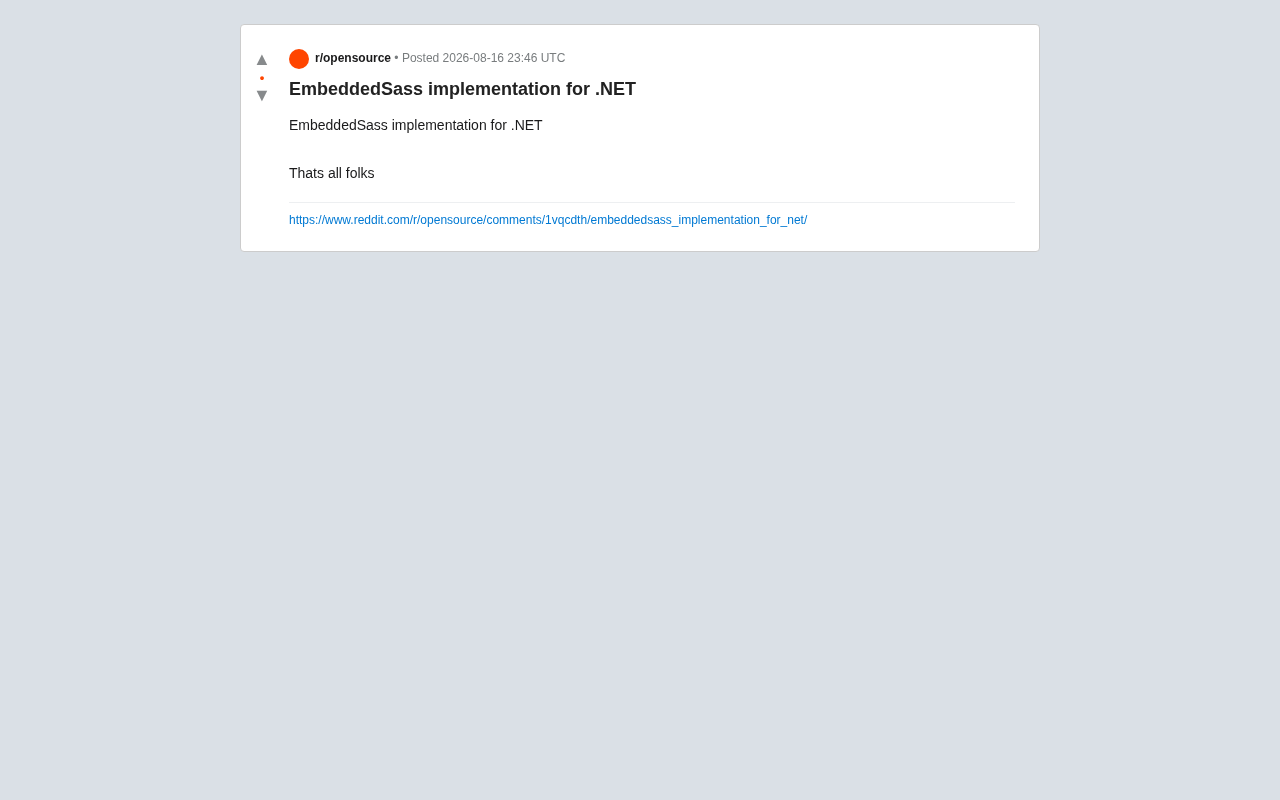
Recently, a noteworthy post appeared on the Reddit community: an EmbeddedSass implementation targeting .NET. While the original information was quite brief, the emergence of this project marks another reliable option for .NET developers seeking native Sass compilation integration.
Technical Principles Behind EmbeddedSass
Dart Sass and the Embedded Protocol
To understand the value of this project, you first need to understand Sass's official technical roadmap. After Ruby Sass and LibSass successively entered maintenance or deprecation phases, Dart Sass became the only officially recommended primary implementation, offering the most complete feature support and the fastest update cadence.
The Sass compiler has gone through three generations of evolution. The first was Ruby Sass (2006–2019), written in Ruby — feature-complete but poor in performance, officially discontinued in 2019. The second was LibSass (2012–2020), a high-performance C/C++ rewrite widely used in wrappers like node-sass. However, due to limited maintainer bandwidth, feature updates chronically lagged behind the official specification, and it was officially deprecated in 2020. The third generation is Dart Sass (2016–present), written in Dart and distributed as a standalone executable or JavaScript package. Dart Sass was the first to support the module system (@use/@forward replacing @import), math modules (sass:math), and other modern features. This evolutionary history explains why older LibSass-based solutions (such as node-sass and .NET wrappers like LibSassHost) are being phased out.
However, Dart Sass itself is written in Dart, making direct invocation from other languages far from straightforward. To solve this cross-language integration challenge, the Sass team introduced the Embedded Sass Protocol. This is a standardized protocol based on inter-process communication that allows host languages (such as .NET, Node.js, Rust, etc.) to communicate with a standalone dart-sass executable to perform SCSS/Sass compilation.
On the technical implementation side, the Embedded Sass Protocol uses Protocol Buffers (protobuf) for message serialization and communicates with the host process via standard input/output (stdin/stdout) pipes. This design draws inspiration from the Language Server Protocol (LSP) — encapsulating core functionality in an independent process and exposing capabilities through a standardized protocol. Specifically, the host program launches a dart-sass-embedded executable as a subprocess, then sends compilation requests via protobuf messages (containing SCSS source code, source map options, import paths, and other parameters). The compiler processes the request and returns the compilation result or error information. Protobuf's binary serialization is far more efficient than text formats like JSON, keeping communication overhead within acceptable bounds.
The core advantage of this architecture is that the host language doesn't need to reimplement the entire Sass compiler — it only needs to implement the client side of the protocol to gain compilation capabilities fully consistent with official Dart Sass, along with feature updates. Meanwhile, Sass compiler updates and host language SDK updates remain independent of each other, as long as protocol versions are compatible.
Sass Compilation Implementation for the .NET Platform
The EmbeddedSass for .NET shared by the community is precisely the implementation of the Embedded Sass Protocol on the .NET platform. By communicating with the embedded Sass compiler, it enables developers using C#, F#, and other .NET languages to natively invoke the latest Sass compilation capabilities without introducing a bulky Node.js dependency.
Before EmbeddedSass appeared, .NET developers mainly had the following Sass compilation options: LibSassHost used P/Invoke to call LibSass's C API — excellent performance but constrained by the reality that LibSass has been deprecated, with no new feature support available. WebCompiler and BundlerMinifier Visual Studio extensions provided visual compilation support but were unsuitable for CI/CD automation scenarios. Calling dart-sass or sass (npm package) through npm scripts or Gulp/Webpack tasks was the most common approach, but it introduced a dependency on the Node.js runtime, increasing Docker image size and build complexity. Additionally, the CSS isolation feature introduced in .NET 8 addresses component-level style isolation but doesn't provide preprocessing capabilities. EmbeddedSass fills precisely the gap of "native .NET + latest Sass standards."
Use Cases and Technical Value of EmbeddedSass
Eliminating Node.js Toolchain Dependencies
For teams running a pure .NET tech stack, installing a complete Node.js environment in the CI/CD pipeline just to compile a few SCSS files has always felt somewhat cumbersome. EmbeddedSass for .NET allows style compilation to be completed entirely within the .NET process (or a subprocess it manages), significantly simplifying the build pipeline and reducing environment configuration complexity.
Deep Integration with ASP.NET Core and Blazor
In modern web development frameworks like ASP.NET Core and Blazor, style processing is an essential component. A native .NET Sass compilation library can integrate more naturally into the following workflows:
- MSBuild build pipeline: Automatically transform SCSS files during project compilation. MSBuild is the core build engine for .NET projects and supports extending the build process through custom Targets and Tasks. A mature Sass compilation NuGet package typically defines
BeforeBuildorAfterBuildTargets in its.targetsfile, automatically scanning.scssfiles in the project, invoking the compiler to convert them to.cssfiles, and outputting them to thewwwrootdirectory. Incremental Build is a key optimization — MSBuild'sInputs/Outputsproperties can compare timestamps between source and output files, triggering recompilation only when source files have changed. Furthermore, throughItemGroupmetadata, developers can precisely control which SCSS files are entry files (requiring compilation) and which are partials (only referenced via@use, not requiring independent compilation) — this aligns naturally with Sass's convention of using underscore prefixes to identify partial files. - Middleware pipeline: Dynamically compile Sass during HTTP request processing
- Runtime resource handling: Implement on-demand compilation and caching strategies
Staying in Sync with Official Sass Features
Since the underlying implementation relies on the official Embedded Sass Protocol and the Dart Sass compiler, this type of implementation can immediately benefit from new Sass language features — such as the module system (@use and @forward) and various new built-in functions. Compared to wrappers based on the deprecated LibSass, this represents a qualitative leap.
Key Evaluation Points Before Production Adoption
It's worth noting that the Reddit post itself was extremely brief. This suggests that the project is likely in an early stage or maintained by an individual. Before adopting it in a production environment, developers should carefully evaluate the following aspects:
- Stability and maintenance activity: Whether the project has continuous updates and issue responsiveness
- Compilation performance: While inter-process communication provides functional consistency, it may also introduce communication overhead. Benchmarking under high-frequency compilation scenarios is necessary. In a typical web project, SCSS compilation mainly occurs in two phases: build-time and development hot-reload. Build-time compilation is usually a batch operation, where startup costs can be amortized by reusing a single
dart-sass-embeddedprocess instance and sending compilation requests in batches. The Embedded Sass Protocol supports handling multiple compilation requests within a single session, avoiding the overhead of repeatedly starting and destroying processes. In development hot-reload scenarios, keeping the compiler process as a long-running process is the key strategy. According to community benchmarks, Embedded Dart Sass compilation speed is slightly slower than direct Dart Sass CLI invocation, but the gap is typically within 10–20% — entirely acceptable for the vast majority of projects. - API design conventions: Whether the library's interfaces follow idiomatic .NET patterns and whether documentation is comprehensive
- Community adoption: Whether there is sufficient user feedback and usage cases for reference
Summary
The emergence of EmbeddedSass for .NET reflects the .NET community's ongoing efforts to close gaps in frontend toolchain support. By leveraging the official Embedded Sass Protocol, projects like this can deliver feature-complete, continuously updated Sass compilation capabilities to .NET developers with minimal implementation cost.
For teams looking to handle Sass styles in a pure .NET environment, this is a direction worth keeping an eye on. As community participation grows and the project matures, it has the potential to become an indispensable part of the .NET full-stack developer's toolkit.
Related articles

Chain of Thought Isn't Just for AI: How Humans Can Use CoT to Improve Thinking Quality
Chain of Thought isn't just a prompt trick for large models. Starting from a Hacker News discussion, this article analyzes why CoT works for human thinking too, breaks down actionable ways to transfer it, and highlights the key differences between human CoT and machine CoT.
Cloudflare Teams Up with OpenAI: Closi…
Cloudflare Teams Up with OpenAI: Closing the Loop from Vulnerability Discovery to Defense with AI
Cloudflare uses OpenAI Daybreak to investigate security vulnerabilities and generate reviewable remediation plans, while developers use Codex to boost coding efficiency and quality.

Orca Multi-Agent Orchestration in Practice: A Guide to Parallel Collaboration with Claude and Codex
Orca is Stable AI's free open-source agent workbench supporting 34 agents like Claude Code and Codex in parallel. Learn its Git worktree isolation, multi-model orchestration, and mobile management.