Embedding Model Migration: Reusing the Old Index Only Defers Re-encoding, It Can't Be Avoided

Reusing old vector indexes only defers re-encoding cost; full re-encoding cannot be avoided.
A study covering 16 model pairs, multiple corpora, and the NQ dataset shows that upgrading embedding models while reusing the old index cannot avoid eventual full re-encoding—reuse only changes when costs are paid and transition-period retrieval quality. Among five adapters, only same-family LLM bridging marginally beats the old model, so the baseline should be the old model. Window reranking costs can be estimated from the old index alone and validated via pre-registered replay over 8,841,823 paragraphs; load skew affects strategy choice, with planned strategy family matching in 32 of 36 Zipf replays. The study provides pre-migration rules on whether to reuse, which strategy to use, and window depth, and stresses measuring quality inputs on the serving index.
When the embedding model behind a vector index is upgraded, must the entire corpus be re-encoded? Some recent work attempts to reuse the old index through adapters or window reranking, but a study covering multiple model pairs and multiple corpora gives a clear answer: reuse strategies can only defer the cost of re-encoding, not truly avoid it.
Core Conclusion: Re-encoding Is an Unavoidable Bill
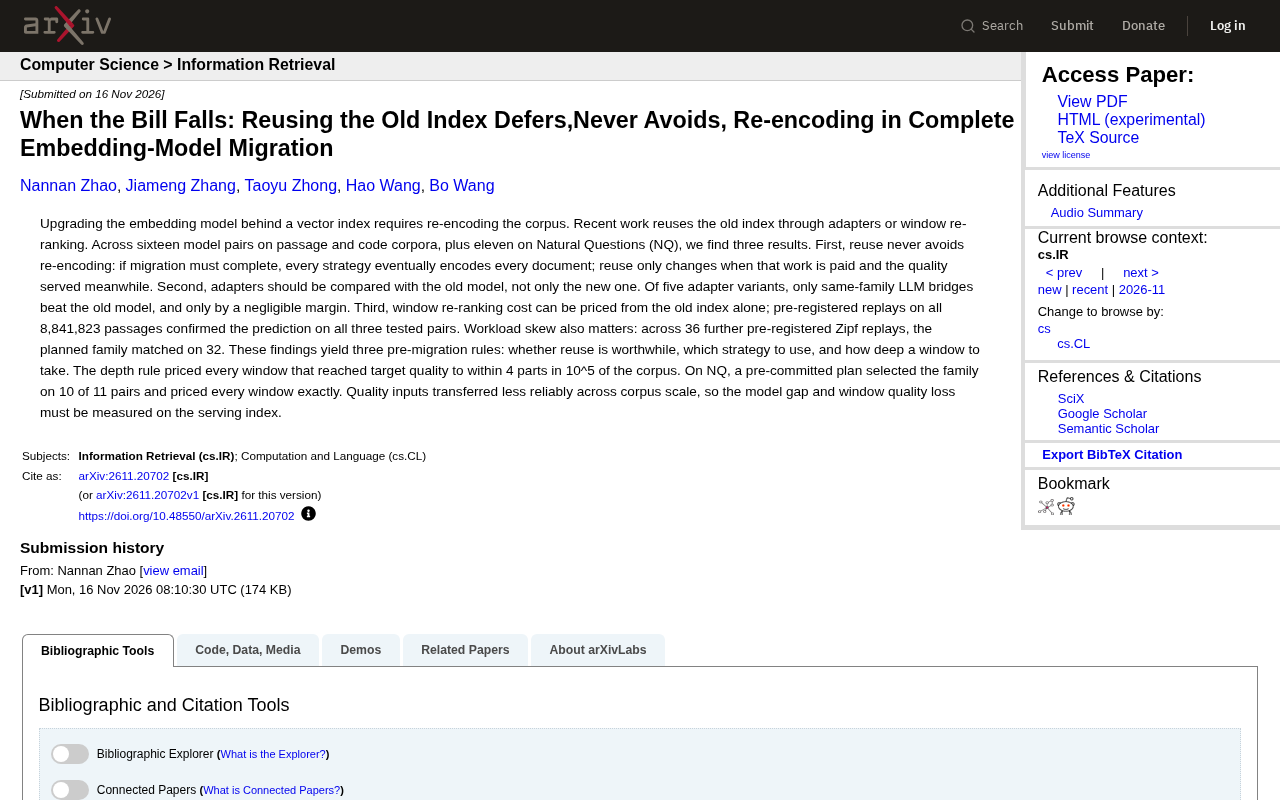
The study tested sixteen model pairs on paragraph and code corpora, plus eleven additional pairs on the Natural Questions (NQ) dataset. Three main findings form the core of the paper.
First, reuse never avoids re-encoding. If the migration must be fully completed, then every strategy ultimately encodes every document. What reuse changes is only when that work gets paid for, and what retrieval quality it can deliver in the meantime. In other words, reusing the old index is a "payment plan," not a "free lunch."
Second, adapters should be compared against the old model, not just the new one. This point is easy to overlook. Among five adapter variants, only the same-family LLM bridging approach was able to beat the old model—and by a razor-thin margin. If you only look at the gap between "adapter vs. new model," it's easy to overestimate the value of reuse; the real baseline should be "adapter vs. the old model you're replacing."
Third, window reranking costs can be estimated from the old index alone. The researchers conducted a pre-registered replay over all 8,841,823 paragraphs, and predictions were confirmed on all three tested model pairs. This means the cost of reranking can be reliably estimated before you even start the migration.
The relationship between embedding models and vector indexes: A vector index (such as HNSW or IVF) stores dense vectors produced by encoding documents with an embedding model, along with their nearest-neighbor structure. The index is tightly coupled to the embedding model that generated it—switching models means the vector space undergoes rotation, scaling, or even dimensional changes, so distance relationships in the old index no longer correspond to semantic similarity under the new model. Therefore, when reusing the old index, you must bridge the two spaces through adapters (mapping old vectors into the new space) or window reranking (using the new model to re-score only the candidate set). Adapters are typically lightweight mapping layers, while window reranking re-encodes only the top-k candidates returned by retrieval. Both attempt to avoid full re-encoding, but at the cost of approximation errors and quality loss during the transition period.
LLM bridging approach refers to leveraging the representational space alignment capability of large language models within the same family to establish a mapping between the old and new models. The study emphasizes that only same-family bridging works because models from different families differ too much in training objectives, tokenization, and semantic geometry for simple linear or nonlinear adaptation to bridge the gap. The reason same-family bridging only "marginally" outperforms the old model is that it preserves the old model's semantic structure and only applies limited corrections; once you go cross-family, adapter performance often falls below simply keeping the old model. This explains why "adapter vs. new model" comparisons overestimate the value of reuse—the real question is whether adaptation is better than not upgrading at all.
Load Distribution Also Affects Strategy Selection
Beyond cost prediction, the study also examined query load skew. In another 36 pre-registered Zipf-distribution replays, the planned strategy family matched actual optimal performance in 32 of them. This shows that load distribution is not a detail to be ignored—the same reuse plan can perform noticeably differently under query distributions with varying degrees of skew.
These findings ultimately crystallize into three pre-migration rules: whether reuse is worthwhile, which strategy to use, and how deep the window should be. The depth rule stands out in particular: it can price every window that meets the target quality, with error controlled to within 4 parts in 10^5 of the corpus. On the NQ dataset, a pre-committed plan selected the correct strategy family for 10 out of 11 model pairs and provided precise pricing for every window.
You may not have noticed that quality-related inputs become less reliable when transferring across corpus scales. That is, the two metrics of model gap and window quality loss must be measured on the actual serving index—you cannot simply apply conclusions from corpora at other scales.
Zipf distribution is a classic model for describing query load skew: a few high-frequency queries account for most of the traffic, while a large number of low-frequency queries occupy only the tail. In vector retrieval, the degree of load skew directly affects the amortized cost of window reranking—if queries are highly concentrated on a few documents, caching or precomputing reranking results can significantly reduce average overhead; if the load is flat, every query requires independent reranking, which costs more. The 36 Zipf replays in the study simulate strategy performance under different skew parameters, and the planned strategy family matched the actual optimum in 32 of them, showing that load distribution is an observable variable that can be incorporated into decision-making, not random noise.
Implications for Engineering Practice
The most valuable aspect of this work is that it turns "should we reuse the old index?" from an intuitive judgment into a computable decision. When planning an embedding model migration, teams can first use the old index to estimate window reranking costs, then combine that with load distribution to select a strategy family, and finally validate quality loss on the actual serving index.
But it's also important to recognize clearly: no matter which path you choose, the full re-encoding work is waiting at the finish line. The real value of reuse strategies lies in smoothing the quality curve and cost rhythm during migration, not in eliminating the bill. Comparing adapters against the old model and measuring quality inputs on the serving index—these two recommendations deserve a place in any vector database upgrade checklist.
Pre-registered replay is an experimental design method: before the formal migration, you fix the strategy and evaluation metrics on historical query logs or simulated loads, then replay to verify whether predictions hold, avoiding cherry-picking favorable results after the fact. The "pre-registered replay over 8,841,823 paragraphs" in the paper means the researchers pre-committed to cost predictions for window reranking on the full corpus and confirmed through actual replay that the error was extremely small (4 parts in 10^5). For engineering teams, this provides a reusable pre-migration validation paradigm: using the old index and real query logs for small-scale replay can calibrate the cost model and strategy selection without first bearing the risk of full re-encoding.
One-line Summary
Reusing the old vector index only defers the re-encoding cost; it cannot truly avoid full re-encoding.
Paragraph Summary
A study covering sixteen model pairs, multiple corpora, and the NQ dataset shows that when upgrading embedding models, reusing the old index cannot avoid eventual full re-encoding—reuse only changes when costs are paid and the retrieval quality during the transition period. Among five adapters, only same-family LLM bridging marginally outperforms the old model, so the baseline should be the old model, not the new one. Window reranking costs can be estimated from the old index alone and were validated via pre-registered replay over 8,841,823 paragraphs; load skew affects strategy selection, with the planned strategy family matching in 32 of 36 Zipf replays. The study ultimately provides pre-migration rules: whether to reuse, which strategy to use, and how deep the window should be—and emphasizes that quality inputs must be measured on the serving index.
Related articles

From 0 to 1: Vibe Coding an AI Knowledge Base — A Practical Retrospective and Tech Stack Breakdown
A retrospective on building the AI knowledge base OilBook from scratch with Vibe Coding: Next.js+Neon stack, Oil Dev Skill workflow, Stripe paywall security, interview-style writing, AI-flavor control, and Vercel deployment.

GLM-5.4 Hands-On: Native Vision Meets a New Vibe Coding Workflow
Hands-on with Zhipu GLM-5.4: native vision tested across a 3D product demo, pure-code video generation, and remote-control Vibe Coding, compared with GPT-6.2 and Gemini Neon.

AI and Humans Claim to Prove the Riemann Hypothesis: Machine-Verified, Yet Nobody Can Understand It
Anthropic mathematician and AI Claude claim to prove the Riemann Hypothesis with 17 million lines of Lean code, machine-verified but unreadable by humans. This article analyzes the event, the zero proportion record from 41.6% to 67.2%, and the gap between machine verification and human understanding.