Emo-Jev: A Training-Free Paradigm for Emotion Classification via Probabilistic Reasoning

The Jev interface replaces free-form text generation with probabilistic decisions for efficient, low-cost emotion classification.
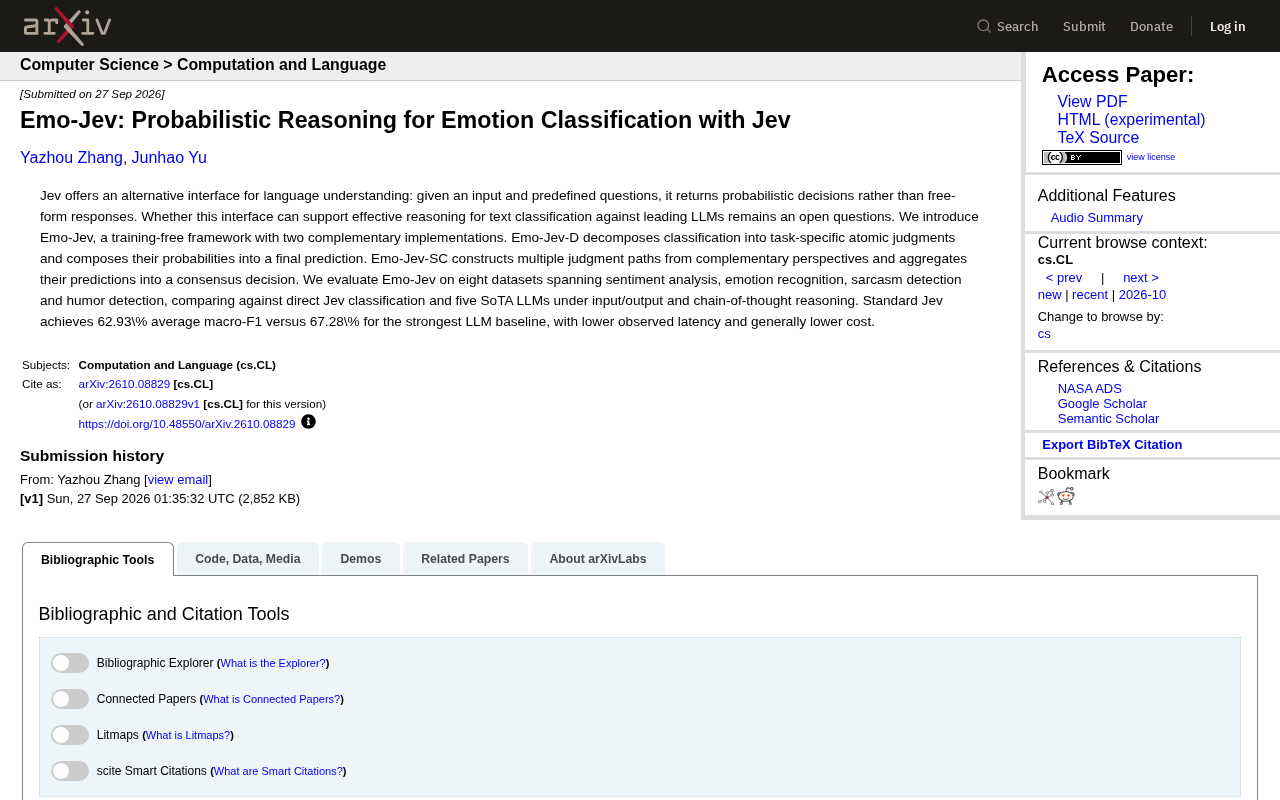
This arXiv study introduces Jev, a novel LLM interface that reframes text classification as probabilistic judgment rather than text generation. Built on Jev, the training-free Emo-Jev framework offers two implementations: decomposed judgment (Emo-Jev-D) and multi-perspective consensus (Emo-Jev-SC). Evaluated across eight datasets covering sentiment analysis, emotion recognition, sarcasm, and humor detection, standard Jev achieves 62.93% macro-F1 — slightly below the best LLM baseline of 67.28% — but at lower latency and cost, offering a compelling efficiency trade-off for high-frequency classification at scale.
From Free-Form Text to Probabilistic Decisions: The Jev Interface
Most large language models (LLMs) in mainstream use today generate free-form text as output when handling text understanding tasks. A new study published on arXiv (arXiv:2610.08829v1) proposes an alternative interface called Jev: given an input and a set of predefined questions, Jev returns not open-ended answers, but probabilistic decision results.
The significance of this design lies in shifting language understanding from "generation" to "judgment." For tasks like text classification, where the label space is well-defined, a probabilistic decision interface is a natural fit — what we actually need is rarely a paragraph of explanation, but rather a category assignment with a confidence score. This leads the researchers to their central question: can such an interface compete with state-of-the-art LLMs on text classification tasks?
Emo-Jev: Two Complementary Training-Free Frameworks
Building on the Jev interface, the research team developed Emo-Jev, a training-free framework with two complementary implementations.
Emo-Jev-D: Decomposed Judgment
The first implementation, Emo-Jev-D, adopts a divide-and-conquer strategy. It breaks down a full classification task into a series of task-relevant atomic judgments, computes the probability of each atomic judgment independently, and then combines these probabilities into a final classification prediction.
The advantage of this approach is that complex emotion-related judgments are decomposed into smaller, more manageable sub-problems. Compared to asking the model to produce a conclusion in one shot, the stepwise probability combination is logically more transparent and makes it easier to pinpoint where judgment errors arise.
The concept of Atomic Judgment draws on ideas from logical decomposition and neurosymbolic reasoning: breaking a complex proposition down into indivisible Boolean sub-judgments, each answering a single yes/no question — for example, "Does the text contain negatively valenced words?" or "Does the sentence have a sarcastic tone?" The probabilities of these sub-judgments can be combined using conditional independence assumptions or Bayesian networks. An added benefit of this decomposition strategy is interpretability: when the final classification is wrong, you can trace back step by step to identify which atomic judgment produced a flawed probability estimate, providing a clear handle for error analysis and model improvement.
Emo-Jev-SC: Multi-Perspective Consensus
The second implementation, Emo-Jev-SC, takes a "wisdom of crowds" approach. It constructs multiple judgment paths from complementary perspectives, then aggregates the predictions from these paths into a consensus decision.
This is conceptually similar to the well-known self-consistency method in the LLM field — using multi-path sampling to reduce the random bias of any single reasoning chain, thereby improving robustness. The two implementations each have a distinct emphasis: Emo-Jev-D focuses on structured decomposition, while Emo-Jev-SC focuses on perspective diversity.
The Self-Consistency method was proposed by Wang et al. in 2022. Its core idea is to generate multiple independent reasoning chains for the same problem, then derive the final answer via majority voting or probability aggregation. Experiments show that compared to single-pass greedy decoding, self-consistency significantly boosts accuracy on tasks like arithmetic and commonsense reasoning. Emo-Jev-SC borrows this idea but replaces "multiple reasoning chains" with "multiple complementary perspectives" — for instance, generating one judgment path each from semantic, tonal, and contextual angles, then aggregating them. This approach retains the robustness benefits of multi-path reasoning while introducing diversity through perspective variation rather than random sampling, theoretically providing more targeted coverage of ambiguous cases in emotion understanding.
Empirical Evaluation Across Eight Datasets
To test the framework's real-world performance, the study conducts evaluations on eight datasets spanning four task types:
- Sentiment analysis
- Emotion recognition
- Sarcasm detection
- Humor detection
The comparison baselines include a direct Jev-based classification baseline and five state-of-the-art (SoTA) LLMs, evaluated under both direct input/output inference and chain-of-thought (CoT) inference settings.
The results show that standard Jev achieves an average macro-F1 of 62.93%, while the best-performing LLM baseline reaches 67.28%. In terms of raw accuracy, the Jev interface has not yet surpassed top-tier large models, trailing by approximately 4.35 percentage points.
Macro-F1 (macro-averaged F1) is a commonly used evaluation metric for multi-class tasks. It computes the F1 score for each class separately and then takes the arithmetic mean, without accounting for class size differences. This differs from weighted-F1, which allows high-frequency classes to dominate the overall score. In real-world sentiment analysis settings, class distributions are often imbalanced (e.g., "neutral" samples vastly outnumber "anger" samples), making macro-F1 a better reflection of model performance on minority classes and a key indicator of class bias. Both Jev's 62.93% and the best LLM's 67.28% are measured in macro-F1, meaning the gap is not driven by a preference for high-frequency classes, but reflects a genuine shortfall on harder, fine-grained emotion categories.
Latency and Cost: The Underappreciated Other Side
Notably, the paper emphasizes that the Jev approach achieves these results with lower latency and overall lower cost. This means that in the trade-off between accuracy and resource consumption, Jev occupies a distinct operating point.
In real industrial settings, classification tasks are often high-frequency and large-scale — response speed and per-inference cost directly determine whether a system can be deployed at scale. If an approach can trade a modest accuracy drop for significantly lower latency and cost, it becomes more attractive in many latency-sensitive and budget-constrained scenarios. In other words, evaluating a method's value shouldn't stop at a single macro-F1 number.
Significance and Limitations
Emo-Jev's exploration reveals a valuable direction: probabilistic decision interfaces may offer a cost-effective path for text classification. The training-free nature, structural clarity, and controllable inference cost are all highly practical virtues in engineering contexts.
Of course, the current results also honestly expose a weakness — accuracy still lags behind the strongest LLMs. How much improvement Emo-Jev-D and Emo-Jev-SC bring over standard Jev is not fully detailed in the abstract, making this an area worth watching in follow-up work.
For researchers and engineers working on affective computing and text classification system design, this work offers a fresh entry point for rethinking the "reasoning interface": we don't always need a model that talks. Sometimes, a precise, fast, and affordable probabilistic classifier is the better answer.
Note: This article is based on the arXiv preprint abstract (arXiv:2610.08829v1). For complete experimental details, please refer to the original paper.
Related articles

Chain of Thought Isn't Just for AI: How Humans Can Use CoT to Improve Thinking Quality
Chain of Thought isn't just a prompt trick for large models. Starting from a Hacker News discussion, this article analyzes why CoT works for human thinking too, breaks down actionable ways to transfer it, and highlights the key differences between human CoT and machine CoT.
Cloudflare Teams Up with OpenAI: Closi…
Cloudflare Teams Up with OpenAI: Closing the Loop from Vulnerability Discovery to Defense with AI
Cloudflare uses OpenAI Daybreak to investigate security vulnerabilities and generate reviewable remediation plans, while developers use Codex to boost coding efficiency and quality.

Orca Multi-Agent Orchestration in Practice: A Guide to Parallel Collaboration with Claude and Codex
Orca is Stable AI's free open-source agent workbench supporting 34 agents like Claude Code and Codex in parallel. Learn its Git worktree isolation, multi-model orchestration, and mobile management.