eMudhra Exits Global SSL/TLS Certificate Business: Why the Indian CA Giant Is Walking Away

Indian CA eMudhra exits the global SSL/TLS certificate business, reflecting commercial CAs' shift toward enterprise identity services and industry consolidation.
Indian certificate authority eMudhra has announced its exit from the global SSL/TLS certificate business, sparking heated discussion on Hacker News with 532 points and 409 comments. The article argues that free CAs like Let's Encrypt and cloud bundling have driven DV certificate profits to near zero, leaving commercial space in OV/EV, private PKI, and IoT—where competition remains fierce. eMudhra's core business is in e-signatures, digital identity, and Indian government projects, making the exit a reallocation toward higher-return identity management. Users should watch certificate renewal and CRL/OCSP continuity during the transition and build multi-CA backup plans. More broadly, this reflects the CA industry's shift from selling certificates to selling identity trust services, with narrowing supplier diversity a potential ecosystem risk.
Event Overview: A Global Strategic Retreat by an Indian CA
Indian certificate authority (CA) eMudhra has announced it will exit the global SSL/TLS certificate business. The news quickly sparked heated discussion on Hacker News, with the post garnering 532 points and 409 comments—far exceeding the attention typical of a routine business announcement.
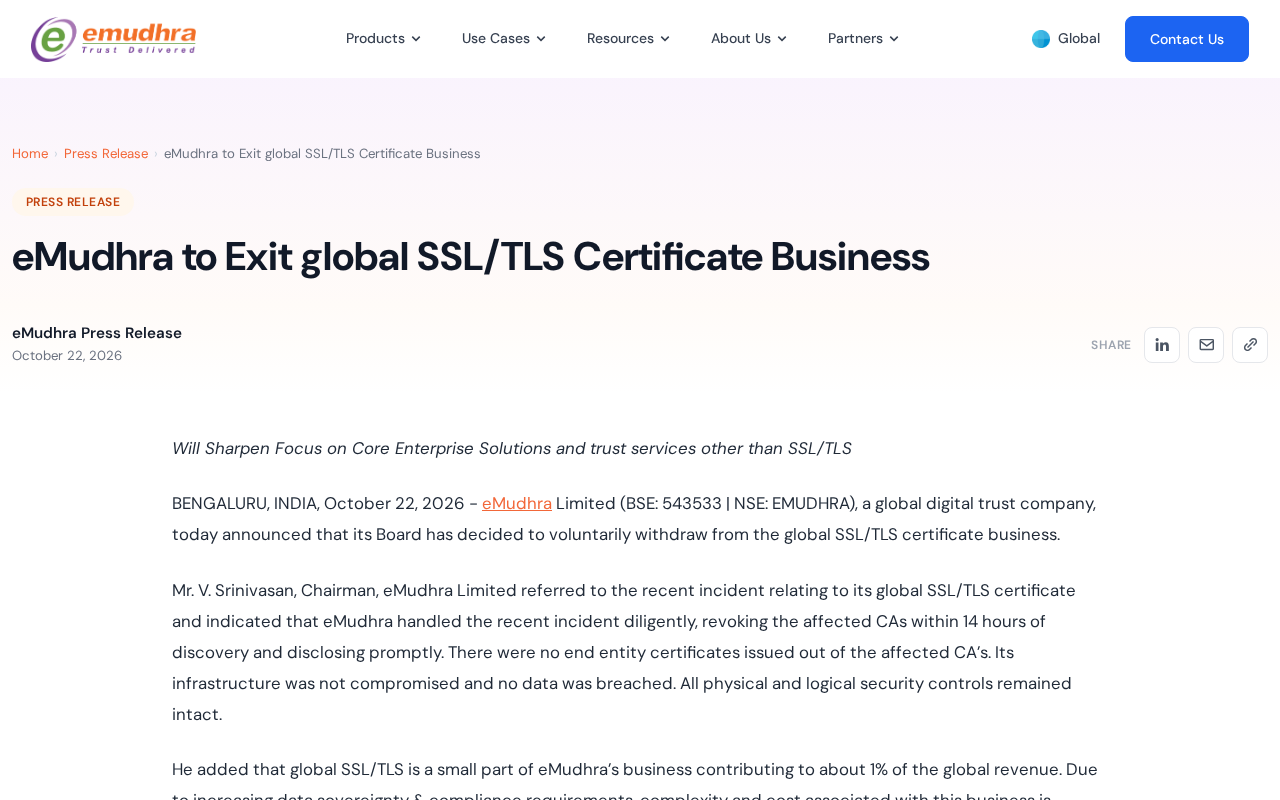
According to the official press release, eMudhra will gradually stop providing SSL/TLS certificate issuance services to the global market. For an Indian publicly listed company centered on digital identity and PKI (public key infrastructure), voluntarily abandoning the global TLS certificate market is a decision worth unpacking.
The SSL/TLS Certificate Market: Survival Logic in a Red Ocean
SSL/TLS certificates are the infrastructure underlying encrypted internet communication, but over the past decade the commercial landscape of this market has undergone structural change. The rise of free CAs like Let's Encrypt has driven the price of DV (Domain Validation) certificates toward zero. Major cloud providers and domain registrars have bundled certificates as free add-ons, continually squeezing the profit margins of independent CAs in the low-end market.
The remaining commercial space is concentrated in OV (Organization Validation) and EV (Extended Validation) certificates, private PKI, IoT device certificates, and other enterprise-grade scenarios. These areas demand higher levels of compliance, audit capability, and customer support, but competition is equally fierce—established players like DigiCert, Sectigo, and GlobalSign have been cultivating them for years.
eMudhra's choice to exit now suggests it has concluded that the marginal returns from continued investment in the global TLS certificate business are no longer attractive.
DV, OV, and EV are the three tiers of SSL/TLS certificates categorized by validation depth. DV (Domain Validation) only verifies the applicant's control over the domain, typically via DNS records or HTTP files—it is the most automated, fastest to issue, and the type offered by free CAs like Let's Encrypt. OV (Organization Validation) additionally requires manual verification of the company's registration information and phone callbacks, with the organization name embedded in the certificate. EV (Extended Validation) is the most rigorous; it once triggered a green company-name display in the browser address bar, but major browsers have since removed this UI feature, and its differentiated value now lies more in financial and government scenarios with high compliance and audit requirements. Higher tiers mean higher validation costs and annual fees, but the technical encryption strength is identical—all three use the same public key algorithms and key lengths; the only difference is the identity endorsement.
eMudhra's Business Focus: From TLS to Digital Identity
eMudhra's core competitiveness has never been in SSL/TLS certificates themselves. As India's leading CA, its main business covers e-signatures, digital identity authentication, enterprise PKI management, and government digitalization projects. The Aadhaar identity system and various e-government platforms promoted by the Indian government provide eMudhra with a stable domestic market foundation.
Exiting the global SSL/TLS business is more like a resource reallocation—concentrating engineering, compliance, and sales efforts on the higher-return enterprise identity management track. The global TLS certificate business requires continuous investment in root certificate maintenance, CA/B Forum compliance, audit certification, and multilingual customer support—costs whose input-output ratio is declining for a company rooted in the Indian market.
Direct Impact on Users and Channel Partners
For website operators using eMudhra SSL/TLS certificates, the most immediate concern is certificate renewal and migration. Exit announcements typically come with transition arrangements, but users need to watch several key points: whether existing certificates remain valid until expiry, whether certificate revocation list (CRL) and OCSP services will be maintained, and whether assistance is provided for migration to other CAs.
Judging from the heat of the Hacker News discussion, the community is focused not just on one company's business decision but also on the issue of CA market concentration. The TLS certificate ecosystem is already dominated by a handful of organizations, and any CA's exit further narrows the choices. For organizations relying on smaller CAs as backups, this means one fewer option for supplier diversity.
CRL (Certificate Revocation List) and OCSP (Online Certificate Status Protocol) are two mechanisms in the PKI system used to inform clients that "a certificate has been revoked." CRL is a signed list file periodically issued and published by the CA, which clients download and compare locally; OCSP is a real-time query initiated by the client to the CA's OCSP responder for a single certificate—lower latency but exposing user access behavior. Together they form the trust loop for certificate revocation: even if a certificate has not yet expired, once the private key is compromised or a certificate is misissued, the CA can revoke it so relying parties reject it. When a CA exits the business, if CRL/OCSP services go offline early, clients will be unable to confirm certificate status, and some strict-mode browsers or systems may throw errors directly—this is the technical reason users need to closely monitor the transition timeline.
A Broader Signal: Consolidation and Differentiation in the CA Industry
eMudhra's exit can be understood against the backdrop of CA industry consolidation. On one hand, free certificates and cloud provider bundling have reduced general-purpose TLS certificates to infrastructure rather than a profit center; on the other hand, demand is growing in niche areas such as enterprise PKI, code signing, document signing, and IoT security. CA organizations are shifting from "selling certificates" to "selling identity trust services."
This differentiation is not necessarily bad for the industry. CAs focused on niche scenarios can provide deeper compliance support, while the supply of general-purpose TLS certificates is handled by free CAs and cloud platforms. The real risk is that as the number of commercial CAs decreases, the voice in audit standards and industry governance will further concentrate among a few giants.
For developers and operations teams, the practical takeaway is: don't treat your certificate vendor as a permanent, unchanging dependency. Building multi-CA backup plans, automating certificate lifecycle management, and monitoring policy changes at the CA/B Forum are safer than locking into a single vendor.
The CA/Browser Forum is an industry standards organization composed of CAs and browser vendors, whose voted Baseline Requirements are used as admission criteria by major root certificate programs (such as Mozilla, Apple, Google, and Microsoft root stores). For a CA's certificates to be trusted by browsers, it must pass third-party audits like WebTrust and continuously meet these requirements. The forum's governance structure determines the distribution of influence: browser vendors hold the power to admit and remove root certificates, while large CAs have voting seats in standards development. As the number of commercial CAs decreases, the voices of smaller organizations participating in the forum weaken accordingly, and standards evolution is more likely to tilt toward the interests of a few giants and platform players—this is the hidden cost of supplier concentration at the governance level.
Frequently Asked Questions
Will existing eMudhra certificates become invalid immediately? Usually not. A CA exiting the business will set up a transition period, and existing certificates generally remain valid until expiry, but the timeline for renewal and revocation services should be based on official announcements.
Which CA should I migrate to? It depends on the use case. Public websites can prioritize free CAs or cloud-platform-bundled certificates; enterprise intranets and compliance scenarios require evaluating the audit qualifications and support capabilities of OV/EV certificate vendors.
What is the long-term impact on the TLS ecosystem? Consolidation of commercial CAs will continue, the general certificate market will become further infrastructuralized, and enterprise identity services will become the main growth area for CA organizations.
One-line Summary
Indian CA eMudhra exits the global SSL/TLS certificate business, reflecting the trend of commercial CAs transforming toward enterprise identity services and industry consolidation.
Paragraph Summary
Indian certificate authority eMudhra has announced its exit from the global SSL/TLS certificate business, sparking heated discussion on Hacker News with 532 points and 409 comments. The article analyzes that free CAs like Let's Encrypt and cloud provider bundling have driven DV certificate profits to near zero, with remaining commercial space concentrated in enterprise-grade scenarios like OV/EV, private PKI, and IoT—though competition there is equally fierce. eMudhra's core business has always been in e-signatures, digital identity, and Indian government digitalization projects, so exiting the global TLS business is a reallocation of resources toward the higher-return identity management track. For users, the focus should be on certificate renewal and CRL/OCSP service continuity during the transition period, and on building multi-CA backup plans. More broadly, this reflects the CA industry's differentiation from "selling certificates" to "selling identity trust services," with narrowing supplier diversity being a potential ecosystem-level risk.
Related articles

Hands-On with the Gemini 4 Argon API: Thinking Levels and Background Mode Explained
A Free Code Camp crash course on the Gemini 4 Argon API: from getting a key and sending your first request to controlling reasoning costs with thinking levels, enabling multi-turn chat with previous_interaction_id, and generating a Breakout game in background mode—plus a Google engineer's take on the model's capabilities.

Reinforcement Learning Takes On Getting Over It: Distributed Training Strategies Behind 63% Progress
A developer uses deep reinforcement learning to tackle Getting Over It. The agent climbs from the bottom to 63% progress but gets stuck at the anvil. The project is open-sourced, using divide-and-conquer training and CPU-only training, seeking community collaboration to break the bottleneck.

Sigma FP2 Released: The World's Smallest Full-Frame Camera Gets Sensor and Screen Upgrades
Sigma launches the FP2 full-frame camera, retaining its smallest-and-lightest design with three key upgrades: improved sensor, articulating LCD screen, and longer battery life—built for portable video creators.