ENCORE: The First Exact Parallel Inference-Time Control Method for More Controllable Diffusion Model Generation

ENCORE is the first exact parallel inference-time control method for diffusion models, bypassing time reversal via trajectory storage.
The ENCORE paper addresses inference-time control for diffusion generative models with the first theoretically exact parallel method. Existing approaches face a clear dilemma: SMC-based sequential methods are exact but computationally expensive; RE-based parallel methods are efficient but introduce systematic bias through time reversal approximation. ENCORE's core innovation is having each replica store its full generation trajectory, turning the intractable time reversal into a simple truncation operation — preserving parallelism while achieving theoretical unbiasedness. The paper proves target invariance mathematically and shows that guided proposals are necessary for stability. Experiments spanning synthetic distributions, biomolecular Boltzmann sampling, and image generation demonstrate strong accuracy and diversity, with a unique advantage in distilled sampler settings where existing methods fail entirely.
Inference-Time Control: Tuning Generative Models Without Retraining
Pretrained generative models often need to be steered toward a specific target distribution without modifying their parameters. This class of techniques is known as inference-time control, and its core value lies in avoiding expensive retraining by reshaping the distribution directly at the sampling stage.
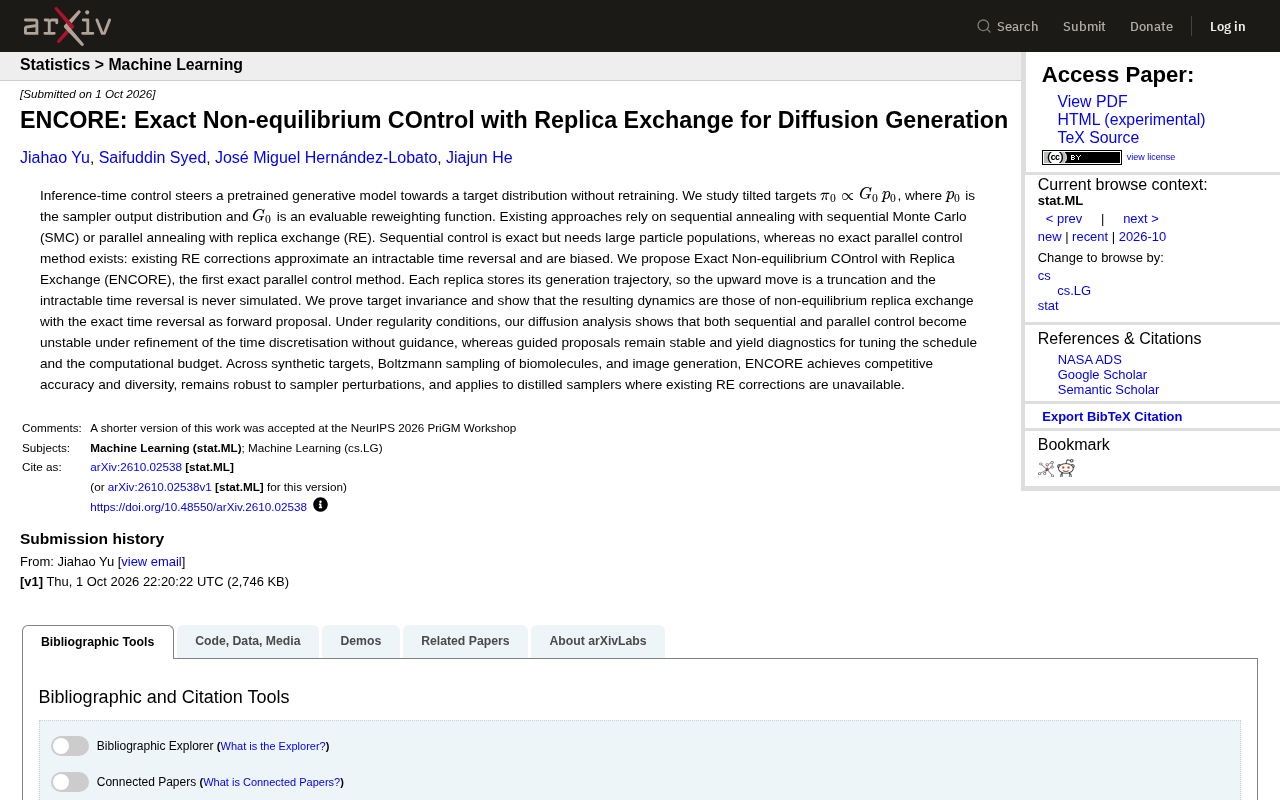
A recent arXiv paper, ENCORE: Exact Non-equilibrium COntrol with Replica Exchange for Diffusion Generation, presents a new solution to this problem. The authors focus on so-called tilted target distributions of the form $\pi_0\propto G_0,p_0$, where $p_0$ is the sampler's own output distribution and $G_0$ is a directly computable reweighting function. In other words: you have a pretrained diffusion model and a scoring function you want to impose as a preference — how do you combine the two without sacrificing sampling accuracy? That is the central question ENCORE sets out to answer.
The Existing Dilemma: Exactness vs. Parallelism
The mainstream approaches to inference-time control fall into two broad categories, each with notable drawbacks.
Sequential Annealing (Sequential Monte Carlo)
Methods based on Sequential Monte Carlo (SMC) are theoretically exact — they can approximate the target distribution in an unbiased manner. The trade-off, however, is the need to maintain a large particle population to ensure quality, which causes computational costs to skyrocket. For high-dimensional problems, this particle-count explosion is often prohibitive.
Parallel Annealing (Replica Exchange)
The other approach uses Replica Exchange (RE)-based parallel annealing. Parallelism brings natural efficiency gains, but the problem is that all existing RE correction schemes are biased. The reason: they require approximating an intractable time reversal process, and that approximation introduces systematic bias. In short, before ENCORE, no truly exact parallel control method existed.
This created a clear gap: either choose an exact but expensive sequential method, or an efficient but biased parallel one — you couldn't have both.
ENCORE's Key Idea: Bypassing Time Reversal with Trajectory Storage
ENCORE (Exact Non-equilibrium COntrol with Replica Exchange) claims to be the first exact parallel control method, and its elegance lies in sidestepping the most intractable part of the problem.
The key design is this: each replica stores its own generation trajectory. With the full trajectory in hand, an upward move becomes a simple trajectory truncation, and the hard-to-simulate time reversal process never needs to be explicitly simulated at all. This is the core trick that makes the entire method work — rather than approximating the time reversal, storing the trajectory makes it directly available.
The paper provides a theoretical proof of target invariance — that is, the method does indeed converge to the correct target distribution without introducing bias. Furthermore, the authors show that the resulting dynamics correspond precisely to non-equilibrium replica exchange, with exact time reversal serving as the forward proposal. This provides a rigorous mathematical guarantee of exactness for parallel control.
Diffusion Analysis: Why Guidance Is Indispensable
The paper also delivers a practically significant result from its diffusion analysis. Under certain regularity conditions, both sequential and parallel control become unstable without guidance when the time discretization is refined.
Once guided proposals are employed, however, the dynamics remain stable and also produce diagnostic signals for tuning the annealing schedule and computational budget. This means practitioners can not only keep the method running stably, but also use these diagnostics to decide how to allocate compute and set step sizes — highly valuable for real-world deployment.
Experimental Validation: From Molecular Sampling to Image Generation
ENCORE is validated across a broad range of tasks:
- Synthetic target distributions: Used as benchmarks to verify correctness and convergence;
- Boltzmann sampling of biomolecules: A demanding task in computational chemistry and structural biology where sampling accuracy is critical;
- Image generation: Demonstrating the method's utility in visual generation.
Experimental results show that ENCORE achieves competitive performance in both accuracy and diversity, while exhibiting two important properties: robustness to sampler perturbations, and compatibility with distilled samplers — scenarios where existing RE correction methods simply cannot be applied. This is especially noteworthy, as distilled models are increasingly deployed in production settings due to their efficiency.
Significance and Outlook
ENCORE's contribution can be summarized as filling a methodological gap: it is the first approach to make parallel and exact simultaneously achievable in diffusion generation control. For applications that require large-scale parallel sampling and cannot tolerate bias — such as molecular conformation sampling or constrained image generation — this work offers a theoretically rigorous and empirically reliable new option.
Its compatibility with distilled samplers in particular hints at a practical path toward efficient and controllable generation. As diffusion models continue to penetrate scientific computing and content generation, inference-time control methods that balance rigor and efficiency — like ENCORE — are likely to become an important foundation for future research.
Related articles

DeepCell: One-Click AI Generation of Documents, Spreadsheets, and Slides
DeepCell tops Product Hunt with one-click generation of documents, spreadsheets, and slides, using the .deepcell format for linked updates, designed for System 2 tasks like modeling and sales reviews.

Doneas: 15-Minute Daily Accountability Calls That Keep Indie Developers From Procrastinating
Doneas is a daily accountability tool for indie developers: plan tasks on Monday, join a 15-minute call with five builders each day, and log deliveries on a public progress page. This article analyzes its core mechanics, effectiveness, and potential issues around retention and matching.

Fastlane 2.0: Fully Automated AI Ad Campaigns, From Creative to Optimization
Fastlane 2.0 is an AI ad automation tool: enter your website and it learns your brand, generates video and image ads, and runs and optimizes them on Meta, TikTok, Instagram, and YouTube.