End-to-End Speech Recognition: Which Classic Challenges Have Actually Been Solved?

End-to-end ASR solved context understanding but merely masked accent bias and code-switching failures.
This article examines five classic ASR challenges in the end-to-end era. While contextual understanding has been genuinely solved through attention mechanisms, background noise robustness remains fragile at low SNR. Accent recognition improvements are illusory—aggregate WER masks persistent gaps for underrepresented groups. Code-switching has barely progressed due to data scarcity, and audio-visual ASR remains confined to research. The key insight: end-to-end models changed architecture, but most remaining failures are data distribution problems that no architecture can fix alone.
Introduction: The Truth Hidden Behind Averages
Automatic Speech Recognition (ASR) has undergone a complete architectural overhaul in the past decade. Traditional ASR systems were assembled from three independent modules: an acoustic model, a pronunciation lexicon, and a language model. Each served a distinct purpose—the acoustic model mapped audio frames to phoneme probabilities, the pronunciation lexicon defined word-to-phoneme mappings, and the language model provided prior probabilities over word sequences. They were trained and optimized separately, then combined through a Weighted Finite-State Transducer (WFST) into a decoding graph. The core problem with this design was that each module's training objective was independent, making joint optimization impossible and creating information bottlenecks between modules.
End-to-end models replaced this cumbersome pipeline with a single unified neural network architecture. The three dominant end-to-end architectures today are: CTC (Connectionist Temporal Classification), Attention-based Encoder-Decoder, and RNN-Transducer. By directly mapping input audio to text sequences, they eliminate intermediate representations and enable end-to-end gradient propagation from acoustic features to text output.
However, a pointed question from the Reddit tech community sparked widespread discussion: Which classic ASR challenges have end-to-end models truly solved, and which have merely "gone quiet"? This distinction is crucial—because improved aggregate metrics don't necessarily mean a problem has been conquered. Sometimes, poor performance is simply masked by attractive average numbers.
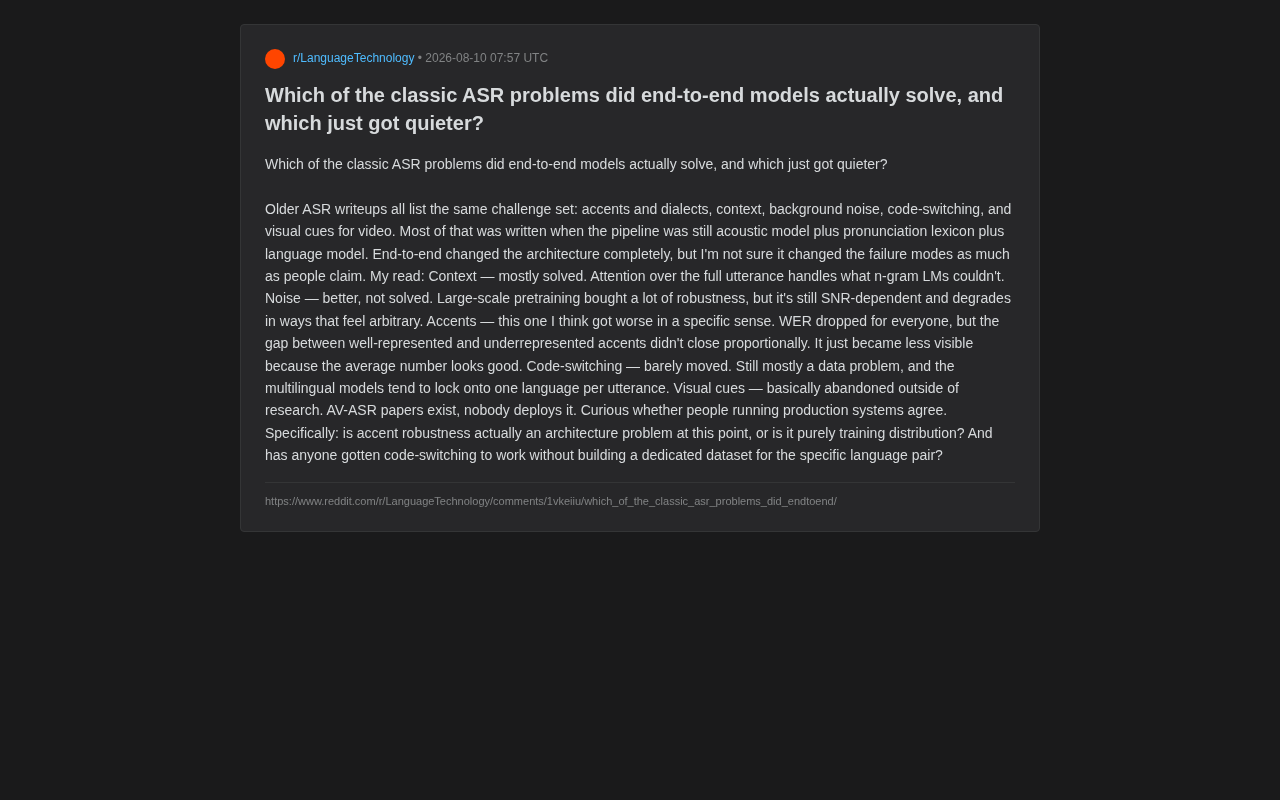
This article examines five classic ASR challenges and their true status in the end-to-end era.
Breaking Down the Classic Challenges
Early ASR literature almost universally listed the same set of challenges: accents and dialects, contextual understanding, background noise, code-switching, and visual cues in video. These descriptions were mostly written during the era of pipeline architectures. End-to-end fundamentally changed the architecture, but has it truly changed the failure modes as people claim? The answer is layered.
Contextual Understanding: A Clear Victory for End-to-End Models
This is the most unambiguous win for end-to-end models. Traditional n-gram language models could only capture local word-order relationships—typically modeling dependencies within a window of just 3 to 5 words—and were helpless against long-range dependencies. Attention-based models can model entire utterances, effortlessly handling long-range context that n-grams simply cannot.
The attention mechanism was originally proposed by Bahdanau et al. in their 2014 machine translation paper. Its core idea is to allow the decoder, at each output step, to dynamically compute a weighted sum over all encoder hidden states, rather than relying solely on the final hidden state. In ASR, this means the model can attend to any position in the entire speech signal when predicting the t-th word. The Transformer architecture further introduced self-attention, enabling every position in a sequence to directly establish dependencies with all other positions, theoretically providing an infinite receptive field.
This "look-back" capability means that once-intractable problems like homophone disambiguation and semantic coherence now have fundamental architectural solutions. Contextual understanding is one area where end-to-end models have delivered a passing grade.
Background Noise: Significant Improvement but Far from Solved
Noise robustness has seen notable progress, but calling it "solved" would be a stretch. Large-scale pretraining has given models considerable noise resistance, thanks to the massive amount of real-world noisy scenarios present in training data.
Pretrained models like wav2vec 2.0, HuBERT, and Whisper learn rich acoustic representations through self-supervised learning on hundreds of thousands to millions of hours of unlabeled or weakly-labeled audio. Whisper deserves special mention—trained on 680,000 hours of multilingual weakly-supervised data that naturally includes diverse recording environments, channel conditions, and background noise. This "natural exposure" approach to noise robustness contrasts with traditional methods (multi-condition training, noise-aware training, front-end enhancement)—it doesn't explicitly remove noise through signal processing, but lets the model implicitly learn to ignore noise interference during training.
However, the fundamental problem hasn't disappeared: recognition accuracy still strongly depends on signal-to-noise ratio (SNR). SNR measures the power ratio between useful signal and noise. When SNR drops below 0dB (meaning noise energy exceeds speech energy), even humans experience significant comprehension difficulties. Under these low-SNR conditions, model performance degradation often lacks graceful degradation, instead exhibiting cliff-edge drops—you can't predict at what noise level the model will suddenly collapse. This unpredictability is precisely the thorniest problem for production deployment.
Problems That "Went Quiet" Rather Than Being Solved
The next three problems are the real heart of this discussion—their surface-level improvements mask untouched fundamentals.
Accent and Dialect Recognition: Structural Bias Hidden by Metrics
This is the most controversial and thought-provoking point. On the surface, Word Error Rate (WER) has dropped across all accent groups, making it seem like end-to-end models benefit everyone. But a deeper look reveals a harsh reality: the gap between well-represented accents and underrepresented accents hasn't narrowed proportionally.
WER is calculated as (substitutions + deletions + insertions) / total reference words. When we report a single average WER across multiple accent groups, we're effectively summing errors across groups and dividing by total words. If mainstream accents comprise over 80% of the evaluation set, then even if minority accent groups have WER as high as 30-40%, it might only raise the overall WER by 1-2 percentage points when averaged out. This phenomenon is a variant of Simpson's Paradox in machine learning fairness research—aggregate statistics mask systematic differences between subgroups. A 2018 Google study found that their ASR system's error rate for African American English (AAE) was roughly double that for Standard American English.
The accent problem has in a certain sense "gotten worse." Because overall average WER looks great—stellar performance on mainstream accents pulls up the average—the struggles of disadvantaged accent groups become "invisible." This is a textbook case of metrics masking inequity—the numbers look good, but structural bias persists, and because it's no longer noticed, it becomes even harder to fix.
This raises a critical technical debate: is accent robustness fundamentally an architecture problem, or purely a training data distribution problem? Based on current evidence, it appears to be a data distribution problem. No matter how advanced the architecture, if training data severely lacks samples of a particular accent type, the model has nothing to learn from.
Code-Switching Recognition: Nearly Standing Still
Code-switching—switching between multiple languages within a single utterance—is the area where end-to-end progress has been weakest. In sociolinguistics, code-switching is divided into inter-sentential switching (changing languages at sentence boundaries) and intra-sentential switching (changing within a sentence). The latter poses a particularly severe challenge for ASR, as it requires the model to recalibrate its acoustic and language model expectations within extremely short time windows. It remains fundamentally a data problem.
What makes things worse is that current multilingual models tend to "lock in" a single language: they typically assume each utterance uses only one language, and once the dominant language is identified, they struggle to switch flexibly mid-sentence. Technically, models like Whisper use language tokens to specify the target language for an entire utterance—a design assumption that inherently contradicts intra-sentential code-switching. This runs counter to how bilingual speakers naturally communicate—in multilingual societies like Singapore, India, and Hong Kong, intra-sentential code-switching is the norm rather than the exception.
A practical question that still lacks a satisfactory answer: Can anyone make code-switching actually work without building a dedicated dataset for each specific language pair? Currently, the answer is essentially no—building custom datasets for each language pair remains the only reliable path. The deeper difficulty lies in the extreme scarcity of paired code-switching data. Common switching pairs like Cantonese-English or Hindi-English lack large-scale annotated natural conversation data, and artificially constructed data fails to reflect real switching patterns and prosodic features.
Visual Cue-Assisted Recognition: Essentially Abandoned Outside Research
Audio-Visual Speech Recognition (AV-ASR) was once highly anticipated, with the belief that visual information like lip movements could aid speech recognition in noisy environments. Its theoretical foundation comes from the McGurk Effect—humans automatically integrate auditory and visual information when perceiving speech, and seeing a speaker's lip movements significantly improves comprehension accuracy even in noisy conditions.
Technically, AV-ASR typically requires a complex processing pipeline: face detection, facial landmark localization, mouth region cropping (ROI extraction), visual feature extraction (usually using 3D-CNN or Vision Transformer), and multimodal fusion. The reality is: outside of research papers, virtually no one deploys it in production. AV-ASR papers keep appearing, but real-world deployment is nearly zero.
The reasons for its deployment difficulties are multiple: first, video data acquisition involves strict privacy compliance requirements (such as GDPR); second, speakers' faces aren't always visible (profile views, occlusion, off-screen); third, the information gain from the visual modality primarily manifests in high-noise environments and contributes almost nothing in quiet conditions, making ROI (return on investment) hard to justify. Additionally, the extra computational overhead and latency during inference are practical barriers to production deployment. The mismatch between engineering complexity, data collection costs, and actual benefits has kept this direction confined to the academic ivory tower.
Deeper Insight: Architectural Revolution vs. Data Distribution Problems
Synthesizing this discussion, a recurring theme emerges: End-to-end models primarily changed the architecture, but many failure modes are rooted in data, not architecture.
Contextual understanding was solved because the attention mechanism addressed the problem at the architectural level—it directly eliminated the structural limitation of n-gram models' finite windows. Noise, accents, and code-switching have seen limited or masked progress because they are fundamentally data distribution problems—no architecture, however powerful, can conjure training signals from nothing. An accent pattern insufficiently represented in training data, or a code-switching conversation that was never annotated, cannot be correctly handled regardless of architecture.
This has clear implications for practitioners:
- Don't be fooled by average WER. Fine-grained evaluation broken down by group and scenario is what exposes real weaknesses hidden by averages. At minimum, stratify analysis by accent category, noise level, utterance length, and similar dimensions.
- Stay vigilant about disadvantaged groups. Users with underrepresented accents and dialects may be bearing the implicit discrimination of a system that "looks great." This is not just a technical issue—it's an ethical one.
- Data remains the moat. For problems like code-switching, high-quality, targeted datasets remain irreplaceable core assets. In an era of architectural convergence (everyone uses Transformers), data uniqueness and coverage often determine the ceiling of system performance.
Conclusion
End-to-end models are undeniably a paradigm shift in ASR, but an "architectural revolution" doesn't equal "all problems solved." The problems that have truly been resolved (like contextual understanding) can be counted on one hand. Most classic challenges have merely "gone quiet" beneath attractive average metrics.
For engineers running production systems, identifying which problems are "truly solved" versus "merely masked" may be more practically valuable than chasing the next SOTA model. Because in technology like speech recognition that directly serves real users, the overlooked minority groups and edge cases are often where the system's true vulnerabilities lie.
Related articles

Chain of Thought Isn't Just for AI: How Humans Can Use CoT to Improve Thinking Quality
Chain of Thought isn't just a prompt trick for large models. Starting from a Hacker News discussion, this article analyzes why CoT works for human thinking too, breaks down actionable ways to transfer it, and highlights the key differences between human CoT and machine CoT.
Cloudflare Teams Up with OpenAI: Closi…
Cloudflare Teams Up with OpenAI: Closing the Loop from Vulnerability Discovery to Defense with AI
Cloudflare uses OpenAI Daybreak to investigate security vulnerabilities and generate reviewable remediation plans, while developers use Codex to boost coding efficiency and quality.

Orca Multi-Agent Orchestration in Practice: A Guide to Parallel Collaboration with Claude and Codex
Orca is Stable AI's free open-source agent workbench supporting 34 agents like Claude Code and Codex in parallel. Learn its Git worktree isolation, multi-model orchestration, and mobile management.