Energy-Constrained Remote ECG Monitoring: Anomaly Filtering Outperforms Predictive Uncertainty

In energy-constrained wearable ECG monitoring, upstream unsupervised anomaly filtering (Deep SVDD) is more energy-efficient and effective than classifier uncertainty estimation, but hardware platform affects method ranking.
This study compares two approaches for improving decision reliability in remote ECG monitoring: upstream unsupervised anomaly detection (filtering) versus classifier uncertainty estimation (Monte Carlo Dropout, Deep Ensembles). On PTB-XL and BUT QDB with real CPU/NPU energy measurements, Deep SVDD filtering achieves the highest average AUC across all finite CPU energy budgets, boosts correct classification or rejection by 15.0–19.4 percentage points, and uses an order of magnitude less energy than Monte Carlo Dropout. On NPU, Deep SVDD leads at 1 mJ but MC Dropout is slightly better at 10–100 mJ, indicating hardware platform affects method ranking. Independent validation and full-system measurements remain necessary.
Remote ECG monitoring on wearable devices has always faced a fundamental tension: models need to handle noise and disease types never seen during training, while the device's energy budget is extremely limited. A new study systematically compares two technical approaches—upstream unsupervised anomaly detection (i.e., filtering) versus the classifier's own uncertainty estimation (such as Monte Carlo Dropout and Deep Ensembles)—on the PTB-XL and BUT QDB datasets, combined with real energy measurements on microcontroller CPUs and NPUs, and reaches a clear conclusion with a definite preference.
Problem Background: Monitoring Decisions Under Noise and Unknown Diseases
Remote ECG monitoring systems are typically deployed on resource-constrained microcontrollers. The acquired signals not only contain noise such as baseline drift and muscle artifacts but may also encounter disease categories not present in the training set. The conventional approach is to train a classifier and use its output confidence or uncertainty to decide whether to reject (i.e., abstain). Another line of thinking is to add an unsupervised anomaly detector before the classifier to first filter out obviously abnormal or noisy segments, allowing only "normal" segments to enter the classifier.
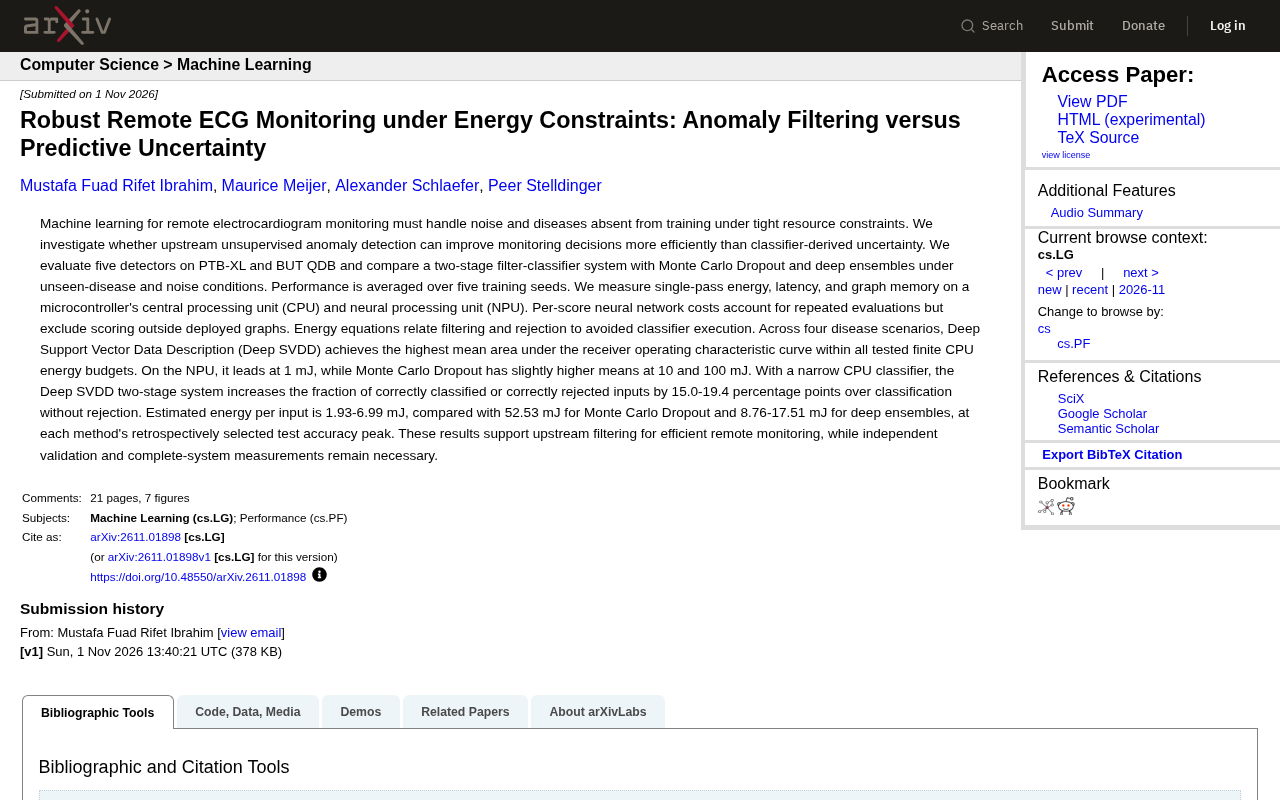
This study attempts to answer: under a limited energy budget, which approach can more efficiently improve the accuracy of monitoring decisions? The authors evaluated five anomaly detectors on the PTB-XL and BUT QDB datasets and compared them with two uncertainty methods—Monte Carlo Dropout and Deep Ensembles. All performance figures are averages over five training random seeds.
Experimental Design: Two-Stage System vs. Uncertainty Estimation
The study constructed a two-stage system: the first stage is an unsupervised anomaly detector, and the second stage is a narrow CPU classifier. The comparison baselines include two end-to-end uncertainty models—Monte Carlo Dropout (multiple forward passes to estimate variance) and Deep Ensembles (an ensemble of multiple models). The evaluation scenarios cover four disease settings and introduce noise conditions to simulate distribution shifts in real deployments.
Energy measurements were performed separately on the microcontroller's CPU and NPU, recording per-inference energy, latency, and graph memory footprint. The authors also derived an energy equation that relates filtering and rejection operations to "avoided classifier executions," thereby fairly comparing the per-input energy of different methods at the same peak accuracy.
Monte Carlo Dropout (MC Dropout) is a commonly used uncertainty estimation method. At inference time, it keeps the Dropout layers active and performs multiple forward passes on the same input to obtain multiple prediction results. The mean of these results serves as the final prediction, while the variance reflects the model's uncertainty. When the variance is large, the model tends to reject the decision. Deep Ensembles, on the other hand, train multiple independently initialized models and ensemble their predictions at inference time, also using prediction variance to measure uncertainty. Both require multiple network executions and have high energy consumption.
An NPU (Neural Processing Unit) is a hardware accelerator designed specifically to accelerate neural network inference, commonly found in modern microcontrollers and edge devices. Compared with general-purpose CPUs, NPUs are more energy-efficient when executing operations such as matrix multiplication and convolution, but may have poor support for certain operations (such as control flow in multiple forward passes). In this study, energy and latency measurements on the NPU revealed the impact of the hardware platform on method ranking: under a low energy budget (1 mJ), single-forward-pass Deep SVDD leads; under higher budgets (10 mJ, 100 mJ), MC Dropout gains a slight advantage due to NPU optimizations for multiple forward passes.
Key Findings: Deep SVDD Leads Within CPU Energy Budgets
Across the four disease scenarios, Deep Support Vector Data Description (Deep SVDD) achieved the highest average AUC (area under the receiver operating characteristic curve) within all tested finite CPU energy budgets. This means that when running on a CPU under energy constraints, upstream anomaly filtering is more effective than classifier uncertainty at distinguishing normal from abnormal samples.
On the NPU, the results diverged slightly: Deep SVDD still led under a 1 mJ budget, but at 10 mJ and 100 mJ, Monte Carlo Dropout performed slightly better on average. The researchers point out that this is related to the cost structure of repeated evaluation on the NPU—uncertainty methods require multiple forward passes, whereas anomaly detection requires only a single forward pass.
The two-stage system (Deep SVDD + narrow CPU classifier) increased the proportion of inputs that were "correctly classified or correctly rejected" by 15.0–19.4 percentage points, a significant improvement over a classifier without a rejection mechanism.
Deep SVDD (Deep Support Vector Data Description) is a deep learning-based one-class classification method. Its core idea is to train a neural network to map normal samples near a center point in feature space while pushing abnormal samples away from that center. At inference time, a sample whose distance to the center exceeds a threshold is judged as anomalous. Unlike methods that require anomalous samples for supervised training, Deep SVDD is trained using only normal data, making it highly suitable for detecting noise or disease types unseen during training. Its single-forward-pass nature also gives it a significant advantage in energy-constrained scenarios.
Energy Comparison: Filtering Approach an Order of Magnitude Lower Than Uncertainty
The energy data is the most compelling part of this study. At the peak test accuracy retrospectively selected for each method, the estimated per-input energy of the Deep SVDD two-stage system is 1.93–6.99 mJ; Monte Carlo Dropout is 52.53 mJ; Deep Ensembles are 8.76–17.51 mJ. In other words, the anomaly filtering approach consumes an order of magnitude less energy than Monte Carlo Dropout and several times less than Deep Ensembles.
This gap stems from structural differences: uncertainty methods require multiple executions of the same network (MC Dropout) or multiple networks (Deep Ensembles), whereas an anomaly detector requires only a single forward pass, and filtered-out samples skip classifier execution entirely, further saving energy.
Limitations and Outlook: Independent Validation and Full-System Measurements Remain Essential
The authors explicitly caution in their conclusion that while these results support upstream filtering for efficient remote monitoring, independent validation and end-to-end measurements of complete systems are still needed. The current energy estimates exclude scoring overhead outside the deployment graph, and the peak test accuracy was retrospectively selected—the peak point cannot be known in advance in real deployments. Moreover, the behavioral differences of the five detectors on the NPU suggest that the hardware platform can change method ranking, and practical selection must consider the target hardware.
For designers of wearable ECG devices, the signal from this study is: in extremely energy-constrained CPU scenarios, first filtering with lightweight unsupervised anomaly detection and then performing classification may be a more cost-effective strategy than end-to-end uncertainty estimation. However, if the device is equipped with an NPU and the energy budget is relatively generous, Monte Carlo Dropout remains competitive at higher energy levels.
Implications for Remote Monitoring System Design
This study directly links "algorithm selection" with "energy budget" rather than comparing accuracy in isolation. For remote ECG monitoring, this means system design should treat anomaly filtering as an energy management tool: filtering out noise and unknown disease segments not only reduces false alarms but also avoids unnecessary classification computation. If future work can incorporate full-system measurements and prospective validation, it will provide a more reliable basis for algorithm deployment on wearable devices.
One-line Summary
In energy-constrained wearable ECG monitoring, upstream unsupervised anomaly filtering (Deep SVDD) is more energy-efficient and effective than classifier uncertainty estimation, but the hardware platform affects method ranking.
Paragraph Summary
This study compares two technical approaches for improving decision reliability in remote ECG monitoring: upstream unsupervised anomaly detection (filtering) versus the classifier's own uncertainty estimation (Monte Carlo Dropout, Deep Ensembles). On the PTB-XL and BUT QDB datasets, combined with real energy measurements on microcontroller CPUs and NPUs, the results show that on the CPU, Deep SVDD anomaly filtering achieves the highest average AUC across all finite energy budgets, the two-stage system increases the proportion of correct classification or correct rejection by 15.0–19.4 percentage points, and per-input energy is an order of magnitude lower than Monte Carlo Dropout. On the NPU, Deep SVDD leads at a 1 mJ budget, but Monte Carlo Dropout is slightly higher at 10 mJ and 100 mJ, suggesting that the hardware platform affects method ranking. The authors emphasize that independent validation and end-to-end measurements of complete systems remain necessary follow-up work.
Related articles
 Tech Frontiers
Gemini Omni 1.2 Flash: AI Video Moves Toward Draft-Style Editing
Google's Gemini Omni 1.2 Flash update enables conversational, draft-style editing of the same video—swap scenes while keeping products, adjust lighting while keeping characters. Clips up to 15s, 720p costs 30% less than the previous Flash—ideal for e-commerce ads, previs, and short-asset production.

Codex Tutorial: One-Command Install and Run Your First Task
Codex tutorial: one-command install and run your first task. Covers the four Codex forms, sandbox and approval guardrails, AGENTS.md and MCP configs, cloud network policy, and the iron rule of human review—everything you need to get started with this autonomous coding agent.
 Tech Frontiers
Localix: An Open-Source Agentic Development Environment with Multi-Model and Local AI Integration
Localix is an MIT open-source Agentic Development Environment (ADE) supporting seamless Claude Code plugin loading, multi-model cloud and local execution, Mini Apps extensions, and agent context management—an open AI collaboration workbench for developers.