Engineered Microbial Nitrogen Fixation: A New Path to Agricultural Decarbonization by Replacing Synthetic Fertilizers
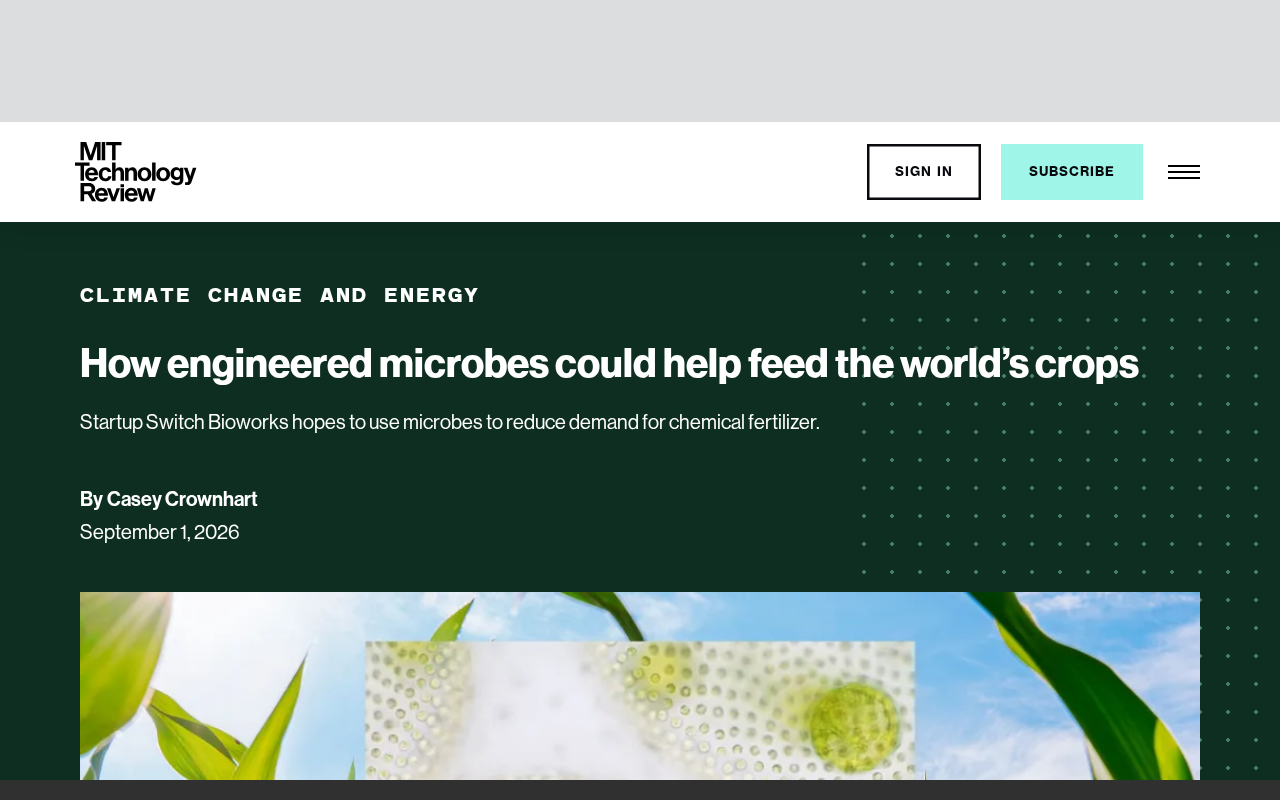
Engineered microbes could slash agricultural carbon emissions by replacing synthetic nitrogen fertilizers.
Synthetic nitrogen fertilizer production via the Haber-Bosch process accounts for ~1.2% of global CO₂ emissions. Engineered microbial nitrogen fixation offers a promising alternative by genetically modifying soil microbes to supply nitrogen directly to staple crops like corn and wheat. While companies such as Pivot Bio are advancing commercialization, key challenges remain—including colonization stability in complex soil ecosystems, insufficient fixation efficiency, environmental safety concerns, and cost competitiveness—positioning current products as fertilizer supplements rather than full replacements.
The Fertilizer Dilemma: The Carbon Emission Problem Behind Food Security
Fertilizer is the backbone of the global food supply system. Without it, modern agriculture simply could not feed the billions of people on Earth. However, behind this contribution lies a heavy environmental cost—the production of synthetic nitrogen fertilizer is an energy-intensive, high-emission process.
The traditional Haber-Bosch process synthesizes ammonia by combining atmospheric nitrogen with hydrogen gas, requiring iron-based catalysts under extreme conditions of 400–500°C and 150–300 atmospheres of pressure. This process was born in the early 20th century, with German chemist Fritz Haber discovering the underlying principles and Carl Bosch achieving industrial-scale production—both received Nobel Prizes in Chemistry for their contributions. Notably, the hydrogen needed for ammonia synthesis primarily comes from Steam Methane Reforming of natural gas, a step that itself releases large amounts of CO₂. According to International Energy Agency (IEA) data, global ammonia production consumes approximately 1.8% of global energy annually and emits around 450 million tons of CO₂, accounting for roughly 1.2% of global carbon emissions. The Haber-Bosch process has been hailed as the invention that "fed half the world's population," but its deep dependence on fossil fuels has also made it a key decarbonization target. As climate change grows increasingly urgent, how to reduce these emissions while safeguarding food production has become a critical challenge shared by the scientific and agricultural communities.
Microbial Nitrogen Fixation: A Natural Emission-Reduction Solution from the Soil
Facing the carbon emission dilemma posed by fertilizers, some companies have turned their attention to the microscopic world—soil microorganisms. A growing body of research shows that introducing beneficial microbes into the soil around crop root systems can help plants acquire nutrients, particularly the nitrogen essential for crop growth.
This approach rests on a solid natural foundation. Nitrogen-fixing microorganisms already exist in nature, with the most classic example being Rhizobium bacteria that form symbiotic relationships with leguminous plants. At the core of Biological Nitrogen Fixation (BNF) is nitrogenase—the only known enzyme system in nature capable of breaking the extremely stable triple bond of N₂ molecules (bond energy up to 945 kJ/mol) under ambient temperature and pressure. It consists of two components: iron protein and molybdenum-iron protein. In the Rhizobium-legume symbiotic system, after Rhizobium infects plant root hairs, the plant forms specialized root nodule structures that maintain a micro-oxic environment internally to protect the oxygen-sensitive nitrogenase. The plant provides carbon sources to the bacteria through photosynthesis, while the bacteria supply ammonium nitrogen in return, forming a precisely coordinated metabolic mutualism. Global biological nitrogen fixation contributes approximately 100–175 million tons of nitrogen annually, making it a critical component of the natural nitrogen cycle. This "biological nitrogen fixation" mechanism provides a natural template for reducing dependence on synthetic nitrogen fertilizers.
From Natural Nitrogen Fixation to Genetic Engineering
However, natural nitrogen-fixing microorganisms have clear limitations—most can only establish symbiotic relationships with specific crops (such as legumes) and are largely ineffective with staple crops like corn, wheat, and rice. This is precisely where "engineered microbes" come into play.
Through genetic engineering, researchers and companies are attempting to modify microorganisms to provide nitrogen fixation services for a broader range of crop species. Current technical approaches involve several strategies: The first transfers nitrogen fixation gene clusters (nif genes, typically comprising about 20 genes) into non-nitrogen-fixing microorganisms, such as common symbiotic bacteria in cereal crop rhizospheres. The second involves "de-domesticating" natural nitrogen-fixing bacteria by removing negative feedback mechanisms that regulate nitrogen fixation—under natural conditions, when sufficient ammonium ions are already present in the environment, nitrogen-fixing bacteria shut down nitrogenase expression to conserve energy. By knocking out or modifying regulatory genes such as nifL, strains can continue fixing nitrogen even in fertilized soils. The third uses synthetic biology tools (such as CRISPR-Cas9) to redesign nitrogen fixation metabolic pathways, optimizing nitrogenase oxygen tolerance and catalytic efficiency. Representative companies include Pivot Bio (whose flagship product PROVEN involves genetically modified rhizosphere microbes targeting corn) and Kula Bio, among others. In theory, if these engineered bacteria can colonize the root zones of staple crops and continuously supply nitrogen, it could dramatically reduce or even partially replace traditional fertilizer use, fundamentally lowering agricultural carbon emissions.
Technical Challenges Facing Industrialization of Engineered Microbes
Translating laboratory results into scalable agricultural products is the core test for this technology pathway. Engineered microbes must perform reliably in real field environments, which involves a series of complex issues:
- Colonization stability: Whether modified microorganisms can survive and continue functioning in the highly competitive soil ecosystem. Soil is one of the most microbially diverse ecosystems on Earth, with each gram containing billions of microbial cells and thousands to tens of thousands of species. After engineered microbes are introduced, indigenous microbial communities can reject these "outsiders" through multiple mechanisms including nutrient competition, antibiotic secretion, and phage attacks. Additionally, abiotic factors such as soil type (sandy, clay, loam), pH, moisture content, organic matter content, and temperature can significantly affect the survival rate and nitrogen fixation efficiency of engineered bacteria. This is the fundamental reason why many microbial products perform excellently in greenhouse experiments but show inconsistent results under field conditions—the industry calls this the "greenhouse-to-field" translation gap.
- Nitrogen fixation efficiency: Whether the nitrogen supplied is sufficient to meet actual crop demands. Taking corn as an example, nitrogen requirements can exceed 200 kilograms per hectare, while engineered microbes currently can typically only replace a portion of fertilizer usage.
- Environmental safety: Releasing engineered microorganisms into open agricultural environments requires careful assessment of ecological impacts. Risks including horizontal gene transfer (passing engineered genes to wild microorganisms) and long-term disruption of native soil microbial community structures are key concerns for regulatory agencies.
- Cost-effectiveness: Whether microbial solutions are economically competitive compared to traditional fertilizers. Farmers' ultimate adoption decisions depend on quantifiable yield gains and cost savings.
Multiple startups and agtech companies have already entered this field, attempting to commercialize microbial nitrogen fixation technology. Their products typically take the form of microbial formulations that can be applied with seeds or directly to the soil. On the regulatory front, these products face complex approval processes: in the United States, environmental release of genetically modified microorganisms requires EPA approval under TSCA (Toxic Substances Control Act), and may also involve USDA-APHIS biotechnology regulatory assessment. The EU applies an even stricter case-by-case approval system for GMO field releases. Notably, some companies adopt a "non-GMO" strategy—for example, Pivot Bio claims its products use precise editing of the microorganism's native genes (rather than introducing foreign genes), seeking a more favorable regulatory classification.
Long-term Significance and Development Outlook for Engineered Microbial Technology
If engineered microbial technology can mature and be deployed at scale, its significance will be profound. On one hand, it has the potential to significantly reduce fertilizer-related carbon emissions in agricultural production, advancing global agriculture toward a low-carbon transition. On the other hand, reducing dependence on synthetic fertilizers could also mitigate the chain of environmental problems caused by fertilizer overuse.
The environmental damage from excessive fertilizer use forms a complete pollution chain. First is soil degradation: prolonged heavy application of chemical nitrogen fertilizers leads to soil acidification, declining organic matter content, and reduced microbial community diversity, ultimately affecting long-term soil productivity. Second is water eutrophication: nitrogen not absorbed by crops (crop utilization rates for fertilizer nitrogen are typically only 30%–50%) enters rivers, lakes, and oceans through surface runoff and groundwater infiltration, stimulating massive algal blooms. When algae die and decompose, they consume dissolved oxygen in the water, creating vast "dead zones"—such as the seasonal hypoxic zone in the Gulf of Mexico, which now exceeds 15,000 square kilometers. Third is secondary greenhouse gas emissions: nitrification and denitrification processes in the soil convert some fertilizer nitrogen into N₂O (nitrous oxide), whose greenhouse effect is approximately 265 times that of CO₂, with an atmospheric residence time exceeding 100 years. The precision nitrogen delivery model of engineered microbes—releasing nitrogen at specific points in the crop rhizosphere—could theoretically dramatically improve nitrogen use efficiency and reduce these environmental harms at the source.
Of course, this technology is still in its developmental stage. Moving from proof of concept to broad field deployment requires overcoming multiple hurdles across technology, regulation, and market adoption. Currently, most microbial nitrogen fixation products are positioned as "supplements" rather than "replacements" for fertilizers, recommending that farmers reduce fertilizer usage by 15%–25%. This reflects both the current technological reality and a pragmatic market strategy. However, driven by the dual pressures of climate change and food security, engineered microbes undoubtedly represent a direction worthy of sustained attention—they deeply integrate synthetic biology with sustainable agriculture, offering an imaginative answer to the fundamental question of "how to feed the world with fewer emissions."
Related articles

DeepCell: One-Click AI Generation of Documents, Spreadsheets, and Slides
DeepCell tops Product Hunt with one-click generation of documents, spreadsheets, and slides, using the .deepcell format for linked updates, designed for System 2 tasks like modeling and sales reviews.

Doneas: 15-Minute Daily Accountability Calls That Keep Indie Developers From Procrastinating
Doneas is a daily accountability tool for indie developers: plan tasks on Monday, join a 15-minute call with five builders each day, and log deliveries on a public progress page. This article analyzes its core mechanics, effectiveness, and potential issues around retention and matching.

Fastlane 2.0: Fully Automated AI Ad Campaigns, From Creative to Optimization
Fastlane 2.0 is an AI ad automation tool: enter your website and it learns your brand, generates video and image ads, and runs and optimizes them on Meta, TikTok, Instagram, and YouTube.