Engineering an AI Harness for Game Development: Approach and Practice
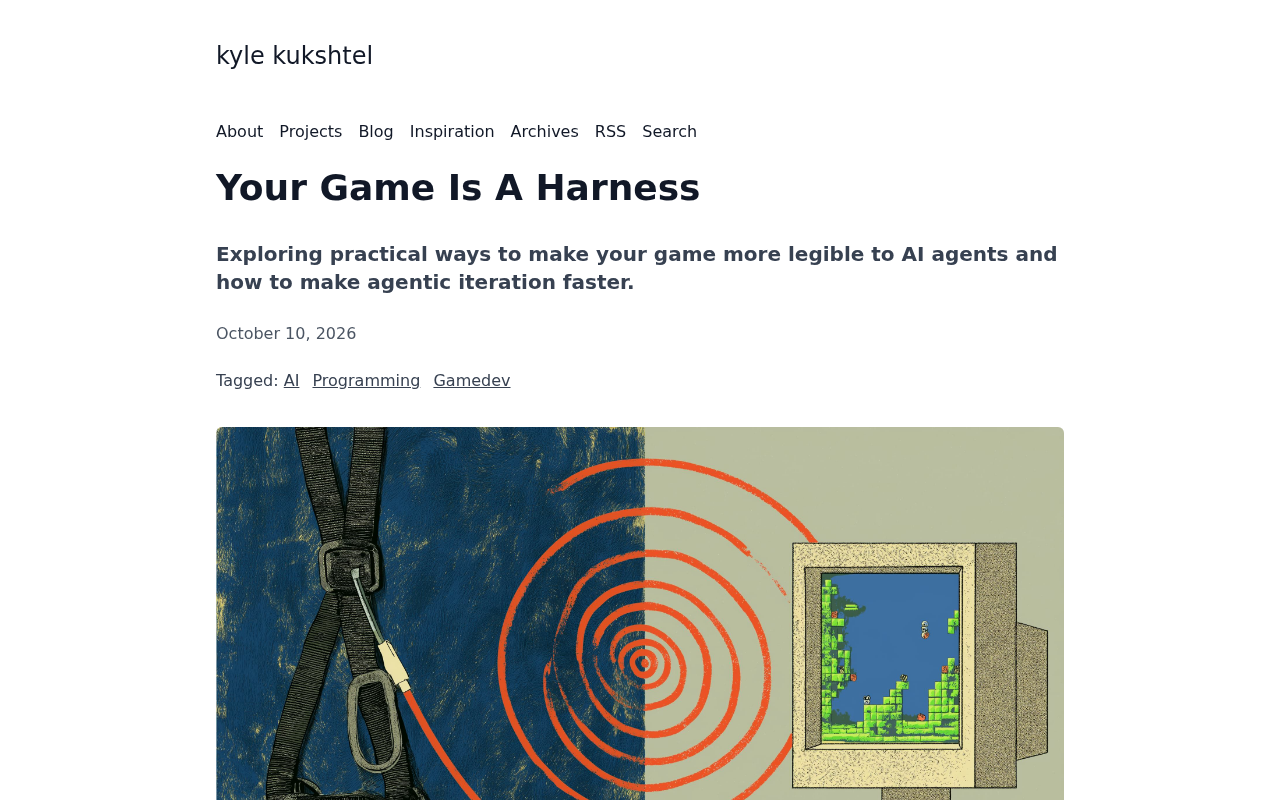
Building an AI harness for game development so model output is truly accepted by engineering systems.
The article argues that when integrating AI into game development, the scarce resource isn't model capability but the "AI harness" built around the model—an engineering framework that constrains inputs, orchestrates tools, and validates outputs. A harness typically has four decoupled layers: the context layer injects project knowledge on demand, determining whether output fits the project; the orchestration layer breaks vague requirements into verifiable subtasks, avoiding one-shot generation of all changes; the tool layer lets the model read/write files, run tests, and launch the engine, feeding failure info back into a correction loop; the validation layer defines "done," covering compilation, testing, in-engine runs, and presentation-layer comparison. Rollout advice: start with low-risk high-frequency scenarios, front-load acceptance criteria before prompts, keep human review entry points, and archive failure samples. A harness doesn't replace creative judgment—it compresses repetitive engineering labor.
Game development has long sat at the intersection of "high creative density and heavy repetitive labor": level construction, numeric configuration, script glue code, asset pipelines, and QA regression each consume enormous amounts of time. When integrating AI into this pipeline, what's truly scarce is not model capability, but the "AI harness" built around the model: it constrains inputs, orchestrates tools, validates outputs, and reliably feeds results back into the production pipeline.
Why Game Development Needs an "AI Harness"
Directly calling a general-purpose large model to write game logic typically runs into three problems:
- Context distortion: The model doesn't understand the project's entity definitions, component naming, asset paths, or existing architecture, making generated content hard to compile or run.
- Non-reproducible results: The same requirement produces wildly different outputs across generations, making version control and code review difficult.
- No verification loop: Generated content can't automatically run tests, can't be imported by the engine, and can't be used directly by content designers.
The so-called AI harness is a layer of "scaffolding + constraints + validation" between the model and game engineering. It translates natural language requirements into structured tasks, constrains model outputs into parseable formats, and then closes the loop through tool calls (compilation, unit tests, engine import, screenshot comparison). Its value lies not in "making AI write more code," but in making AI output acceptable to engineering systems.
Core Components of an AI Harness
A deployable harness typically contains four layers that are decoupled from each other and can be replaced independently.
1) Context Layer: Turning Project Knowledge into Retrievable Input
The model can't memorize an entire project. The context layer's job is to inject task-relevant information on demand. Common approaches include:
- Code and asset indexing: Build indexes over scripts, prefabs, config tables, and shaders, supporting symbol and semantic retrieval.
- Architecture constraint documentation: Explicitly state in docs "which modules may be modified," "what the naming conventions are," and "cross-layer calls are prohibited."
- Example-driven: Provide 2–3 completed cases of the same type so the model imitates existing style rather than inventing from scratch.
This layer determines whether generated results "look like this project." Many teams pour all their effort into model selection while neglecting the context layer, resulting in stronger models producing smoother output that drifts further from project conventions.
RAG (Retrieval-Augmented Generation) is the most common implementation paradigm for the context layer: split project docs, code, and config into chunks, vectorize them into an index, and when a task arrives, first recall the most relevant chunks by semantic similarity, then stitch them into the prompt for the model. It addresses the fundamental contradiction of "your project isn't in the model's parameters"—knowledge doesn't enter the weights but is injected temporarily at inference time. For game projects, retrieval units are often not uniformly split text blocks but semantically bounded entities: a component class, a config table, a prefab's dependency tree. In practice, teams often do "symbol retrieval + semantic retrieval" hybrid recall: first exact-match by class name, function name, or asset path, then fill in related context via vector retrieval. Note that recall quality affects final output more than model size—index granularity, update timing, and chunk ordering all directly change the usability of generated results.
2) Orchestration Layer: Breaking Vague Requirements into Executable Steps
Game requirements are often vague, like "make the Boss fight feel more oppressive." The orchestration layer needs to decompose this into verifiable subtasks: state machine adjustments, skill cooldown curves, camera and sound triggers, UI prompt pacing, etc.
Common orchestration patterns in practice:
- Replace pure natural language instructions with structured task descriptions (field-based: goal, scope, constraints, acceptance criteria).
- Have the model first produce a plan, then have the harness execute it step by step, rather than generating all changes at once.
- Set manual confirmation checkpoints for high-risk operations (deleting assets, modifying core systems).
ReAct (Reasoning + Acting) and plan-execute separation are two typical paradigms for the orchestration layer. ReAct has the model alternate between "thinking" and "acting," deciding the next step based on each tool's return, suitable for exploratory tasks with uncertain paths. Plan-execute separation has the model produce a complete step list at once, then the harness schedules execution step by step—the advantage is that plans can be human-reviewed, cached, and reused; the disadvantage is that unexpected obstacles require replanning. Given the many high-risk changes in game development, a hybrid is usually adopted: low-risk tasks go through ReAct for efficiency, while tasks involving core systems or asset deletion freeze the plan and wait for manual confirmation before execution. Either way, the model needs a clear tool-calling protocol and termination conditions, or it easily falls into meaningless loops.
3) Tool Layer: Letting the Model "Do Things" Rather Than "Just Talk"
The tool layer is the harness's interface to the engine and build system. Typical tools include: reading/writing script files, querying scene hierarchy, running unit tests, triggering builds, invoking engine command lines for headless runs, and capturing runtime screenshots or logs.
The key is that tool results must be fed back to the model: compilation failures, test error stacks, and runtime exception logs are all inputs for the next correction round. A harness without a tool layer can only generate "looks correct" text; a harness with a tool layer can converge on "actually runs" implementations.
4) Validation Layer: Defining What Counts as "Done"
This is the most underrated layer. For game development, validation methods are richer and more demanding than ordinary software:
- Compilation and static checks: The minimum threshold.
- Unit and integration tests: Covering numeric logic, state transitions, and save compatibility.
- In-engine runtime validation: Headless scene launch to check for crashes and expected event triggers.
- Presentation-layer validation: Screenshot comparison, frame rate and memory curves, to avoid "logically correct but visually broken."
Only with a solid validation layer does AI-generated content dare enter the main branch; otherwise it stays on experimental branches with greatly reduced value.
Headless run is a key in-engine validation technique: launching the game or a scene without rendering a graphical interface, scripting inputs, fast-forwarding time, triggering events, then collecting crash logs, exception stacks, and state snapshots. It turns "run it and see" from a manual operation into a single command in CI, and is a prerequisite for auto-validating AI-generated content. Complementary to it is golden image diff: capturing screenshots of the same scene under fixed camera and lighting, then comparing against a baseline image at the pixel or perceptual level to catch logically correct but visually broken cases. Because rendering has minor platform and driver variations, a tolerable difference threshold is typically set rather than requiring pixel-perfect matching. These two validation methods cost mainly in the setup phase, and once working, they can be reused by all subsequent tasks—making them the highest ROI part of the validation layer.
Practical Advice for Engineering Deployment
Building a complete harness from scratch isn't cheap. You can proceed incrementally in this order:
- Start with low-risk, high-frequency scenarios: Config table generation, asset naming normalization, simple script template filling—these have low validation cost and intuitive returns.
- Front-load acceptance criteria: Write tests before writing prompts, so the model works toward verifiable goals rather than adjectives.
- Keep a human review entry point: Harness outputs enter the PR process, with humans deciding whether to merge, gradually building trust in automation boundaries.
- Record failure samples: Classify and archive the cause of each generation failure (missing context, tool misuse, insufficient validation)—these samples guide harness iteration better than success cases.
A reminder: an AI harness won't eliminate creative judgment in game development. What it excels at is compressing repetitive engineering labor and freeing designers' and programmers' attention for gameplay polish and experience tuning. Treat it as "smart tooling" on the pipeline, not a "machine that makes games automatically," and expectations will be more realistic.
Summary
Engineering an AI harness for game development essentially means embedding the model into a constrained, tool-equipped, validated engineering pipeline. The context layer determines whether output fits the project, the orchestration layer determines whether tasks can be decomposed, the tool layer determines whether the model can truly act, and the validation layer determines whether results can be trusted. If any of the four layers is missing, AI's performance in game development degrades to "can chat but can't do." Getting this chain working delivers more stable returns than simply chasing stronger models.
Related articles

How Big Can Stars Really Get? The Physical Limits of the Largest Stars
Red supergiants are the largest stars by volume, with radii up to 2,000 times the Sun, engulfing the inner solar system. But there is no precise upper limit on stellar size—models predict up to 15,000 solar radii. The most massive blue stars are far smaller than red supergiants—biggest and heaviest are two different things.

Apple HomeView Smart Display Full Feature Breakdown: Wall-Mount or Desktop, $299
Apple launches HomeView, a $299 smart display with wall-mount and desktop options, 12MP camera for facial recognition, smart home control, music playback, and recipe step-by-step cooking. Full breakdown of watch faces, apps, privacy, and cooking integration.

Where Did the Promised New Studio Go? Craft Computing Answers After Five Years
Craft Computing's host responds to viewer questions: the new studio promised five years ago was shelved as construction costs soared from $30,000 to $75,000, and was replaced by a 168-square-foot garage conversion.