EngramEdit: Decoupled Knowledge Updates in LLMs via Conditional Memory

EngramEdit updates n-gram embeddings in a frozen LLM to achieve precise, generalizable factual knowledge editing.
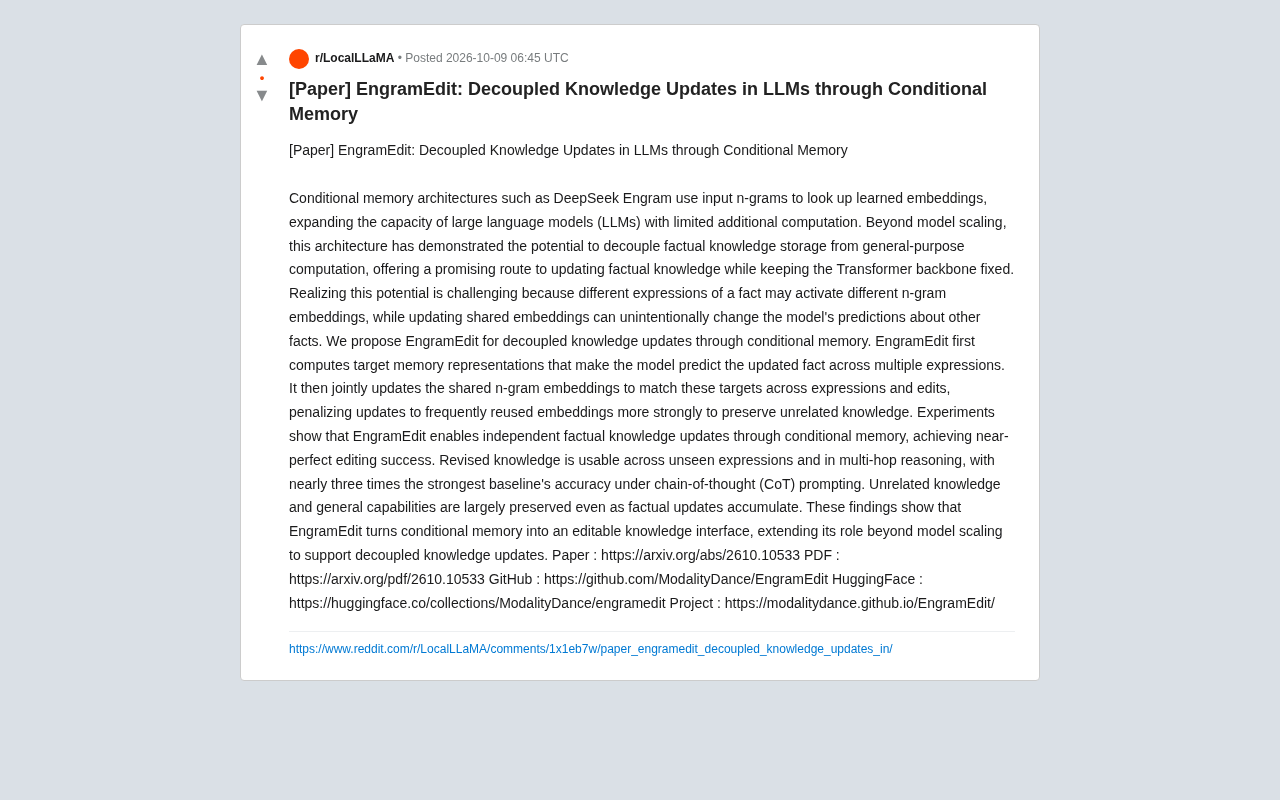
EngramEdit proposes a new approach to updating factual knowledge in LLMs by exploiting the structural separation between n-gram embedding lookup tables and the Transformer backbone in conditional memory architectures like DeepSeek Engram. Its two-step method computes target memory representations that generalize across diverse phrasings, then jointly updates shared n-gram embeddings while penalizing frequently reused ones to protect unrelated knowledge. Experiments show near-perfect edit success rates, and — critically — roughly triple the CoT multi-hop reasoning accuracy of the strongest baseline, demonstrating that updated knowledge is genuinely integrated into reasoning chains rather than just remapped at the output layer.
Why Updating Knowledge in LLMs Is So Hard
Once a large language model finishes training, the factual knowledge it stores becomes woven into billions of parameters. When a fact changes — say, a company gets a new CEO or a country relocates its capital — the traditional options are either expensive retraining or parameter edits that risk cascading unintended side effects. The core tension is this: factual knowledge storage is deeply coupled with the model's general-purpose computation, so touching one tends to damage the other.
A paper titled EngramEdit: Decoupled Knowledge Updates in LLMs through Conditional Memory proposes a new approach — separating factual knowledge from the model backbone and turning it into an independently editable interface.
Knowledge editing is an active subfield of LLM research. The main approaches fall into three categories: (1) direct parameter modification — methods like ROME and MEMIT locate weights associated with a target fact and apply matrix updates; fast but prone to degrading general capabilities at scale; (2) external memory or retrieval-augmented generation (RAG) — new knowledge is stored in an external database and retrieved at inference time; model parameters stay unchanged, but this depends on retrieval quality and doesn't truly alter the model's internal "beliefs"; (3) fine-tuning — continued training on new factual data; straightforward but expensive, and vulnerable to catastrophic forgetting. EngramEdit occupies a novel position between categories one and three: it does modify parameters (n-gram embeddings), but structural isolation via the conditional memory architecture strictly confines changes to the knowledge storage module, leaving the Transformer backbone completely frozen.
Conditional Memory Architecture: Decoupling Knowledge Storage from Computation
The technical foundation of the paper rests on a class of architectures called Conditional Memory, with DeepSeekAd Engram as a prime example. The core mechanism: the model uses input n-grams (contiguous token spans) to look up pre-learned embeddings, expanding model capacity with virtually no added compute overhead.
This design yields a critical side effect — it naturally separates factual knowledge storage from general-purpose computation. In other words, the Transformer backbone handles "thinking," while the conditional memory module handles "remembering specific facts." This opens up an appealing possibility: update only the memory module, while keeping the Transformer backbone completely frozen.
However, the paper is clear that realizing this potential isn't straightforward. The same fact can be expressed in many ways, and different phrasings activate different n-gram embeddings. Because embeddings are shared, updating one embedding to reflect a new fact can inadvertently alter the model's predictions about unrelated facts. This is the core challenge EngramEdit sets out to solve.
Background — What are n-grams and conditional memory? An n-gram is a foundational concept in NLP referring to a sequence of n consecutive tokens in text. For example, "U.S. President" is a 3-gram and "artificial intelligence" is a 2-gram (bigram). Conditional memory architectures use these local contiguous spans as "query keys" to retrieve corresponding vector representations from a pretrained embedding lookup table, then inject those vectors into the Transformer's computation flow. DeepSeek Engram is a canonical implementation: it maintains a large n-gram embedding lookup table, and as the model processes input, relevant n-gram embeddings are retrieved automatically. The key advantage is that knowledge is stored in explicit, addressable embeddings rather than scattered across weight matrices in every layer — providing a theoretical basis for precise knowledge localization and replacement.
EngramEdit's Two-Step Method
EngramEdit's workflow breaks down into two phases.
Step 1: Compute Target Memory Representations
The method first computes a set of target memory representations that cause the model to stably predict the updated fact across many different phrasings of that fact. This step addresses the "expression diversity" problem — the edit isn't limited to a single sentence; instead, the new knowledge is made to hold across varied wordings.
Step 2: Jointly Update Shared Embeddings While Protecting Existing Knowledge
EngramEdit then performs a joint update on the shared n-gram embeddings, steering them toward the target representations across multiple expressions and multiple edits. The key insight is applying stronger update penalties to frequently reused embeddings.
This design directly targets the "collateral damage" risk described earlier. Heavily reused embeddings tend to carry a large amount of unrelated knowledge; modifying them freely causes the greatest ripple effects. By "touching them more gently," EngramEdit maximizes preservation of unrelated knowledge while still successfully updating the target fact.
Experimental Results: Near-Perfect Edit Success Rate
The paper's experimental results are impressive. A few standout numbers:
- Near-perfect edit success rate: EngramEdit achieves close to 100% edit success rate for independent factual knowledge updates through conditional memory.
- Generalization to unseen expressions: Revised knowledge works not only for phrasings seen during training, but also for entirely new expressions.
- Multi-hop reasoning support: Under Chain-of-Thought (CoT) prompting, EngramEdit's multi-hop reasoning accuracy approaches roughly three times that of the strongest baseline. This means updated knowledge isn't just "memorized" — it can be genuinely used in downstream chained reasoning.
- Protection of unrelated capabilities: Even as factual edits accumulate, the model's unrelated knowledge and general capabilities are largely preserved.
The multi-hop reasoning result is particularly significant. Many knowledge editing methods can get a model to produce the new answer in direct Q&A, but fail to integrate the new knowledge into complex reasoning chains. EngramEdit's substantial lead in CoT settings suggests it modifies the knowledge itself, not just a surface-level output mapping.
Background — What is multi-hop reasoning? Multi-hop reasoning refers to tasks that require chaining multiple independent facts together to reach an answer. For example, "In which city is the alma mater of the current CEO of Company X located?" requires first knowing who the current CEO is, then knowing which school they attended, before the city can be named. This poses a serious challenge for knowledge editing methods: even if a model gives the updated CEO's name in direct Q&A, if the new knowledge hasn't been truly integrated into internal representations, the reasoning chain will break at the second hop and still draw the wrong conclusion from stale information. Chain-of-Thought (CoT) prompting — which asks the model to output its reasoning step by step — effectively exposes this failure mode. EngramEdit achieving roughly three times the CoT multi-hop accuracy of the strongest baseline indicates that its updated knowledge has been integrated into the model's intermediate reasoning steps, not merely adjusted at the final output layer.
Broader Significance: From Capacity Expansion to an Editable Knowledge Interface
The paper's most thought-provoking argument is repositioning the conditional memory architecture from a mere "model capacity expansion tool" to an editable knowledge interface.
Previously, conditional memory designs like DeepSeek Engram were primarily seen as a way to scale model capacity. EngramEdit demonstrates that the same architecture can also serve as the substrate for continuous, independent, low-interference knowledge updates. For real-world applications that require frequent maintenance of factual accuracy — enterprise knowledge bases, news Q&A systems, compliance information platforms — the ability to freeze the backbone and update only the memory module carries clear engineering value.
The authors have also publicly released all resources, including the arXiv paper, GitHub repository, HuggingFace model collection, and project homepage, making it easy for researchers to reproduce and build upon the work.
Summary
EngramEdit's contribution can be summarized as follows: built on top of a conditional memory architecture, it provides a factual update mechanism that is stable across diverse expressions and multiple edits, while protecting unrelated knowledge. It turns the theoretically appealing advantage of "decoupled knowledge storage and computation" into a practically operable editing interface. As LLMs face increasingly demanding requirements for factual currency in real-world deployments, this line of research offers a promising path toward keeping models continuously factually accurate.
Related articles

Chain of Thought Isn't Just for AI: How Humans Can Use CoT to Improve Thinking Quality
Chain of Thought isn't just a prompt trick for large models. Starting from a Hacker News discussion, this article analyzes why CoT works for human thinking too, breaks down actionable ways to transfer it, and highlights the key differences between human CoT and machine CoT.
Cloudflare Teams Up with OpenAI: Closi…
Cloudflare Teams Up with OpenAI: Closing the Loop from Vulnerability Discovery to Defense with AI
Cloudflare uses OpenAI Daybreak to investigate security vulnerabilities and generate reviewable remediation plans, while developers use Codex to boost coding efficiency and quality.

Orca Multi-Agent Orchestration in Practice: A Guide to Parallel Collaboration with Claude and Codex
Orca is Stable AI's free open-source agent workbench supporting 34 agents like Claude Code and Codex in parallel. Learn its Git worktree isolation, multi-model orchestration, and mobile management.