Enough Phone: Users Tired of Big Screens Built Their Own Small-Screen Phone
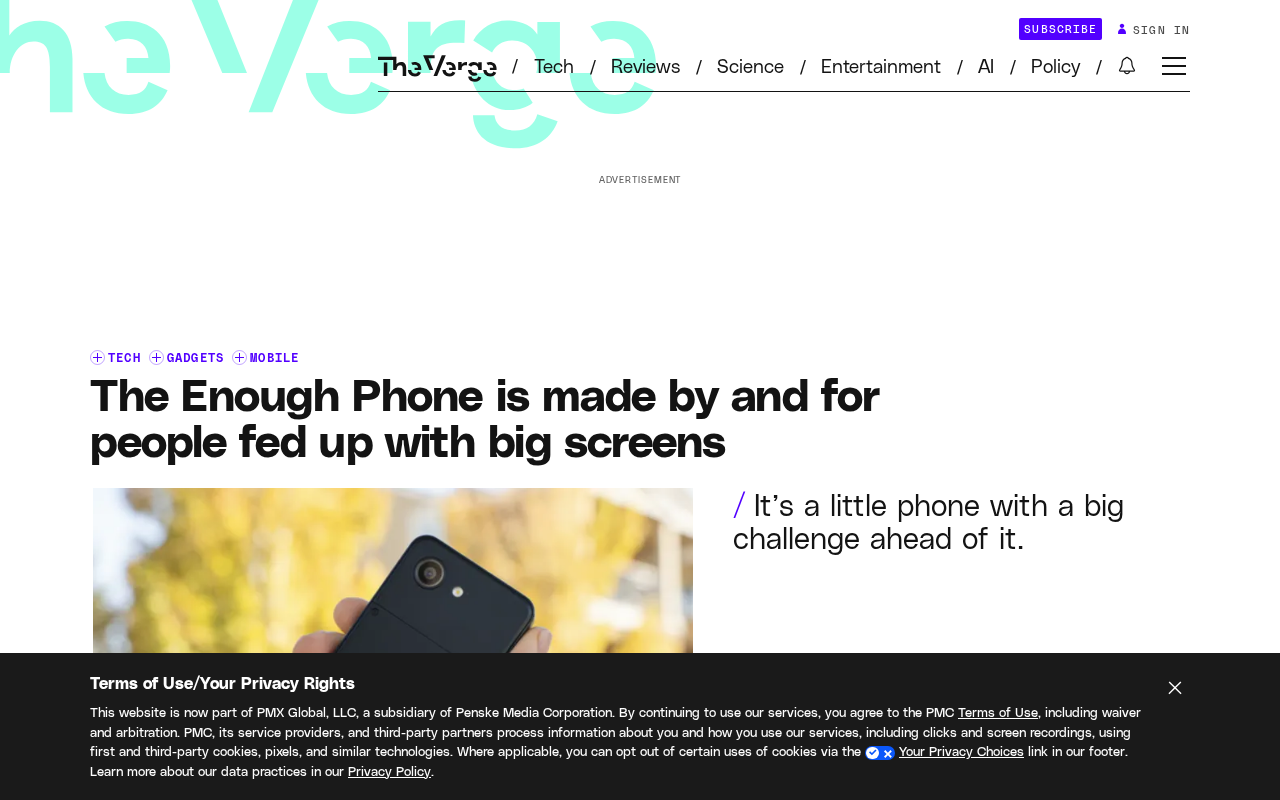
A three-person team crowdfunds the small-screen Enough Phone with dual-system choice, validating niche demand ignored by big screens.
Enough Phone is a small-screen phone project by a three-person team including Brennan Jordan and Austin Boer, crowdfunding on Kickstarter. Its core selling points are a compact body and system choice: users can switch freely between stock Android and minimalist OdysseyOS, putting control back in their hands. The article notes that years of unidirectional big-screen growth have brought costs like difficult one-handed use and heavy devices, while small-screen solutions lack supply-chain scale advantages, leaving mainstream brands reluctant to invest seriously. Enough Phone aims to fill this overlooked gap, but crowdfunded phones commonly face delivery delays, supply-chain fluctuations, and quality risks—backers are essentially voting for a product philosophy, and mass production depends on the team's execution.
A "good enough" phone, made by the people it frustrated
While mainstream phone makers keep stretching screens larger and cramming in more features, a group of users decided to take matters into their own hands. According to an RSS source, Brennan Jordan and Austin Boer are two of the three core members of the Enough Phone project, and they are crowdfunding a small-screen phone on Kickstarter. The pitch is refreshingly direct: a compact body, plus the freedom to choose between stock Android and a minimalist system called OdysseyOS.
The very existence of this project is a signal. Big-screen phones have dominated the market for years, but the demand for "good enough" has never been taken seriously. Enough Phone is trying to fill exactly the gap that mainstream manufacturers have ignored.
Why small-screen phones have become a rarity
Over the past few years, smartphone screen sizes have grown almost unidirectionally. The logic is easy to understand: bigger screens mean better entertainment, larger batteries, and more internal space. But the cost is increasingly difficult one-handed use, pockets that can't fit the device, and heavier hardware.
For some users, those costs now outweigh the benefits. They want a device that's easy to hold, doesn't demand attention, and returns to the essence of a communication tool. Enough Phone targets exactly these people—not enthusiasts chasing peak performance, but ordinary users who have long felt held hostage by big screens.
Interestingly, small-screen phones have no supply-chain advantage. Displays, batteries, and structural components all favor standardized large-size solutions, and small-batch customization means higher costs. This is why mainstream brands rarely make small-screen flagships seriously, and why Enough Phone chose crowdfunding to validate demand and raise seed capital.
The supply-chain disadvantage of small-screen phones stems from the consumer electronics industry's economies of scale. Display panel makers, battery manufacturers, and structural component suppliers typically organize production lines by size and specification. Standardized large-size panels offer high yields, large order volumes, and low unit costs; custom small-size panels require separate production runs, have high minimum order quantity (MOQ) thresholds, and actually cost more per unit. On the battery side, a smaller body means less battery compartment volume, higher energy density requirements, and fewer available cell options. In addition, internal components like motherboards and camera modules also favor standardized sizes, and small-batch procurement makes it hard to amortize R&D and tooling costs. The result is that the bill of materials for a small-screen phone is often no cheaper than—and sometimes more expensive than—a large-screen one, which directly undermines the commercial incentive for mainstream brands to build small-screen flagships.
System choice: stock Android or OdysseyOS
The most distinctive design of Enough Phone is letting users decide what system the phone runs. You can choose standard stock Android, or OdysseyOS—an operating system focused on a minimalist experience.
This approach is uncommon among niche phone projects. Most custom phones either lock users into their own system or offer only a single near-stock experience. Enough Phone hands the choice back to users, fundamentally responding to a deeper question: phones should adapt to people, not the other way around.
From a product perspective, the dual-system strategy also lowers the barrier to switching. People accustomed to the stock Android ecosystem can pick it up seamlessly, while those seeking minimalism and reduced screen time can choose OdysseyOS. This flexibility is a key differentiator between Enough Phone and other crowdfunded phone projects.
Stock Android (AOSP) refers to the base version of Android developed by Google and released as an open-source project. Unlike the "Google version of Android" found on devices like the Pixel, pure AOSP does not come with Google Mobile Services (GMS, including the Play Store, Google Play Services, etc.) preinstalled, and manufacturers or communities can freely customize the interface and preloaded apps. Many niche phone projects choose AOSP because it requires no licensing agreement with Google, lowering compliance costs while retaining full app ecosystem compatibility. Users who need Google services can usually flash the GMS package themselves. Understanding this distinction helps determine whether Enough Phone's "stock Android" is a clean system without Google services or a lightly customized near-stock experience—which directly affects the convenience of app access and push notifications in daily use.
The real challenges behind crowdfunding
Enough Phone is currently seeking funding on Kickstarter. According to the source, the project gained some attention shortly after launch, but the history of crowdfunded phones is not always rosy. Delivery delays, supply-chain fluctuations, and quality control issues are common risks these projects face.
Among the three-person team, Jordan and Boer are driving the project forward. The advantage of a small team is fast decision-making and a clear direction; the disadvantage is limited resources and experience. For backers, participating in crowdfunding is essentially voting for a product philosophy—while also bearing the corresponding uncertainty.
From an industry perspective, the value of Enough Phone goes beyond a single product. It's more like a demand validation exercise: in a phone market dominated by giants, can a niche demand sustain a small but beautiful brand? If the crowdfunding succeeds and delivers smoothly, it could encourage more teams to pursue product directions that the mainstream has overlooked.
Kickstarter is one of the world's largest reward-based crowdfunding platforms. Project creators set a funding goal and deadline, and backers pay in advance in exchange for products, memorabilia, or experiences as rewards. It's important to emphasize that reward-based crowdfunding is not presale or investment: backers hold no equity and do not enjoy the full protections of a consumer purchase contract. If a project fails to deliver, the platform typically bears no refund responsibility, and backers can only rely on the project creator's goodwill or organize collective action. Hardware projects involve long-cycle steps like mold tooling, component procurement, and certification testing, so the rate of delivery delays is quite high. This is why industry observers generally advise treating hardware crowdfunding as "supporting an idea" rather than "buying a product guaranteed to arrive," and to contribute only what you can afford to lose.
Editorial take
The emergence of Enough Phone reflects a structural contradiction in the smartphone market: manufacturers pursue bigger and fuller, while some users just want "good enough." This contradiction is especially evident in small-screen phones.
Based on the information available, Enough Phone's product thinking is clear—compact size, dual systems, and a specific target audience. But whether it can move from crowdfunding to mass production still depends on the team's execution and supply-chain capabilities. For users tired of big-screen phones, it is at least a direction worth watching.
One-line Summary
A three-person team is crowdfunding the small-screen Enough Phone, featuring dual-system choice to validate a niche demand ignored by the big-screen market.
Paragraph Summary
Enough Phone is a small-screen phone project by a three-person team including Brennan Jordan and Austin Boer, currently crowdfunding on Kickstarter. Its core selling points are a compact body and system choice: users can freely switch between stock Android and the minimalist OdysseyOS, putting control back in their hands. The article notes that years of unidirectional big-screen growth have brought costs like difficult one-handed use and heavy devices, while small-screen solutions lack supply-chain scale advantages, which is why mainstream brands rarely invest seriously. Enough Phone aims to fill this overlooked gap, but crowdfunded phones commonly face delivery delays, supply-chain fluctuations, and quality control risks. Backers are essentially voting for a product philosophy, and whether the project reaches mass production still depends on the team's execution.
Related articles
 Tech Frontiers
Coldframe: A Honeypot Disguised as a Supermarket Freezer Controller
Coldframe is a honeypot disguised as Danfoss AK-SM 800A and Dixell XWEB freezer controllers, built as a single Python file that detects CVE-2025-41450 attempts and is identified as real devices on Shodan.
 Tech Frontiers
GRFNet: A Lightweight PyTorch Model Designed for Multichannel Time-Series Classification
GRFNet is a lightweight PyTorch model for multichannel time-series classification, originating from EEG decoding research. With only 3,847 parameters, it is based on the ROCKET architecture, combining random convolution kernels with learnable spatial filters, supports arbitrary input lengths, and will soon be evaluated on the PhysioNet dataset.
 Tech Frontiers
CUDA-Accelerated Rocket League Simulator: A Player-Made Hardcore Experiment
A Reddit post shows a "100% Accurate" Rocket League simulator accelerated with CUDA. We analyze its technical context, CUDA's value in game physics simulation, and the significance and limitations of such community projects.