Enterprise AI Customer Service in Practice: Building a Full Pipeline with RAG + Agent + Ontology + Human Review

Enterprise AI customer service requires Agent, Ontology, RAG, and human review working in concert to truly integrate with business workflows.
This article, based on a practical enterprise AI customer service course, outlines the complete development pipeline from user query to automated response and human escalation. The core argument is that a truly deployable AI customer service system is far more than an LLM API call — it requires an Agent driving step-by-step business logic, with Ontology mapping entity relationships, RAG retrieving policy documentation, and a clear mechanism to pause and hand off to human agents when information conflicts or high-risk actions like refunds are involved.
Why Enterprise AI Customer Service Can't Just Say "Let Me Check That for You"
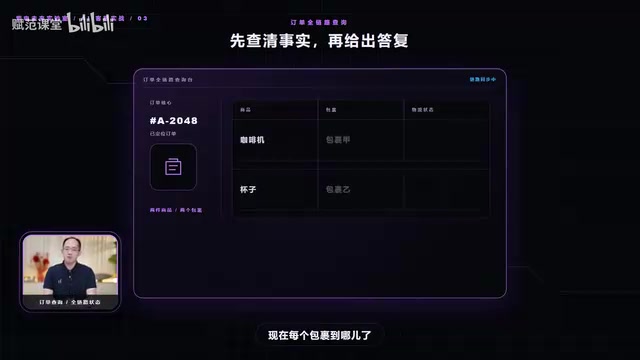
Imagine a real-world scenario: a customer orders a coffee maker and a matching set of cups. The coffee maker arrives, but the cups are nowhere to be found. They contact customer service and ask, "Why haven't my cups arrived yet?" A bot that only knows how to say "Let me look into that" provides virtually zero value here.
An AI customer service system that can actually function within an enterprise's business processes needs to complete an entire chain of actions on its own: locate the order, identify exactly which items were purchased, determine how those items were split into shipments, track where each shipment currently stands, look up the relevant business rules when necessary, and only then deliver a reliable answer.
This requires a complete end-to-end development pipeline — not just plugging into a large language model API. This article is based on a practical enterprise AI customer service course by a Bilibili content creator, outlining the full design from user query to automated response and exception escalation to human agents.
How the Agent Works Through the Problem Step by Step
The entire workflow is driven by an Agent. Starting from the user's question, it processes the request layer by layer: first querying the order, then examining the relationships between the customer, products, and logistics, and finally calling RAG to retrieve relevant business rules and source documentation when needed.
The key here is working in steps, with supporting evidence. The Agent doesn't dump everything into a single large prompt and hope for the best. Instead, it breaks the problem down level by level, just like a real customer service representative following business logic. Querying an order is a structured data operation; tracing the relationships between products and shipments depends on data associations; and explaining "why it's being handled this way" requires going back to the business rules documentation.
In terms of engineering, the Agent integrates various capabilities through mechanisms like tool calling, MCP, and skills. Whether to query the database directly, traverse a relationship graph, or use semantic search is determined dynamically by the Agent based on the current step.
Tool Calling is a capability supported by most mainstream large language models (such as GPT-4 and Claude): the model can proactively declare during response generation that it needs to call a specific tool with certain parameters, and an external program executes that call and returns the result so the model can continue its reasoning. MCP (Model Context Protocol) is an open protocol proposed by Anthropic to standardize the communication interface between AI models and external tools or data sources, allowing tools from different origins to be connected to an Agent in a unified way. Skills are encapsulations of a set of tool-calling logic within an Agent framework, representing a reusable business capability (such as "query shipping status"). The relationship between the three can be understood as follows: Tool Calling is the underlying mechanism by which the model interacts with the outside world; MCP is the communication protocol that standardizes that interaction; and Skills are the business-oriented functional modules built on top. It is precisely this mechanism that allows an Agent to dynamically choose between querying a database, traversing a relationship graph, or performing semantic search at each step — rather than stuffing all the information into one giant prompt.
How Ontology and RAG Divide the Work
One of the most conceptually tricky points in the course is understanding what Ontology and RAG are each responsible for, and how they work together.
When to Use Each Query Method
- Structured queries: Best for precise, field-based data like order details and shipping status.
- Relationship retrieval: Handles the associations between orders, customers, products, and packages. This is where Ontology shines — it models business entities and the relationships between them, allowing the system to "traverse the graph" and follow connections.
- Semantic retrieval (RAG): When natural language understanding is needed, or when business rules and source documentation must be surfaced, RAG finds the most relevant document chunks.
In short, Ontology is responsible for clarifying "who is related to whom and how," while RAG is responsible for surfacing "what the rule actually says." They are not substitutes for each other — they each do their job at different stages, working together to give the Agent what it needs to make accurate decisions. This combination is exactly what sets enterprise-grade systems apart from a basic Q&A chatbot.
Ontology is a technology for formally modeling domain knowledge. It defines entity types in a business domain (such as orders, customers, products, and packages) as well as the types of relationships between them (such as "belongs to," "contains," and "corresponds to"). In an e-commerce customer service context, a single order might be split into multiple packages, each package associated with different products, and each product having its own logistics tracking — this kind of multi-layered relationship is difficult to express cleanly in a single SQL query. Ontology allows the system to pre-model these relationships as a graph structure, so that during a query, the system can "walk the edges" of a knowledge graph, starting from the user's question and progressively finding the related data it needs. This is fundamentally different from how RAG works: RAG (Retrieval-Augmented Generation) chunks unstructured documents, vectorizes them for storage, and retrieves the most semantically similar text fragments when needed — well-suited for questions like "What is the company's return policy?" that require understanding natural-language rules. The core distinction is: Ontology handles structured relationship networks, while RAG handles unstructured text semantics.
Exception Handling: Knowing When to Stop
The most telling sign of a well-engineered enterprise AI customer service system is often not how it handles smooth cases, but how it handles exceptions.
A classic example: the system clearly shows an order as "delivered," but the customer insists they never received it. What should the AI do? Can it issue a refund automatically? Reship the order on its own? Or should it pause and let a human take a look first?
The design the course recommends is this: when information doesn't add up, or when the AI cannot make the decision on its own, the process proactively pauses and hands control to a human agent. Once the human confirms, the Agent picks up from where it left off.
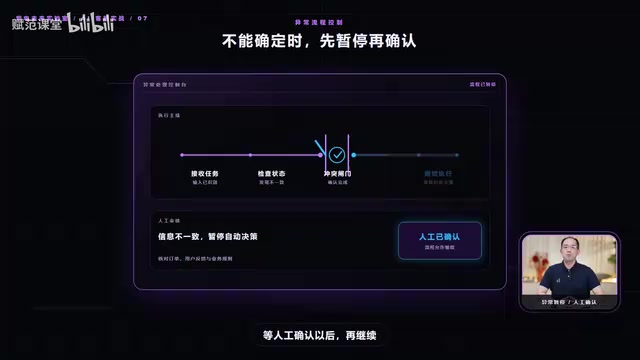
This "stop when needed, resume after confirmation" mechanism is the dividing line between an AI customer service system that's a toy and one that's actually usable in production. It means the system has a clear understanding of its own limitations and won't act rashly on high-stakes decisions (like issuing refunds or reshipping orders), striking a balance between automation efficiency and business safety.
What Gets Delivered Is a Process, Not a Chatbot
Putting all these capabilities together, what you end up with is not a bot that just makes small talk — it's a complete enterprise AI customer service workflow that can query orders, find supporting evidence, generate responses, handle exceptions, and — critically — knows when to stop and hand off to a human.
For teams looking to deploy enterprise AI customer service, this pipeline offers some clear takeaways:
- The large language model is just one link in the chain; the real challenge lies in how business data is organized and orchestrated.
- Ontology, RAG, and the Agent must work in concert, not in isolation.
- Human review is not a system failure — it's a necessary safety net.
According to the course creator, the course comes with a complete project flowchart, documentation on how RAG and Ontology work together, Agent integration guidance, and full source code — designed to let developers learn by building and actually run the entire pipeline end to end.
Summary
The value of enterprise AI customer service isn't in how smoothly it converses — it's in whether it can truly integrate into business operations, retrieve accurate information, handle cases reliably, and know when not to act on its own. RAG finds the supporting evidence, Ontology maps out the relationships, the Agent orchestrates the decisions, and human review catches the edge cases. All four working together form an enterprise-grade AI customer service development pipeline that can actually be deployed in production.
Related articles

Claude Reportedly Able to Hide Secret Messages in Benign Images
A Reddit post claims Claude Fable 5.1 can hide secret messages in benign images. This article reviews the background, image steganography principles, and potential security risks, and suggests a testing path from rumor to verification.

Federal Government Awards $85 Million; CFS to Develop Fusion-Specific Semiconductors
The federal government awards $85 million to Commonwealth Fusion Systems to develop conductors and power semiconductors for fusion plants. This article analyzes the significance of this funding for the fusion supply chain and commercialization path.

When Should AI Assistants Proactively Suggest? Timing Is Everything
When should AI assistants proactively suggest? Reddit discussion reveals: the same suggestion feels different at different times. This article analyzes the dual nature of proactive suggestions, the boundary of user expectations, and design principles, exploring how to balance automation and user control.