Enterprise AI Moves Beyond the Demo: Real Business Deployment Is the True Test

Enterprise AI enters the hard part: moving from flashy demos to reliable, accountable real-world deployment.
The Snowflake World Tour tech session reflects a key inflection point: enterprise AI conversations have shifted from "what can models do" to "how do they run reliably in real business." Code models generate front-ends fast but struggle with backend logic and maintainability. DiDi Xia's in-car AI has evolved into a cross-platform agent. Shopify CEO Lütke's "garbage grenade" warning exposes how unchecked AI outputs shift costs downstream. Meanwhile, awesome-jet-tools offers a local-first, privacy-controlled open-source toolkit. The real challenge now is quality control, accountability, and system integration — not raw capability.
When AI Moves from Demo to Real Business
Enterprise AI is undergoing a pivotal shift — from flashy product demonstrations to being genuinely embedded in day-to-day workflows. At the Snowflake World Tour technical session, over a dozen tech leaders stopped debating how advanced the technology is and refocused the conversation on what happens after deployment: once AI actually enters the workflow, what changes does it bring, and how does it reshape the way companies really work?
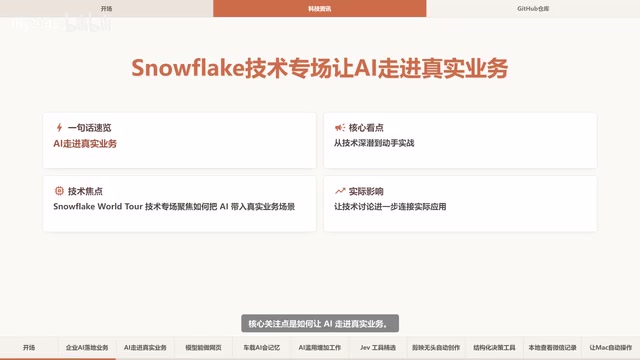
This shift reflects the industry's maturity. Over the past two years, the market has been flooded with AI demos repeatedly showcasing what models can do — but there's often a wide gap between capability and reliably delivering business outcomes. This session expanded its scope from technical depth to hands-on practice, with a single core question: how do you get AI to actually work in real business, and close the gap between technical understanding and practical application?
Can Code Models Handle Product Development End to End?
Claude 3.8 demonstrated impressive speed in generating web pages — handling everything from UI design to front-end implementation in one shot. But the demo also exposed a sharp limitation: the backend wasn't keeping pace.
This brings a familiar question back to the forefront — can code models truly handle full product development independently? Front-end page generation is relatively accessible for models because it has clear visual feedback and predictable patterns. But backend logic, data consistency, system architecture, and long-term maintainability are where software engineering gets genuinely hard. The trade-off between speed, quality, and maintainability remains a fundamental tension that today's AI coding tools cannot avoid. Fast doesn't necessarily mean usable; generating code doesn't necessarily mean maintaining it.
In-Car AI Steps Up to Agent-Level: The Ambitions of DiDi Xia
In-car AI is evolving well beyond simple voice assistants, moving toward genuine AI agents. DiDi Xia is a prime example — it already offers a suite of ecosystem services including music playback, short video browsing, food delivery, and hotel booking, along with companion chat, customizable personas and skills, and voiceprint recognition that remembers user preferences and important reminders.
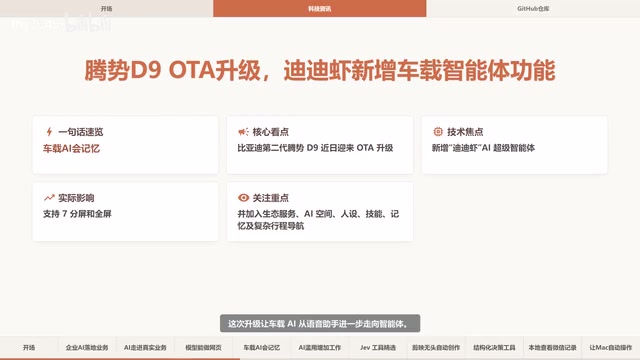
Even more notable is its navigation agent, which supports complex multi-stop route planning while integrating with partners including Qianwen, Doubao, Fliggy, Gaode Maps, Taobao Flash Purchase, and Tingtingmusic. This means in-car AI is no longer an isolated feature module — it has become a central hub connecting mobility, consumption, and entertainment ecosystems. When AI can understand context, invoke third-party services, and proactively complete tasks, it has evolved from a tool into an agent.
The core distinction between an "AI Agent" and a traditional voice assistant lies in autonomy and tool-calling capability. Traditional voice assistants (like early Siri or Xiao Ai) are essentially command routers — they receive voice input, match intent, and return fixed results, with no ability to complete multi-step tasks across systems. AI agents, by contrast, have planning capabilities: they can decompose a complex goal into subtasks, sequentially invoke different external APIs or services (maps, e-commerce, music platforms), and dynamically adjust execution based on intermediate results. The in-car scenario is especially well-suited to this evolution — drivers have limited hands and attention, requiring AI to proactively handle more "agent" work rather than demanding precise step-by-step instructions. Multi-platform integration (Qianwen, Doubao, Gaode, etc.) also signals that in-car AI is beginning to play the role of a "super entry point," with commercial value no longer tied to the hardware itself, but to aggregating and distributing ecosystem traffic.
"Garbage Grenades": How AI Misuse Shifts the Burden
A thought-provoking change comes from Shopify co-founder and CEO Tobias Lütke. Having once mandated that employees treat AI usage as a baseline expectation, he is now openly criticizing unchecked AI-generated emails and code.

He coined the term "garbage grenade" to describe it — a reminder that if AI simply tosses rough outputs at others to review, it doesn't improve productivity at all. Instead, it creates more work by transferring the burden of review and error correction to the recipient. This observation cuts to a widespread misconception in AI adoption: productivity gains cannot be built on the foundation of shifting costs downstream. Truly responsible AI use means the user is accountable for the quality of the output — not using AI as an excuse to pass the buck.
The "garbage grenade" metaphor carries deeper meaning in organizational behavior. When a tool lowers the barrier to producing output without simultaneously raising quality standards, a "cost-shifting" phenomenon emerges: the producer saves time, but the review burden is silently pushed onto the recipient. This mirrors the logic of "technical debt" in software engineering — short-term acceleration creates long-term maintenance burdens. Lütke's warning signals that Shopify is shifting from "mandate AI adoption" to "require responsible AI use" — a classic maturity arc in enterprise AI governance: from broad rollout to establishing quality norms. For organizational leaders, simply requiring employees to use AI isn't enough. It must be paired with output quality standards and accountability mechanisms, or AI tools will actually dilute the team's overall output quality.
awesome-jet-tools: A Curated Open-Source Collection for Local AI
A curated toolkit for the JET ecosystem — awesome-jet-tools — has launched a new open-source release with 1,527 stars. It focuses on typed decision-making, helping creators quickly discover and apply practical tools. The core philosophy emphasizes local AI decision-making, combining llama.cpp, LocalAI, and TypeScript for real-world creative scenarios.
Several tools stand out:
- JET Local Viewer: A local WeChat chat history viewer supporting conversation browsing, full-text search, multi-format export, and optional LLM-powered intelligent summarization — all with no external dependencies and data that never leaves your device.
- JET vs DevUse: Lets you control your Mac using natural language, reading the interface via system accessibility features and executing actions — no vision model required, making it quick to build AI agents.
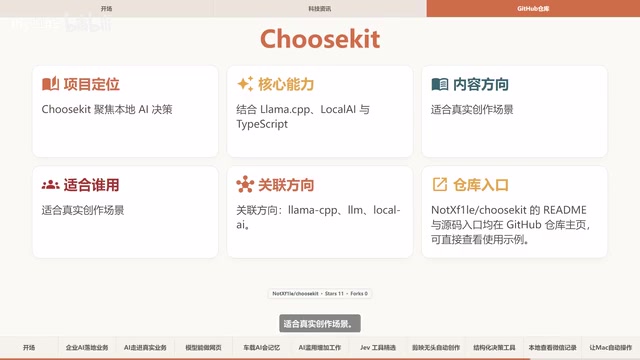
What these tools share is a local-first, privacy-controlled approach. In the broader context of enterprise AI deployment, local deployment capability is becoming increasingly important — it addresses data security concerns while bringing AI capabilities closer to specific creative and development workflows.
llama.cpp is an open-source inference framework developed by Georgi Gerganov. Its core contribution is dramatically reducing the memory footprint and compute requirements of large language models through quantization — compressing model weights from 32-bit floating point to low-precision formats like 4-bit integers — enabling models that previously required high-end GPUs to run locally on consumer-grade CPUs or laptops. LocalAI is an OpenAI API-compatible local server built on backends like llama.cpp, allowing developers to seamlessly switch existing code that calls cloud-based GPT to local models with minimal changes. Together with the TypeScript ecosystem, they form a "no cloud, no GPU, privacy-controlled" local AI development path — particularly critical for tools handling sensitive data such as WeChat chat histories.
Conclusion: Deployment Is the Real Dividing Line
From the hands-on discussions at the Snowflake session, to the capability boundaries of code models, to the "garbage grenade" warning — today's developments all point to the same theme: enterprise AI has moved past the demo competition. The next race is about who can genuinely embed AI into their business, maintain quality, and own accountability. No matter how impressive the technology, it ultimately has to answer one question — can it reliably do the job in the real world?
Related articles

Workbuddy for Absolute Beginners: How a Desktop AI Agent Fits Into Real Workflows
A beginner's guide to the Workbuddy desktop AI agent: installation, claiming credits, file management, and building automated workflows—compared with CodeX for fit and cost, helping professionals shift from AI question-askers to AI managers.

OpenAI's New Agent Stack: Computer Use, Decisions API, and Ultra-Fast Workflows
OpenAI Dev Day unveiled a new agent stack: Computer Use outperforms humans, Decisions API delivers ultra-low-latency classification via Luna, Agents API opens the same Computer Use capabilities, and GPT-6.1 Sol costs only one-seventh of Astra. Core updates, benchmark data, and developer insights.

Liang Wenfeng Open-Sources DeepInfo Inference Framework, Takes On U.S. Ban
DeepSeek open-sources its DeepInfo inference framework after its models, featuring GPU/CPU cross-pipelining, small-model prediction with large-model verification, and full Huawei Ascend and NVIDIA chip support—facing the U.S. federal ban head-on. This article analyzes its significance for AI deployment and open-source strategy.