Enterprise LLM Selection Guide: In-Depth Comparison of Llama 3.1, Qwen 2.5, and DeepSeek

Enterprise guide for selecting and deploying open-source LLMs with a structured decision framework
This article provides a horizontal comparison of mainstream open-source LLMs including Qwen 2.5, Llama 3.1, DeepSeek, and Mistral across three dimensions: model capabilities, hardware requirements, and business scenarios. It argues that enterprise selection should address three core questions: business language determines the base model (Qwen for Chinese, Llama for English), hardware resources determine parameter specifications (considering VRAM and quantization), and operational capability determines deployment approach. The article offers technical decision-makers a systematic selection framework.
Why Do Enterprises Need to Take LLM Selection Seriously?
With the rapid development of large language model technology, more and more enterprises are considering on-premise deployment of open-source LLMs to meet requirements for data security, customization, and cost control. On-premise deployment refers to running a complete large model on the enterprise's own or managed servers, where data never passes through any third-party cloud API — this is particularly critical in industries with strict data compliance requirements such as finance, healthcare, and government. Compared to calling cloud APIs, the advantages of on-premise deployment include full data sovereignty, the ability to deeply customize based on business data, and controllable long-term costs. However, the challenges are equally significant: enterprises need to build their own GPU infrastructure, maintain professional model operations capabilities, and continuously keep up with model iterations from the open-source community.
With so many open-source models available on the market — Llama 3.1, Qwen 2.5, DeepSeekAd, Mistral, and more — how should enterprises make the right selection decision?
This article provides an in-depth comparative analysis of mainstream open-source LLMs across three dimensions: model capabilities, hardware requirements, and business scenarios, helping technical decision-makers quickly identify the model solution best suited to their business needs.
Horizontal Comparison of Mainstream Open-Source LLM Capabilities
Several open-source models deserve special attention for enterprise-grade applications. Each model has its own strengths when evaluated across dimensions such as parameter count, coding ability, Chinese language support, and multilingual capabilities.
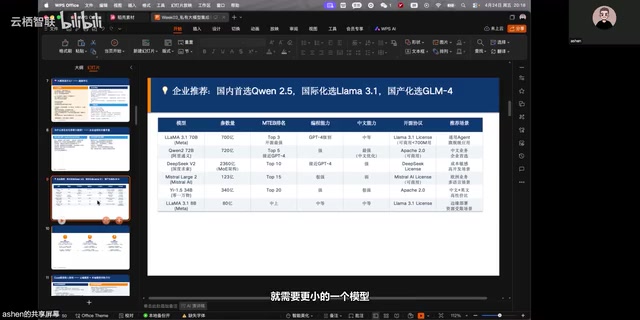
Qwen 2.5: Top Choice for Chinese Business Scenarios
For domestic enterprises, Qwen 2.5 is currently the top recommended model for Chinese-language business. It excels in Chinese comprehension and generation, with the 72B version being particularly impressive. In actual deployment, the 7B version can be used for inference, while the smaller 1.5B version can be chosen for fine-tuning to reduce resource consumption. This flexible parameter specification design allows enterprises of different scales to find a solution that fits their needs.
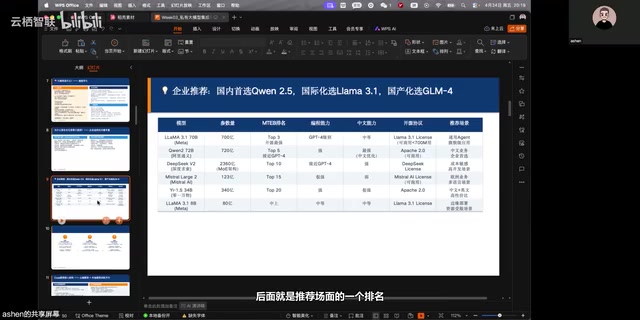
Llama 3.1: Flagship Model for General-Purpose Agent Applications
Meta's Llama 3.1 is positioned as a flagship model for general-purpose agents, delivering outstanding performance in English-language scenarios. It offers multiple parameter versions ranging from 8B to 405B, covering the full spectrum from edge deployment to data center needs. The 405B version requires approximately 640GB of VRAM for full loading and execution, imposing substantial hardware requirements, but it truly achieves top-tier open-source model performance in terms of overall capabilities.
DeepSeek: A Powerhouse for High-Concurrency Enterprise Scenarios
DeepSeek employs a MOE (Mixture of Experts) architecture, giving it unique advantages in enterprise-grade high-concurrency scenarios. MOE is a sparse-activation neural network design paradigm whose core idea is to split the model into multiple "expert" sub-networks, activating only a small subset of experts during each inference pass rather than activating all parameters like dense models do. Taking DeepSeek-V2 as an example, its total parameter count reaches 236B, but only approximately 21B parameters are activated per inference — maintaining model capacity while dramatically reducing the computation required for each inference pass. This is precisely why it achieves higher throughput efficiency in high-concurrency scenarios. Although the overall deployment cost is relatively high, the MOE architecture's characteristics make it more efficient when processing large volumes of concurrent requests. The DeepSeek team provides very candid analysis of their strengths and weaknesses in their technical reports, an pragmatic attitude that has earned high regard from the developer community.
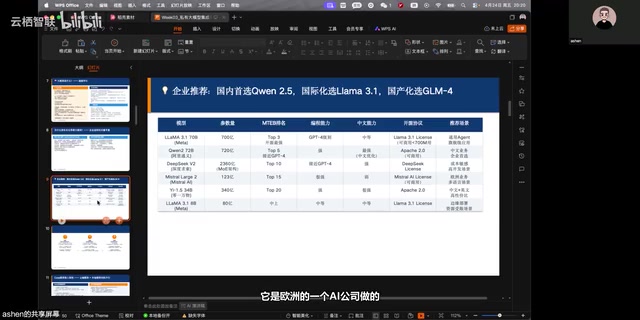
Mistral: The Choice for Multilingual International Scenarios
Mistral is a European AI company whose models perform well in multilingual support. Its early conversational capabilities were quite impressive, but during the rapid iteration phase of multimodal, Skills, and Agent capabilities, Mistral's development pace has relatively slowed. However, for European or international business scenarios with multilingual requirements, it remains a worthy option to consider.
Other Notable Open-Source Models
- Zhipu GLM: A solid choice among domestic models with well-rounded capabilities
- 01.AI: Chinese-English bilingual support with lower deployment costs
- Llama 3.3 8B: A lightweight solution suitable for edge deployment and resource-constrained scenarios
Three Core Questions for Enterprise LLM Selection
When selecting a large language model, enterprises need to systematically consider the following three key questions:
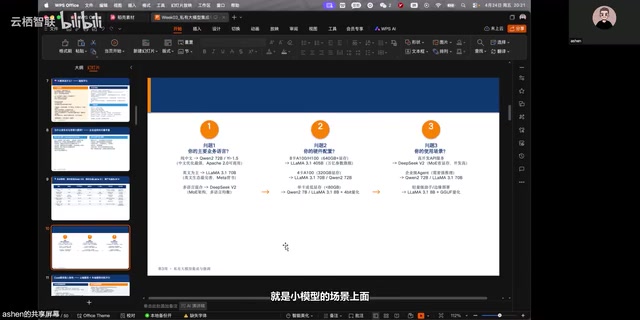
Business Language Determines the Base Model
Language requirements are the primary consideration in model selection:
| Language Requirement | Recommended Model |
|---|---|
| Chinese only | Qwen 2.5 |
| English only | Llama 3.1 |
| Multilingual | DeepSeek / Mistral |
This criterion is straightforward — a model performs best in whatever language its training data is most abundant. Qwen's extensive Chinese corpus makes it the undisputed choice for Chinese scenarios, while Llama 3.1 clearly leads in English capabilities.
Hardware Resources Determine Parameter Specifications
Hardware configuration directly determines how large a model can be deployed. Using the enterprise-common A100/H100 GPUs as examples:
- Single A100 (80GB VRAM): Can run 7B-13B class models
- 4x A100 (320GB VRAM): Can run 70B class models
- 8x A100 (640GB VRAM): Can run ultra-large models like Llama 3.1 405B
The conversion relationship between model parameters and VRAM is fundamental knowledge enterprises must master. Generally speaking, each billion parameters requires approximately 2GB of VRAM at FP16 precision. Notably, additional VRAM must be reserved for KV Cache during inference — KV Cache is a core inference optimization mechanism in the Transformer architecture that caches attention key-value pairs of historical tokens in VRAM to avoid redundant computation. However, its memory footprint grows linearly with sequence length and concurrent batch size, potentially becoming a VRAM bottleneck in long-context or high-concurrency scenarios. Therefore, actual VRAM requirements are often higher than estimates based solely on parameter count.
Through quantization techniques (such as INT4/INT8), VRAM requirements can be significantly reduced. Quantization is the technique of compressing model weights from high-precision floating-point numbers (FP16) to low-precision integers: INT4 quantization can theoretically compress VRAM usage to one-quarter of FP16, with commonly used tools including GPTQ, AWQ, GGUF, etc. The trade-off of quantization is a slight decrease in model accuracy, which is usually within acceptable ranges, but careful evaluation is needed for high-precision tasks such as mathematical reasoning and code generation.
Operational Capability Determines Deployment Approach
On-premise deployment is more than just "getting the model running"
Related articles
Meta Muse Hits 900K Downloads in Six D…
Meta Muse Hits 900K Downloads in Six Days: The AI Agent Era Has Officially Arrived
Meta's AI agent Muse hit 902K downloads in 6 days, topping US App Store and Google Play charts above ChatGPT and Claude. A deep dive into Muse's capabilities and the AI Agent race.
 Industry Insights
IRS Fully Embraces Claude AI, Accelerating Federal Government's AI Adoption
The IRS is recruiting staff with 24/7 Claude AI access, marking Anthropic's breakthrough into the federal government. Explore the strategic implications and tax use cases.
 Industry Insights
The IRS Mobile App Debate: A Trust Crisis in Government Digital Transformation
The IRS's proposed mobile app has sparked heated debate. This article analyzes the core arguments, exploring data security, privacy, and the trust crisis in government digital transformation.