Enterprise RAG Knowledge Isolation in Practice: Physical Isolation vs. Adaptive Soft Boundaries

Comparing physical isolation vs. adaptive soft boundaries for enterprise RAG knowledge management across departments.
This article compares two enterprise RAG knowledge isolation approaches: physical isolation (separate vector stores per department) and adaptive soft boundaries (single store with metadata filtering and user profiles). It covers three-path hybrid retrieval architecture, chunking strategies, and why data cleaning is the most critical factor in production RAG deployments.
Article Content
When building enterprise-grade RAG (Retrieval-Augmented Generation) systems, knowledge isolation across multi-department, multi-scenario environments is a critical factor that determines the success or failure of the entire system. A technical content creator on Bilibili systematically compared two mainstream knowledge isolation approaches — physical isolation and adaptive soft boundaries — in their enterprise RAG tutorial series, providing actionable architecture designs. This article summarizes and analyzes that practical methodology in depth.
Technical Background: What is RAG? RAG (Retrieval-Augmented Generation) is a technical paradigm introduced by Meta AI in 2020. Its core idea is to retrieve relevant document chunks (called "context") from an external knowledge base in real time when a user asks a question, then inject those chunks into the LLM's prompt to assist in generating an answer. This mechanism effectively addresses three key challenges: ① bridging the gap caused by an LLM's knowledge cutoff date; ② significantly reducing model hallucinations (confidently stating incorrect information); ③ enabling secure integration of enterprise private-domain knowledge without retraining the model. For these reasons, RAG has become one of the most widely adopted technical approaches for enterprise AI deployment.
Two Isolation Approaches: Physical Isolation vs. Adaptive Soft Boundaries
Enterprise knowledge bases often span multiple departments or business scenarios. In the medical domain, for example, a medical Agent's knowledge base might cover multiple departments, each with its own specialized documents and case data. Preventing cross-department retrieval interference is a core engineering challenge when deploying RAG in production.
Approach 1: Physical Isolation
Physical isolation establishes a separate, independent vector store for each department or unit. A "scene classifier" first determines which scenario a user's query belongs to, then routes it to the corresponding knowledge base for retrieval. The tutorial implements this scene classifier using an "LLM + keyword" approach.
Vector Database Overview A vector database is the core infrastructure of a RAG system. It works by converting text into high-dimensional numerical vectors using an Embedding model (e.g., OpenAI's text-embedding-ada-002, or domestic options like the BGE series), then using Approximate Nearest Neighbor (ANN) algorithms (such as HNSW or IVF-Flat) to efficiently retrieve semantically similar content at scale. Popular vector databases include open-source options like Milvus, Qdrant, and Weaviate, as well as cloud services like Pinecone and Zilliz Cloud. In a multi-store physical isolation architecture, each independent vector store covers a smaller search space, giving ANN algorithms a natural advantage in both recall precision and retrieval speed.
Advantages of Physical Isolation:
- Hot-update friendly: Updating documents for one department only requires rebuilding that store's index, leaving other stores unaffected
- Better retrieval performance: Smaller search scope means faster response times
Shortcomings of Physical Isolation:
- Routing pressure scales with scenario growth: As the number of departments or scenarios increases, the system must sequentially complete intent recognition, scene classification, and routing — noticeably lengthening the entire response pipeline and degrading user experience
Approach 2: Adaptive Soft Boundaries (Logical-Layer Isolation)
To address the limitations of physical isolation, the tutorial introduces a second approach — adaptive knowledge boundary recognition, also referred to as "soft boundaries" or "logical-layer isolation."
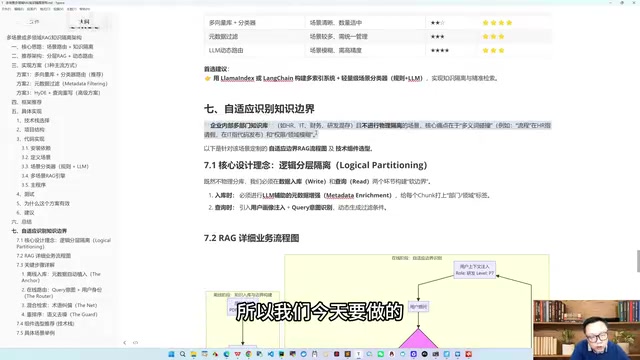
The fundamental difference from physical isolation is this: all department documents are stored in a single unified vector store with no physical partitioning. Isolation is achieved through logical mechanisms instead. This architecture is particularly well-suited for multi-department enterprise collaboration scenarios — for example, consolidating knowledge from Product, HR, IT, and Marketing into a single knowledge base.
Core Pain Points of Soft Boundaries and How to Solve Them
The biggest risk with single-store storage is hallucinations triggered by polysemous term collisions. A typical example: when a user asks about a "process," it could mean a leave-of-absence procedure in an HR context, or a code release/deployment pipeline in an IT context. Without isolation, retrieval results from different contexts can intermingle, producing seriously incorrect answers.
Soft boundary implementation relies on two critical steps:
- Data augmentation at ingestion time: Each document chunk is tagged with metadata labels that explicitly indicate its department or product line
- Dynamic filtering at query time: A "user profile" mechanism identifies the current user's affiliation (Product, IT, Marketing, etc.), combines it with intent recognition to dynamically generate filter conditions, and precisely scopes the retrieval range within the shared store
Metadata Filtering: The Technical Foundation of Soft Boundaries Metadata filtering is one of the core capabilities of modern vector databases. It allows structured conditional constraints to be applied alongside semantic similarity search. In Qdrant, for example, you can specify filter conditions such as
{"department": "HR", "product_line": "ERP"}at query time — the system first narrows the candidate set using metadata, then runs ANN vector retrieval within that scope. This "filter-first, then retrieve" or hybrid filtering strategy makes a single vector store logically equivalent to multiple isolated sub-stores, while eliminating the complexity of a routing layer. The user profile system automatically obtains a user's department affiliation through enterprise authentication mechanisms like JWT tokens or SSO single sign-on, eliminating the need to declare it manually each time and enabling dynamic injection of filter conditions.
Full Architecture: Offline and Online Phases
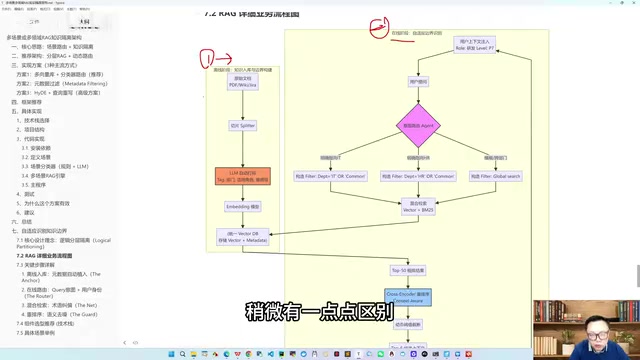
The complete adaptive RAG architecture is divided into two phases: offline (data processing) and online (query handling).
Offline Phase: Data Quality Is the First Gating Factor
The offline phase starts with raw documents from each department. Before entering the chunking (splitter) pipeline, there is a repeatedly emphasized core step — data cleaning.
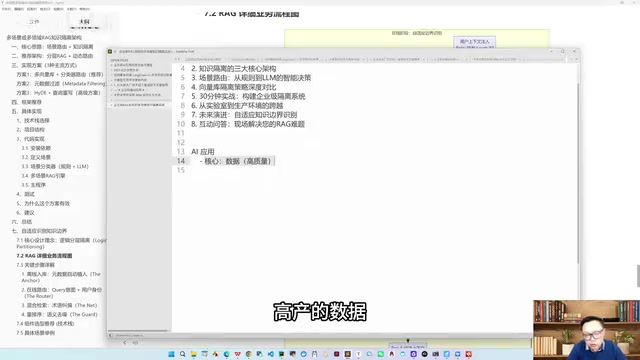
"The most critical factor in whether an AI application succeeds is the data — and it must be high-quality data."
This point deserves to be top of mind for every RAG developer. The classic principle of Garbage In, Garbage Out is especially pronounced in RAG scenarios. Because LLMs are highly "compliant" — they will do their best to generate an answer based on whatever context is retrieved — even if that context contains errors, contradictions, or formatting issues, the model will still produce a response that appears plausible but is actually wrong. Whether building agents, knowledge bases, or training large models (pre-training, SFT), a high-quality dataset always comes first.
Core Data Cleaning Operations in RAG Enterprise source documents come in diverse formats (PDF, Word, Excel, HTML, scanned documents, etc.), and data cleaning must cover several layers: ① Format normalization — convert all formats to structured text, handling tables and text embedded in images (OCR); ② Noise removal — strip headers, footers, watermarks, duplicate paragraphs, and garbled characters; ③ Content deduplication — apply semantic deduplication to highly similar document chunks to avoid redundant stacking in retrieval results; ④ Freshness management — flag or remove outdated policies, pricing, or version information to prevent historical data from contaminating current answers. In large enterprise deployments, this process often requires deep involvement from data governance teams and is typically the most labor-intensive phase of any RAG project.
After data cleaning, a manual review, proofreading, and validation step is required to ensure the accuracy of ingested data as much as possible. In practice, this step consumes the most human effort — but it cannot be skipped.
Chunking and Multi-Path Hybrid Retrieval Construction
Once data processing is complete, the pipeline moves to the chunking stage. Chunking strategy has a direct impact on RAG quality — chunks that are too large introduce excessive irrelevant content that dilutes key information, while chunks that are too small lose contextual semantic integrity. Common strategies include fixed-length chunking (with a sliding window), recursive chunking based on semantic boundaries, and hierarchical chunking for structured documents (e.g., splitting by chapter and paragraph). In production practice, chunk size is typically set between 256–1024 tokens, with a 10–20% overlap to prevent semantic fragmentation at boundaries.
Production-grade RAG systems typically do not rely on a single retrieval method. Instead, they build three-path hybrid retrieval capabilities:
| Retrieval Method | Implementation | Core Advantage |
|---|---|---|
| Vector Search | Chunk vectorization + semantic retrieval | Understands semantic similarity; handles fuzzy queries |
| Knowledge Graph (KG) | Graph built from entities and relationships | More comprehensive answers; excels at relational reasoning |
| Keyword Inverted Index | Built with ElasticSearch or similar | Exact matching; prevents semantic drift |
Fusion Mechanism for Three-Path Hybrid Retrieval Merging results from three retrieval paths is not a simple aggregation — it requires a dedicated rank fusion algorithm. The current mainstream approach is RRF (Reciprocal Rank Fusion): for each document, take the reciprocal of its rank in each retrieval path's result list and sum those values, then re-rank by total score. RRF's key advantage is its insensitivity to the different score scales across retrieval paths, eliminating the need for complex normalization. Additionally, Knowledge Graphs are particularly well-suited in enterprise RAG for handling multi-hop reasoning queries such as "Who is the target audience for Product XX? How is it related to Product YY?" — graphs explicitly model entities (products, people, processes) and their relationships, allowing an LLM to trace associated information along graph structure paths. Pure vector retrieval often falls short on such tasks. Neo4j and NebulaGraph are the leading choices for enterprise-grade graph databases.
In a true production-grade RAG system, all three retrieval paths must be built and fused — semantic search alone lacks precision, knowledge graphs alone cannot cover all scenarios, and only the three-way combination delivers semantic understanding, entity relationships, and exact matching together.
Comparison Summary: Two Approaches Side by Side
| Dimension | Physical Isolation | Adaptive Soft Boundaries |
|---|---|---|
| Store structure | Multiple independent vector stores | Single unified vector store |
| Hot updates | ✅ Friendly — rebuild locally | Requires full-store update |
| Retrieval performance | Small scope, faster speed | Depends on filtering efficiency |
| Scenario scalability | High routing pressure with many scenarios | ✅ Naturally scales to multi-department environments |
| Best fit | Manageable number of scenarios with clear boundaries | Many departments, highly diverse scenarios |
Knowledge isolation in enterprise RAG is not limited to "splitting into separate stores." Physical isolation excels at hot updates and retrieval performance, making it suitable when the number of scenarios is limited. Adaptive soft boundaries, through metadata tagging + user profiles + dynamic filtering, achieve logical isolation within a single store — better suited for enterprises with many departments and complex, diverse scenarios.
Regardless of which approach is chosen, data cleaning and a high-quality dataset remain the single most important factor for RAG success. For teams currently deploying enterprise knowledge bases, this architecture — balancing physical and logical isolation — offers a pragmatic, reusable reference framework.
Key Takeaways
Related articles

Disaster and Glory of the Apollo Program: The History We Must Revisit Before Returning to the Moon
From the fatal Apollo 1 fire to Apollo 8's daring lunar orbit to Apollo 11's successful landing—revisiting the disasters, fears, and compromises of the Apollo program and their lessons for today's return to the Moon.

Netflix Trust Exercise Turns Into Firing Trap: Where Are the Boundaries of Corporate Trust?
A Netflix employee was fired after sharing private info in a trust exercise. We analyze the risks of corporate trust exercises and how employees can protect themselves.

AMD CDNA5 Architecture Deep Dive: Technical Evolution and the AI Computing Competition Landscape
Deep analysis of AMD's CDNA5 architecture covering Chiplet packaging upgrades, HBM memory evolution, and low-precision compute optimization, examining how AMD challenges NVIDIA's AI chip dominance.