Entire CLI: An Open-Source Tool That Automatically Records AI Programming Sessions via Git

Entire CLI auto-captures AI programming sessions via Git hooks, making code generation processes traceable.
Entire CLI is an open-source Go command-line tool that hooks into Git workflows to automatically capture developer interactions with AI programming assistants like Cursor, Copilot, and Claude Code, bidirectionally indexing sessions with Git commits. It solves the "black box" problem where AI-assisted code has results but no recorded process, addressing needs for code review, team knowledge sharing, debug tracing, and enterprise compliance auditing, filling a critical "observability" gap in the AI programming toolchain.
What Is Entire CLI
Entire CLI is an open-source command-line tool that hooks into Git workflows to automatically capture interaction sessions between developers and AI programming assistants (such as Cursor, Copilot, Claude Code, etc.), indexing these sessions in association with Git commit records to create a searchable archive of the code-writing process.
Today's mainstream AI programming assistants each have their own focus: GitHub Copilot started with inline code completion, deeply integrated into IDEs like VS Code and JetBrains, powered by OpenAI's Codex and GPT model series; Cursor is an AI-native editor built on a VS Code fork, supporting multi-model switching and whole-file editing, known for its Composer multi-file editing and Agent mode; Claude Code is Anthropic's terminal-native AI programming tool that runs directly in the command line, excelling at understanding entire codebase context and executing complex multi-step coding tasks. There are also products like Windsurf (formerly Codeium) and Amazon Q Developer. The common thread among these tools is that they drive code generation through natural language conversations, but they generally lack structured export and long-term archiving capabilities for session history—which is precisely the problem Entire CLI aims to solve.
The project is written in Go and has already earned over 4,100 stars and 319 forks on GitHub, with rapid growth momentum that reflects the developer community's strong demand for AI programming traceability.
The "Black Box" Problem in AI Programming
Code Has Results, But No Process
As AI programming assistants like Cursor, Copilot, and Claude Code become widespread, more and more code is produced through human-AI conversations. However, traditional Git commit records only preserve the "results" of code changes while losing the "process"—What questions did the developer ask the AI? What solutions did the AI propose? Why was the current implementation chosen over alternatives?
This contextual information is crucial for code review, knowledge transfer, and team collaboration, yet it's almost entirely absent from existing workflows. This information gap already existed in traditional development—the thought process in a developer's mind was never systematically recorded—but the AI programming era makes this problem far more pronounced, because AI conversations themselves are structured text records that could theoretically be captured and preserved. What's been missing is simply the right tool to incorporate them into the version control system.
Enterprise Compliance Needs for AI-Generated Code
In enterprise environments, understanding the origin and generation process of code is becoming increasingly important. When AI participates in code writing, teams need to know which code was AI-generated, based on what prompts, and through what iterations.
Compliance of AI-generated code has become a new focus of enterprise technology governance. Since 2023, multiple legal disputes over AI code copyright ownership (such as the class-action lawsuit against GitHub Copilot) have drawn widespread industry attention. The EU's AI Act requires transparency and traceability for high-risk AI systems; the US White House's AI Executive Order also emphasizes safety evaluation and provenance tracking for AI systems. In regulated industries like finance, healthcare, and defense, code audit requirements are even stricter—auditors need to understand how code was generated, which models trained on what data were used, and the degree of human developer involvement in the process. Additionally, AI-generated code may inadvertently introduce open-source license conflicts or security vulnerabilities, and recording the complete generation process helps with post-hoc accountability and risk assessment. The session archiving capability provided by Entire CLI offers precisely the technical foundation for these compliance needs.
How Entire CLI Works
Seamless Integration via Git Hooks
Entire CLI's design philosophy is "zero friction"—it runs automatically through Git hooks, requiring no changes to developers' existing coding habits.
Git Hooks are an event-driven mechanism built into the Git version control system, allowing developers to automatically trigger custom scripts before or after specific Git operations (such as commit, push, merge). Common hooks include pre-commit (executed before commit, often used for code formatting checks and linting), post-commit (executed after commit), pre-push (executed before push), and more. Hook scripts are stored in the project's .git/hooks directory and can be written in any executable language. In recent years, tools like Husky and lefthook have made Git Hooks management and team sharing more convenient, establishing them as important infrastructure for modern development workflow automation.
When you execute a normal git commit, Entire CLI automatically performs the following tasks in the background:
- Capture AI sessions: Records the content of currently active AI agent sessions, including prompts you sent to Cursor or Claude Code and the AI's responses
- Associate with Git commits: Indexes the session data in association with the corresponding Git commit
- Build a searchable index: Creates structured records for convenient subsequent querying by keyword or time
Bidirectional Association Between Sessions and Code Changes
The elegance of this design lies in establishing a bidirectional mapping between code changes and AI conversations. You can start from a commit and find the complete AI conversation that produced that code; you can also start from an AI session and see which code changes it ultimately influenced.
The value of this bidirectional association can be compared to foreign key relationships in databases: commits and AI sessions are no longer two isolated datasets but form an interconnected network through indexing. When this network accumulates to a certain scale, it effectively constitutes a "decision log" for the project—recording not only what was done, but why it was done that way.
Technical Characteristics and Ecosystem Position
Go Implementation: Lightweight and Efficient
Choosing Go was a pragmatic decision. Go compiles into a single binary file, making distribution and installation easy, with good cross-platform support and excellent runtime performance that won't slow down everyday Git operations.
Go has become one of the preferred languages for command-line tool development, with well-known projects like Docker, Kubernetes, Terraform, and Hugo all built with Go. Its core advantages include: static compilation produces a dependency-free single binary, allowing users to use it without installing a runtime environment; cross-compilation support lets developers build versions for Linux, macOS, Windows, and other platforms from a single machine; the goroutine concurrency model makes parallel processing of file I/O and network requests clean and efficient; startup speed is extremely fast (millisecond-level), adding no perceptible delay to Git Hook execution. In comparison, CLI tools written in Python or Node.js require users to pre-install the corresponding runtime, and while Rust offers better performance, it has a steeper learning curve. Go strikes a good balance between development efficiency and runtime performance.
Filling a Critical Gap in the AI Programming Toolchain
In the current AI programming tool ecosystem, a large number of products focus on "how to write code better with AI," but very few tools address "how to record and trace the process of AI writing code." Entire CLI fills this gap, positioning itself as the "observability" layer of the AI programming workflow—making the entire process of AI-assisted coding transparent and traceable.
The concept of "Observability" originates from control theory and was later introduced into software engineering, initially applied mainly to operational monitoring of distributed systems. The traditional three pillars of observability include: Logs recording discrete events, Metrics quantifying system state, and Traces reconstructing request paths. Representative tools like Datadog, Grafana, and Jaeger have become standard infrastructure in cloud-native environments. Entire CLI creatively migrates this concept to the development process itself—if traditional observability focuses on "what happens when code runs," then AI programming observability focuses on "what happens when code is written." This paradigm shift means that transparency requirements in software engineering are extending forward from production environments to development environments.
Typical Use Cases
Code Review
Reviewers can examine AI session context to more accurately understand code intent and design decisions, rather than just seeing the final diff. For example, with a complex algorithm implementation, tracing back through the AI conversation reveals which approaches the developer tried and why other options were abandoned. This significantly improves Code Review quality—reviewers no longer need to guess the intent behind the code but can directly read the complete conversation context that produced it, shifting the review focus from "what does this code do" to "is this decision sound."
Team Knowledge Sharing
New team members can quickly understand the project's evolution logic and technology selection background through historical AI sessions, dramatically reducing onboarding time.
Debugging and Issue Tracing
When code has a bug, you can trace back to the AI conversation that produced it, understand the constraints and assumptions at that time, and thus locate the root cause more quickly. For example, the AI may have generated a specific implementation based on a premise described by the developer, and that premise later changed, causing abnormal code behavior. By tracing back through the AI session, developers can quickly identify such "assumption drift" rather than repeatedly investigating at the code level.
Compliance Auditing
Meets enterprise requirements for source tracing and transparency of AI-generated code, reducing intellectual property and security risks.
Future Outlook: The Era of AI Programming Observability
Entire CLI's rapid growth reflects a larger trend: as AI becomes deeply involved in software development, the development toolchain is undergoing a systematic upgrade. Version control is no longer just about managing changes to code text—it also needs to manage metadata about the code generation process.
This trend can be compared to several major paradigm shifts in software engineering history. From manual deployment to CI/CD, from monolithic monitoring to distributed observability, each transition occurred because new engineering practices created new transparency requirements. AI programming is catalyzing similar needs—when the "author" of code shifts from purely human to human-machine collaboration, the metadata dimensions that version control systems need to record must inevitably expand.
It's foreseeable that more tools will emerge around the theme of "AI programming observability," and as a pioneer in this direction, Entire CLI has already secured an advantageous position. For teams that are adopting AI programming tools like Cursor, Copilot, and Claude Code at scale, introducing such process-recording tools early will lay a solid foundation for subsequent code governance and team collaboration.
Key Takeaways
- Entire CLI automatically captures AI agent sessions via Git hooks and indexes them in association with Git commit records, solving the problem of untraceable AI programming processes
- The project is developed in Go with over 4,100 GitHub stars, reflecting strong developer demand for AI programming traceability
- Its core value lies in establishing bidirectional mapping between code changes and AI conversations, supporting scenarios like code review, knowledge sharing, and debug tracing
- It fills the gap of the "observability" layer in the AI programming tool ecosystem, representing a systematic upgrade trend of development toolchains adapting to the AI era
Related articles
 Product Reviews
The Programmer's Desk Setup Guide: Building a Workspace That Feels Like Home
Discover how programmers build productive, comfortable workspaces. From multi-monitor setups to ergonomic design, explore the desk philosophy that drives focus and flow.
 Product Reviews
Qoder vs Cursor Real-World Comparison: Which $20/Month AI IDE Is Better?
Hands-on comparison of Qoder vs Cursor AI IDEs: Agent autonomy, human interaction count, and architecture decisions. Qoder needed only 2 interactions vs Cursor's 8.
 Product Reviews
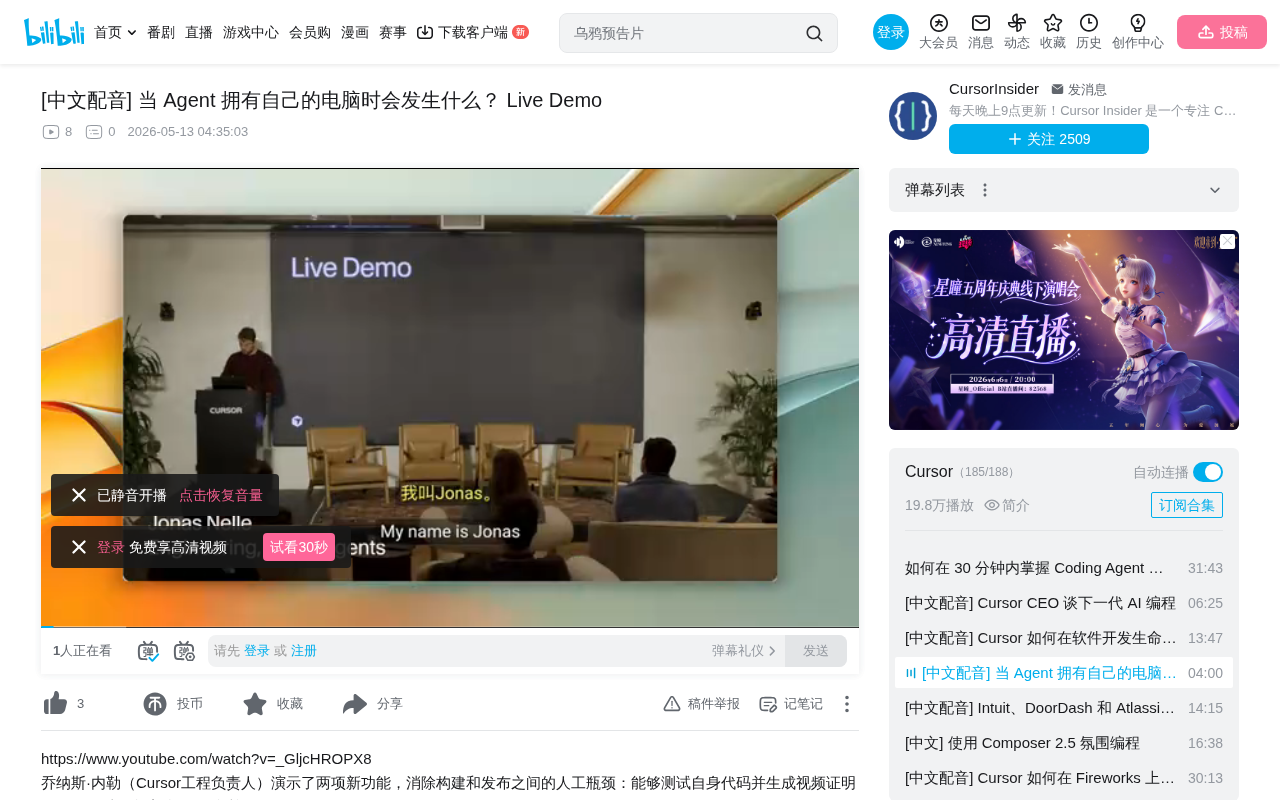
Cursor Cloud Agent Demo: Eliminating Bottlenecks Across the Entire Software Development Lifecycle
Deep analysis of Cursor's Cloud Agent demo showing how cloud VMs, automated test artifacts, and a full-chain control plane systematically eliminate human bottlenecks across the software development lifecycle.