envfix: A Zero-Dependency Node.js .env Configuration Diagnostic Tool

envfix is a zero-dependency CLI that diagnoses .env configuration issues in Node.js projects.
envfix is a zero-dependency Node.js command-line tool that runs instantly via npx envfix to diagnose .env file issues. It detects missing, duplicate, and malformed variables, checks Git safety to prevent secret leaks, syncs .env.example files, and integrates into CI/CD pipelines to catch configuration errors before deployment.
In Node.js development, .env files are a staple of virtually every project — they carry critical configuration like database connection strings, API keys, and environment identifiers. This practice stems from the third principle of the Twelve-Factor App methodology: store config in the environment, strictly separated from code. This idea was proposed by Heroku co-founder Adam Wiggins in 2011 and subsequently became widely standardized in the Node.js ecosystem through the dotenv library (released in 2013, now with over 40 million weekly downloads). However, dotenv only handles "loading" config into process.env — it doesn't "validate" it. It silently ignores format errors and won't warn about missing variables.
This is precisely why this seemingly simple text file often becomes the source of production incidents and debugging nightmares: a single misspelled variable, forgetting to sync the example file, accidentally committing sensitive information to Git… These issues are typically only discovered after a deployment failure or runtime error.
The open-source tool envfix, which recently appeared on Product Hunt, targets exactly this pain point. It positions itself as "a tiny .env doctor" for Node.js projects, helping developers diagnose and fix environment configuration issues in a zero-dependency, out-of-the-box manner.
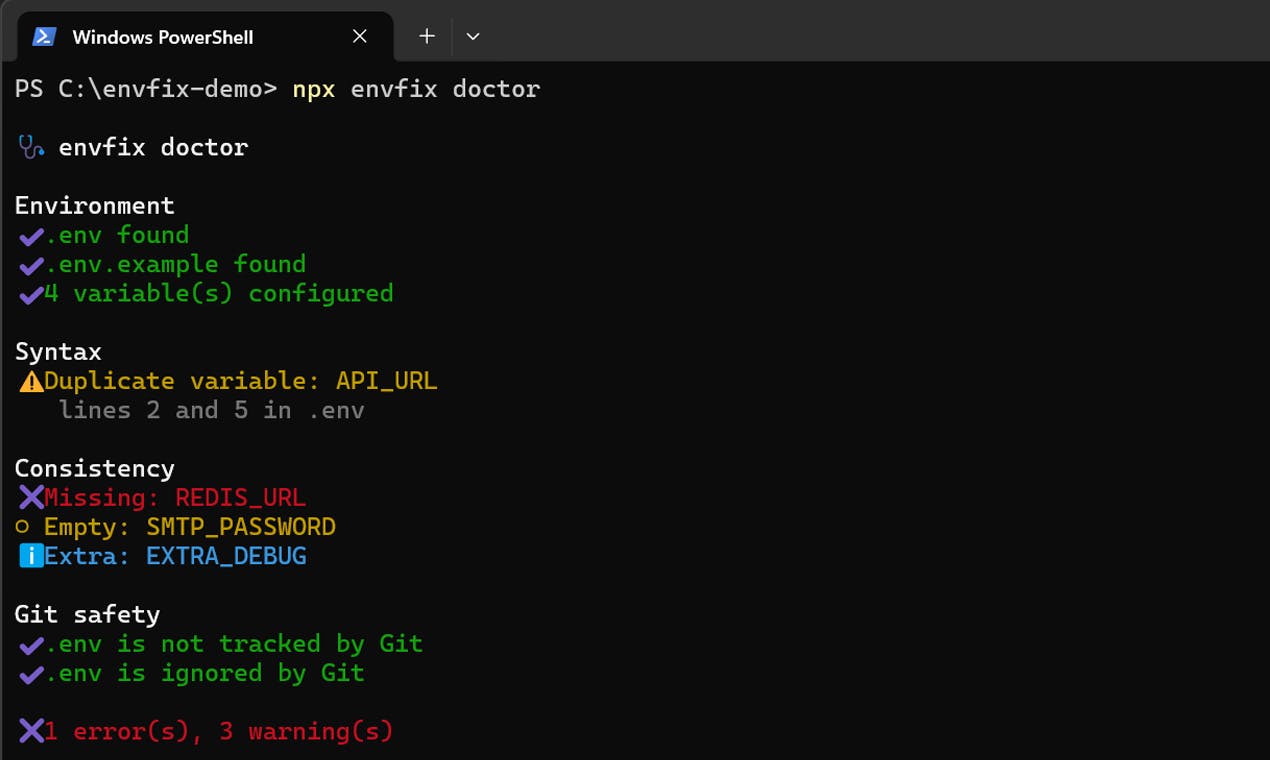
What envfix Is: A CLI Diagnostic Tool Focused on .env Pain Points
envfix is a zero-dependency command-line tool that adds no extra dependency burden to your project. Developers don't need to install anything — just run a single command:
npx envfix
npx is a package execution tool built into npm 5.2+. It allows developers to run CLI commands without globally installing packages. When you run npx envfix, npx temporarily downloads and executes the package, then discards it — it won't pollute your project's node_modules or global environment. This use-and-discard distribution model is increasingly popular among modern CLI tools because it eliminates the mental overhead of version management.
"Zero-dependency" means envfix's package.json has an empty dependencies field — the entire tool is implemented using only the Node.js standard library. This brings two notable advantages: first, installation is extremely fast (no dependency tree to resolve); second, it completely eliminates supply chain attack risks. In recent years, the npm ecosystem has seen frequent malicious dependency injection incidents (such as event-stream and ua-parser-js), and a zero-dependency strategy fundamentally removes this threat surface.
This design fits perfectly into modern developer workflows. Whether in local development environments or CI/CD pipelines, integration is seamless. On Product Hunt, the project was built by Gokhan Ozgezer. After launch, it received 62 upvotes, ranking 16th on the daily leaderboard, categorized under Open Source, Developer Tools, and GitHub.
Why .env Files Need Dedicated Checking Tools
Environment configuration errors typically share several characteristics: they're hard to catch with static analysis, error messages are often misleading, and they're easily amplified in team collaboration when files fall out of sync. Traditionally, developers rely on manual review or runtime errors to locate these issues — an approach that's both inefficient and prone to oversight. envfix's approach is to make these hidden problems visible, intercepting them before they reach the runtime environment.
envfix Core Features in Detail
According to official documentation, envfix covers multiple critical dimensions of .env management. Its features can be grouped into the following categories:
Variable Completeness Detection: Missing, Empty, Extra, and Duplicate
envfix can detect missing, empty, extra, and duplicate environment variables. This is its most core capability — by comparing the actual .env file against an expected variable list (typically using .env.example as the baseline), it quickly identifies configuration items that "should exist but are missing" or "have long been deprecated but still linger."
Duplicate variable detection is particularly valuable because overwritten same-name variables in long files are an extremely subtle source of bugs. Since .env files are essentially key-value pairs parsed line by line, when the same variable name appears multiple times, the later value silently overwrites the earlier one — and dotenv gives no warning. In configuration files spanning hundreds of lines, these issues are virtually impossible to spot with the naked eye.
Syntax and Declaration Format Validation
The tool also catches malformed declarations. Although .env file syntax is simple (one KEY=VALUE per line), issues like extra whitespace, incorrect quotes, missing equals signs, and invisible trailing characters (such as Windows line endings \r) frequently cause variable parsing failures. envfix's checks at this layer act as a "syntax health check" for configuration files — similar to what ESLint does for JavaScript code: catching format-level issues before runtime.
Git Safety Checks: Preventing Key Leaks
This is an extremely practical feature: envfix performs Git safety checks, helping developers confirm whether .env files are properly included in .gitignore. Accidentally committing environment files containing secrets to a code repository is a classic security incident scenario.
The damage from key leaks is not to be underestimated. GitGuardian's 2024 report shows that over 12.7 million leaked secrets (including API keys, database passwords, cloud service credentials, etc.) were detected in public GitHub repositories throughout the year. Once a secret is pushed into Git history, even if the file is subsequently deleted, the secret can still be recovered via git log — meaning costly key rotation operations become necessary. While GitHub itself offers Secret Scanning and tools like GitLeaks can perform pre-commit scanning, envfix approaches from further upstream: it verifies that .gitignore is correctly configured, preventing .env files from entering version control at the source rather than remediating after a leak.
.env.example File Generation and Sync
envfix supports generating and syncing example environment files, commonly known as .env.example. In team collaboration, example files are a key reference for new members to quickly set up their environments — they list all required environment variable names (usually without actual values or with placeholders only), but they frequently fall out of sync with the actual .env. When a developer adds a new environment variable but forgets to sync it to the example file, the next colleague who pulls the code will encounter baffling runtime errors. envfix can automatically generate and keep both files in sync, ensuring documentation stays consistent with actual configuration.
CI/CD Integration: Shifting Environment Checks Left to the Build Stage
envfix explicitly supports both local and CI runtime modes. This means it's not just a local helper tool for developers — it can serve as a quality gate in engineering workflows.
Integrating envfix in a CI pipeline means that before every code commit or deployment, the system automatically validates the completeness and security of environment configuration. If missing variables or Git safety issues are detected, the build can fail early with clear messaging.
This "Shift-Left" error detection strategy is one of the core principles in DevOps and continuous delivery — moving quality verification activities as early as possible in the software development lifecycle. In traditional approaches, environment configuration issues typically only surface when deploying to staging or production, where repair costs are high and blast radius is large. Data from IBM's Systems Sciences Institute shows that defects found in production cost 100 times more to fix than those found during design. Integrating envfix into CI/CD pipelines (such as GitHub Actions, GitLab CI, or Jenkins Pipeline) essentially shifts environment configuration validation from "discovered at runtime" to "intercepted at build time" — following the same logic as ESLint checking code style and TypeScript checking type safety: establishing automated quality gates before code reaches the runtime environment.
The Practical Value of Lightweight Tools
From a product positioning perspective, envfix doesn't try to be a comprehensive configuration management platform. Its value lies precisely in being "small and focused" — solving a high-frequency, well-defined pain point in the lightest possible way.
In the configuration management space, tool choices actually form a continuous spectrum from lightweight to heavyweight. At the lightest end are plain .env files with manual dotenv management; the middle tier includes validation tools like envfix, as well as enhanced solutions like dotenv-vault (encrypted storage) and dotenvx (multi-environment support); further up are enterprise-grade secret management services like HashiCorp Vault, AWS Secrets Manager, and Azure Key Vault, which offer dynamic secret generation, access auditing, automatic rotation, and other capabilities — but introduce significant operational complexity and cost.
For the vast majority of small to medium Node.js projects, introducing heavyweight configuration management solutions is often over-engineering. Tools like envfix — zero-dependency, command-line driven — sit right at the sweet spot of "sufficient but not excessive." Installation cost is virtually zero, the learning curve is gentle, yet they can intercept those headache-inducing configuration errors at critical moments.
As a newly launched open-source project, envfix's maturity and ecosystem still need time to prove themselves. But the developer tool philosophy it represents — "focus on a single pain point, pursue ultimate lightness" — is a paradigm that's quite popular in today's open-source community. If you've been plagued by various .env file annoyances, try running npx envfix to give your project a quick health check.
Related articles

Random Pruning of the DPO Computation Graph: 1.4x Training Speedup and Lower Peak Memory
DPO training too slow and memory-hungry? This paper proposes a random pruning framework for the DPO computation graph, sampling independently across position, sequence, and branch dimensions; branch pruning achieves a 1.426x step-time speedup and cuts training time by about 30%, with in-depth attribution of memory and time gains.

Why Does JEPA Underperform MLM in Longitudinal EHR Representation Learning?
New study compares JEPA and MLM for longitudinal EHR representation learning on MIMIC-IV: three JEPA variants train stably without collapse but underperform MLM; target size, not heterogeneity, drives prediction error.

Transfer Learning + Visible Light Communication: A New Approach to Energy-Efficient Indoor Positioning
A study proposes a transfer learning-based visible light communication indoor positioning method, achieving 47% accuracy improvement on the BOSCH factory dataset, 67.5% model efficiency under high noise, and introducing the ME composite metric for energy-efficient positioning in energy-constrained industrial IoT scenarios.