Machine Learning Interview Assignment Pitfalls: Hidden Traps in Open-Ended Tasks and How to Navigate Them

ML interview rejection reveals the gap between pragmatic engineering choices and implicit evaluation criteria.
A data scientist's interview rejection for using CatBoost without comparing multiple model families exposes the expectation gap in open-ended ML take-home assignments. This article analyzes why technically sound production decisions can fail in interview contexts, and offers practical strategies including building model complexity ladders, clarifying ambiguous requirements, and treating assignments as capability demonstrations rather than production tasks.
A Typical Machine Learning Interview Assignment Gone Wrong
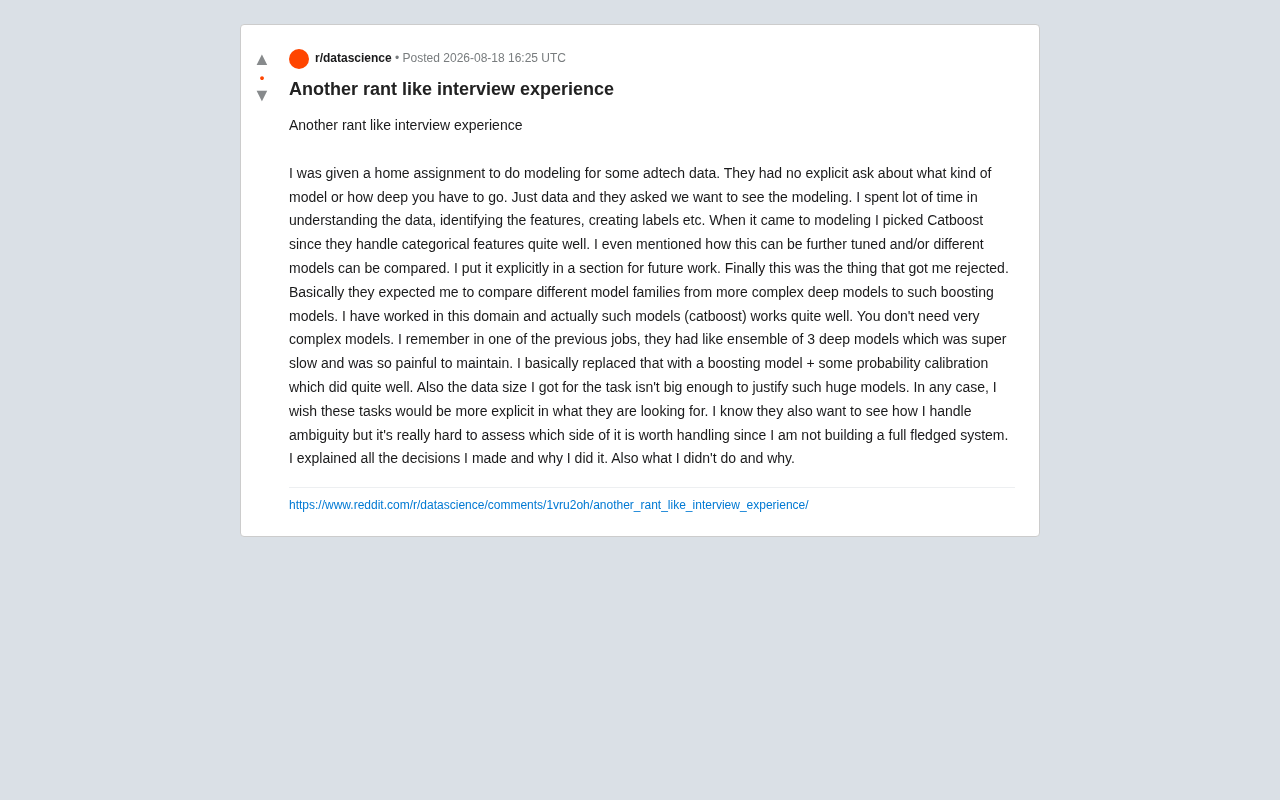
Recently, a data science practitioner shared their job-seeking experience on Reddit, striking a chord with many peers. They received a typical "open-ended" machine learning take-home assignment: the company provided a batch of adtech data and simply asked the candidate to "demonstrate modeling ability," without specifying what type of model was expected or how deep they should go.
This "deliberately vague" assignment format is quite common in data science interviews. The widespread use of open-ended take-home assignments in data science hiring began around 2015, when the industry broadly recognized that traditional whiteboard algorithm interviews couldn't effectively evaluate a data scientist's practical modeling capabilities. However, this format has become increasingly controversial in recent years — companies spend 10 minutes creating the assignment while candidates may invest 10-20 hours completing it; evaluation criteria are often implicit, with interviewers having clear scoring dimensions in mind that they never communicate to candidates, causing excellent engineers to be eliminated for "guessing the wrong direction." Companies often hope to observe how candidates make decisions with incomplete information through this approach — which is reasonable in itself. But as this job seeker experienced, vague boundaries also plant the seeds of misaligned expectations between both parties.
The Candidate's Technical Decision: Pragmatic or Conservative?
This candidate's process was solid. They spent considerable time understanding the data, identifying features, and constructing labels. For the modeling phase, they ultimately chose CatBoost — a gradient boosting framework renowned for its excellent handling of categorical features.
CatBoost is a Gradient Boosted Decision Tree (GBDT) framework open-sourced by Russian search engine company Yandex in 2017. Along with XGBoost and LightGBM, it's considered one of the three major contemporary boosting frameworks. Its core innovation is Ordered Target Encoding — a permutation-based target encoding method that can directly handle categorical features without introducing target leakage, eliminating the need for manual one-hot encoding or other preprocessing. Additionally, CatBoost employs an Ordered Boosting strategy to combat the prediction shift problem in traditional GBDT, maintaining good generalization even on small datasets.
Even more commendably, they didn't stop there. They dedicated a "Future Work" section in their report, explicitly noting that the model could be further tuned and compared against other model families. They also provided detailed explanations for every decision they made and why, as well as "what they didn't do and why."
From an engineering practice perspective, this approach is impeccable. They even cited their real-world experience: at a previous job, their team used an ensemble of three deep models that "ran extremely slowly and was extremely painful to maintain." They replaced the entire system with a single boosting model plus probability calibration, achieving equally excellent results.
Probability calibration refers to a post-processing technique that converts a model's predicted scores into true probability estimates. Many machine learning models produce raw outputs that are useful for ranking but don't strictly correspond to the true probability of an event occurring. In adtech, probability calibration is especially critical because bidding systems require precise click-through rate or conversion rate estimates to calculate bid amounts — even if ranking is correct, biased probability estimates directly lead to budget waste or failed bids. Common calibration methods include Platt Scaling (fitting a sigmoid function using logistic regression) and Isotonic Regression (fitting a non-parametric monotonic mapping using isotonic regression). The candidate's replacement of a deep model ensemble with a boosting model plus probability calibration demonstrates their deep understanding of the business reality that "accurate probability estimation" matters more than "model complexity" in advertising systems.
Why CatBoost Was a Reasonable Modeling Choice
Their technical judgment was well-founded:
- Insufficient data scale: The data volume for this task wasn't large enough to support complex deep models — forcing large models could actually lead to overfitting or wasted resources.
- Categorical feature friendliness: Adtech data typically contains numerous high-cardinality categorical features (such as ad slot IDs, user device types, geographic codes, advertiser IDs, creative IDs, etc.). Traditional models require complex feature engineering to effectively leverage this information, while CatBoost's native categorical feature support makes it a natural strong choice for this scenario.
- Maintainability: Boosting models train fast, deploy light, and are intuitive to debug — often preferred over deep models in production environments.
In adtech — one of machine learning's most mature commercial applications — Real-Time Bidding (RTB) systems must complete the entire pipeline from receiving bid requests, feature extraction, model inference, to returning bids within tens of milliseconds. This strict latency constraint makes model inference efficiency and maintainability core considerations — a gradient boosting model running in 5 milliseconds often delivers far more production value than a deep model running in 50 milliseconds. Furthermore, advertising data distributions drift rapidly over time (ad creatives are frequently updated, user interests change), making lightweight, rapidly-iterable models more favored in actual deployment.
In real business, "good enough and maintainable" is often more valuable than "state-of-the-art." This candidate clearly understood this well.
The Real Reason for Rejection: Misaligned Interview Expectations
However, this pragmatic approach ultimately became the reason for their rejection. The company actually expected them to compare different model families — covering everything from complex deep models to boosting models. In other words, the interviewers wanted to see breadth of exploration, not just the rationality of the final choice.
Here emerges a thought-provoking contradiction:
- Candidate's perspective: Since the goal is solving a practical problem, choosing the most appropriate tool should suffice. Listing comparisons as "future work" is a reasonable trade-off.
- Interviewer's perspective: A take-home assignment is fundamentally a stage for demonstrating capability. Even if CatBoost is already sufficient, they want to see the candidate proactively conduct horizontal comparisons to prove their technical breadth and experimental design ability.
The candidate themselves acknowledged that the company did want to assess how they "handle ambiguity," but the difficulty lies in — when you're not building a complete system but merely doing a capability demonstration, it's hard to judge where to invest your effort.
The Production Environment Trade-off Between Deep Model Ensembles and Boosting Models
Behind this contradiction lies a classic trade-off in machine learning engineering. Deep learning models (such as Wide & Deep, DeepFM, DIN, etc.) can indeed deliver incremental improvements in advertising recommendation, but these improvements often come with enormous system costs. Multi-model ensembles mean multiple training pipelines, multiple model version management systems, more complex online serving architectures, higher computational resource consumption, and more difficult troubleshooting. Google explicitly advises in its classic paper "Rules of ML" to "not rush to introduce complex models before confirming that simple models have been fully optimized." In actual business, a carefully tuned GBDT model with good feature engineering often performs comparably to complex deep model ensembles (typically within 0.1%-0.5% AUC difference), but operational costs may be reduced by an order of magnitude. This is why many mature advertising systems still use boosted tree models as their primary models.
However, the evaluation logic in interview settings is fundamentally different from production settings. In production, you speak through results; in interviews, you need to prove capability through process.
Practical Strategies for ML Interview Assignments
This seemingly ordinary "rant" actually reflects a communication gap that's pervasive in data science interviews.
Take-Home Assignments Are Not Production Tasks
In real work, engineers pursue solutions with the optimal input-output ratio; but in interview assignments, evaluators often want to see "completeness of the thinking process." This means even if you've determined that a simple approach is optimal, you should use experimental data to prove it's superior to complex approaches, rather than asserting it based on experience alone.
Specifically, the implicit scoring dimensions of interview assignments typically include: depth of exploratory data analysis, creativity in feature engineering, diversity of model selection and rigor of comparison experiments, choice and interpretation of evaluation metrics, code quality and reproducibility, and understanding of business context. Candidates need to cover as many dimensions as possible within limited time, rather than reaching perfection in any single dimension.
Make the "Future Work" Section Concrete
The candidate placed model comparison in "Future Work" — standard practice in academic papers, but in an interview context, it's easily interpreted as "didn't do it." If time permits, even running a simple logistic regression or small neural network as a baseline comparison can significantly boost persuasiveness.
A practical strategy is to build a "model complexity ladder": starting from the simplest baseline model (e.g., logistic regression), gradually increasing complexity (random forest → GBDT → simple neural network), using experimental results to demonstrate the trend of diminishing marginal returns, thereby supporting the conclusion that "CatBoost is already good enough" with data rather than intuition. Even if each model is only run once with default parameters, this kind of comparison itself demonstrates systematic thinking and experimental design capability.
Proactively Clarify Ambiguous Requirements
When facing open-ended tasks, candidates can absolutely ask about evaluation criteria before or at submission, or explicitly state their assumptions about the task scope at the beginning of the report. This both demonstrates the ability to handle ambiguity and reduces the risk of expectation misalignment.
In practice, you can add a "Task Understanding and Assumptions" section at the beginning of the report, explicitly listing: how you understand the business objective of the problem, what you assume the evaluation focus to be, and what trade-off decisions you made under time constraints. This practice is known as "issue framing" in the consulting industry — it not only demonstrates structured thinking but also provides interviewers with context to understand your decision logic.
Conclusion: Ambiguity Is a Double-Edged Sword
This job seeker's experience is not an isolated case. It reminds us that the evaluation criteria for machine learning interview assignments are inherently full of subjectivity and ambiguity. The candidate made a technically correct choice but lost on their understanding of the "rules of the game."
For companies, it's perhaps also worth reflecting: if the goal is to assess "model comparison ability," then providing moderate hints in the task description neither undermines the evaluation of candidate judgment nor risks losing truly pragmatic engineers due to expectation misalignment. Some forward-thinking companies have already begun providing explicit scoring rubrics in assignment descriptions or limiting completion time to manage workload expectations — practices that effectively reduce information asymmetry between both parties.
After all, in real production environments, the person who can replace three deep model ensembles with a single CatBoost plus probability calibration is exactly the kind of person a team needs most.
Related articles

JobRunner MCP Server: AI Agents Can Now Fix Failed Java Jobs
JobRunner launches an open-source MCP server enabling AI agents to view cluster status, diagnose failures, and recover Java jobs—incident response from any cloud coding environment or existing agent.

MLAI Digital Launches 9 Security Agents: MCP Server Safeguards the Full Lifecycle of Agentic AI
MLAI Digital launches Security MCP Server with nine built-in specialized security agents covering vulnerability discovery, attack simulation, prompt injection detection, API and infrastructure assessment, and accelerated remediation—embedding security validation across the full Agentic AI lifecycle from development to production.

Running Isaac Lab on H100 GPUs: Exploring Better Approaches
Exploring optimization methods for running Isaac Lab on NVIDIA H100 GPUs, including MIG configuration, mixed precision, TensorRT acceleration, and community experience to improve robotics simulation and reinforcement learning efficiency.