Epic Games Launcher Gets Major Overhaul: Reportedly 'Vibe Coded'

Epic releases PC launcher overhaul preview with speed boosts and Linux support, openly admitting it was AI-assisted 'vibe coded.'
Epic Games is rolling out a PC game launcher overhaul preview, claiming significantly faster performance and first-time official Linux support. More notably, Epic publicly says the overhaul was 'vibe coded' — built with AI programming assistants in a conversational, iterative style. This may be the first time a mainstream gaming platform has openly acknowledged that a core client product was completed with AI assistance, signaling AI-assisted development's move from personal experiments into commercial software release pipelines. The article examines both the efficiency gains and the risks: AI can speed up development, but code stability, security, and maintainability still need validation. For indie developers it's encouraging; for engineering managers it means testing, review, and architecture still require human oversight. The new launcher's real-world performance will decide whether 'vibe coded' becomes a positive case or a target for criticism.
Epic Games is rolling out a major overhaul preview for its PC game launcher. The company says the new version is "way faster" and adds Linux support. More notably, Epic explicitly states that this overhaul was "vibe coded."
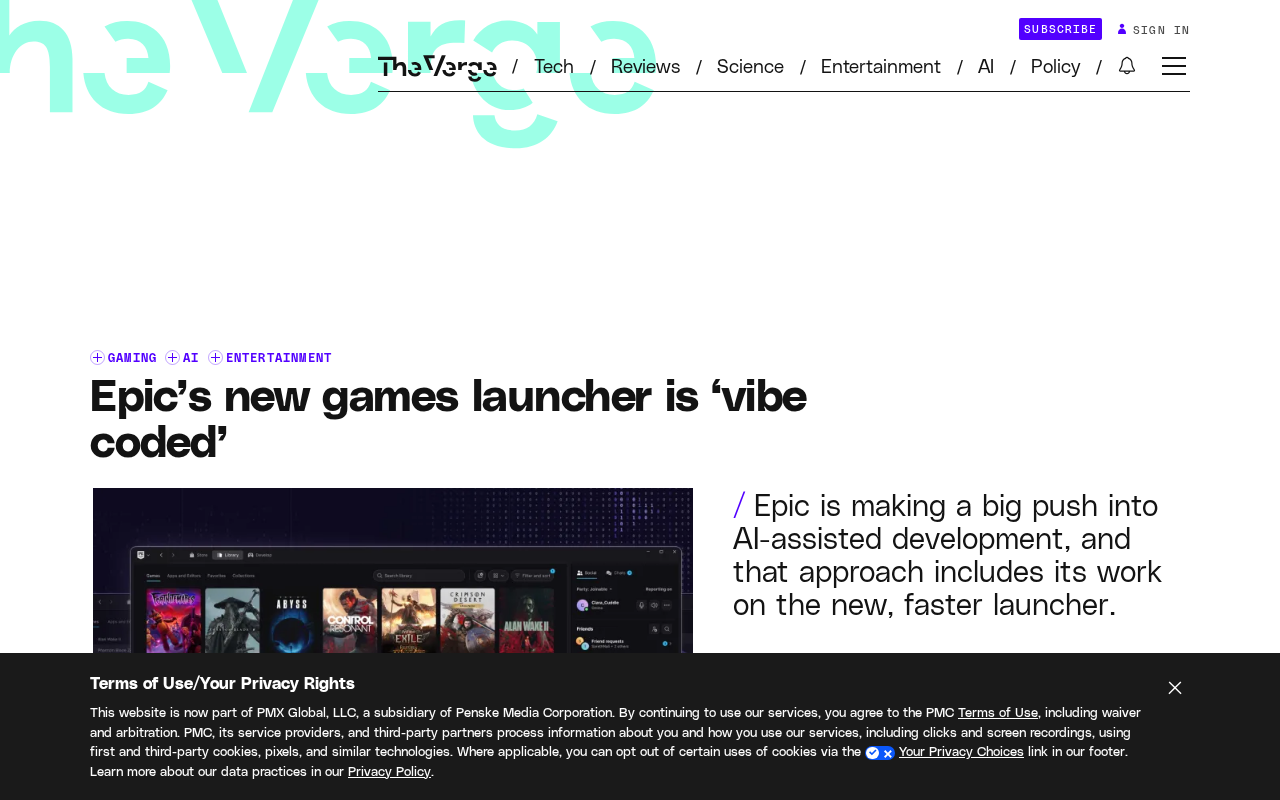
What Is "Vibe Coded"
"Vibe coding" is a term that has recently gained traction in developer circles, referring to a more casual, conversational approach to writing code with the help of AI programming assistants — the developer describes intent, the AI generates the implementation, and adjustments are made through iterative trial and error.
Epic used the term directly in its announcement, writing that "programming is hard." Coming from a company that is publicly betting on AI-assisted development, this reads as both self-deprecation and a declaration. It suggests that a substantial portion of the code in this launcher overhaul was written with the involvement of AI tools.
What's intriguing is that Epic didn't package "vibe coded" as a marketing gimmick, but rather as a statement of fact. This sends a signal: AI-assisted programming is moving from individual developer experiments into the formal release pipeline of large commercial software.
The term "vibe coding" was first coined by AI researcher Andrej Karpathy in early 2025 to describe a state of programming where you "completely give in to the vibes": developers no longer review code line by line, but instead describe requirements to AI in natural language, accept whatever implementation the AI produces, and when errors occur, toss the error messages back to the AI to continue iterating. The difference from traditional "AI-assisted programming" lies in the degree of human involvement — in the traditional approach, developers still lead architecture and logic while AI serves as a completion tool; vibe coding, by contrast, emphasizes rapid trial and error with weakened human review. This mode quickly gained popularity in prototyping, scripting tools, and personal projects, but has remained controversial in commercial software that requires long-term maintenance, because AI-generated code may contain hidden logic errors, security vulnerabilities, or hard-to-understand dependency structures.
Speed Improvements and Linux Support Are Hard Metrics
Setting aside the development approach, the new launcher has two user-perceptible changes.
First is performance. Epic says the new version is "way faster." For a client that has long been criticized by players for slow startup and laggy interface, this strikes right at the pain point.
Second is Linux support. The Epic Games launcher previously lacked official support on Linux, and players often had to rely on third-party tools. Official Linux support means Epic has taken a step forward in its cross-platform strategy, and may also be a response to the Linux gaming device ecosystem such as the Steam Deck.
Whether these two improvements can deliver will depend on the actual performance of the preview version, but at least the direction is clear.
The Epic Games launcher has long been criticized for performance issues due to its interface being built on web technologies like Electron — slow startup, high memory usage, and laggy operations are common complaints in the community. For this overhaul to achieve "way faster," it may involve rewriting or optimizing the underlying rendering framework. As for Linux support, its significance extends beyond serving desktop Linux users — it is closely tied to Valve's Steam Deck and SteamOS ecosystem. The Steam Deck runs an Arch Linux-based system, and if Epic wants a share of the handheld market, an official Linux client is almost a prerequisite. Previously, Linux users mainly relied on third-party open-source tools like Legendary or Heroic Games Launcher to run Epic games, and official support will significantly lower the barrier to entry.
AI Programming Enters the Commercial Software Release Pipeline
The real highlight of this event isn't the launcher itself, but that it may be the first time a mainstream gaming platform has publicly acknowledged that an overhaul of a core client product was completed with AI assistance.
Over the past year, AI programming tools have advanced rapidly, evolving from code completion to being able to understand project context and generate complete modules. But it's still rare for enterprise-grade products to use descriptions like "vibe coded" in public settings. Epic's move is essentially pushing AI-assisted development from behind the scenes to center stage.
There are two layers of meaning here. One is efficiency: if AI assistance can truly make a client of this scale "way faster," then the development acceleration it brings is quantifiable. The other is risk: whether AI-generated code can meet commercial standards in stability, security, and maintainability still needs time and user feedback to verify.
The reason it's rare for enterprise software to publicly acknowledge using AI-assisted programming is partly due to legal and compliance risks. AI-generated code may involve issues such as open-source license contamination and unclear copyright attribution, and many companies' legal teams require additional review of AI-involved portions or simply avoid public mention altogether. Additionally, publicly traded companies need to consider investor reactions to the narrative of "AI replacing engineers." Epic's use of "vibe coded" as a statement of fact rather than marketing rhetoric means it is actually taking on certain reputational risk — if the new version has serious bugs or security vulnerabilities, this label will quickly be amplified as a negative case. This has also drawn attention to whether Epic has established corresponding code review and testing processes to backstop AI-generated content.
What It Means for Developers
For indie developers and small teams, Epic's statement may be encouraging — if even major companies are using AI to help write core products, then using AI tools to boost output on personal projects is no longer "laziness" but a recognized way of working.
For engineering managers, the question is more complex. AI-assisted programming lowers the barrier to writing code, but it doesn't lower the barrier to delivering reliable software. Testing, review, and architecture design still require human oversight. "Vibe coded" can be a development style, but it cannot become a substitute for quality control.
Whether this Epic overhaul ultimately satisfies players is more important than how the code was written. If the new launcher is indeed faster and more stable, then "vibe coded" will become a positive case study; if problems keep cropping up, the term could also be turned around and used as a target for criticism.
One-line Summary
Epic releases PC launcher overhaul preview with speed improvements and Linux support, and publicly acknowledges it was AI-assisted "vibe coded."
Paragraph Summary
Epic Games is rolling out a PC game launcher overhaul preview, with the company saying the new version is significantly faster and adds official Linux support for the first time. More notably, Epic publicly states that this overhaul was "vibe coded" — written with the help of AI programming assistants in a conversational, casual manner. This may be the first time a mainstream gaming platform has publicly acknowledged that a core client product was completed with AI assistance, marking AI-assisted development's transition from personal experimentation into the formal release pipeline of commercial software. The article analyzes the efficiency implications and risks behind this statement: AI can boost development speed, but code stability, security, and maintainability still need verification. For indie developers this is encouraging; for engineering managers, it means testing, review, and architecture design still require human oversight. The actual performance of the new launcher will determine whether "vibe coded" becomes a positive case study or a target for criticism.
Related articles

Chain of Thought Isn't Just for AI: How Humans Can Use CoT to Improve Thinking Quality
Chain of Thought isn't just a prompt trick for large models. Starting from a Hacker News discussion, this article analyzes why CoT works for human thinking too, breaks down actionable ways to transfer it, and highlights the key differences between human CoT and machine CoT.
Cloudflare Teams Up with OpenAI: Closi…
Cloudflare Teams Up with OpenAI: Closing the Loop from Vulnerability Discovery to Defense with AI
Cloudflare uses OpenAI Daybreak to investigate security vulnerabilities and generate reviewable remediation plans, while developers use Codex to boost coding efficiency and quality.

Orca Multi-Agent Orchestration in Practice: A Guide to Parallel Collaboration with Claude and Codex
Orca is Stable AI's free open-source agent workbench supporting 34 agents like Claude Code and Codex in parallel. Learn its Git worktree isolation, multi-model orchestration, and mobile management.