Epismo OS: Keep Your Work Context Intact When Switching AI Tools

Epismo OS preserves full AI decision context in "Cases" so teams never re-brief when switching tools.
Epismo OS is a productivity product tackling the "context fragmentation" problem of the multi-AI-tool era. Its core feature is the "Case" container, which stores not just AI-generated outputs but also decision processes, review records, and next steps — enabling seamless handoffs across tools and teammates. An Auto Review feature flags potential issues without altering the original content, balancing quality control with version traceability. The product launched on Product Hunt with 79 upvotes and a 9th-place daily ranking. The concept is compelling, but whether it can lower the psychological barrier of adopting yet another operational layer remains the key test for scaled adoption.
In an era of ever-proliferating AI tools, teams constantly jump between products — drafting proposals with one model today, switching to another tool for review tomorrow. But every switch means re-explaining context and re-justifying decisions from scratch. Epismo OS, a new entry on Product Hunt, is designed to solve exactly this pain point: enabling seamless migration of work artifacts across AI tools.
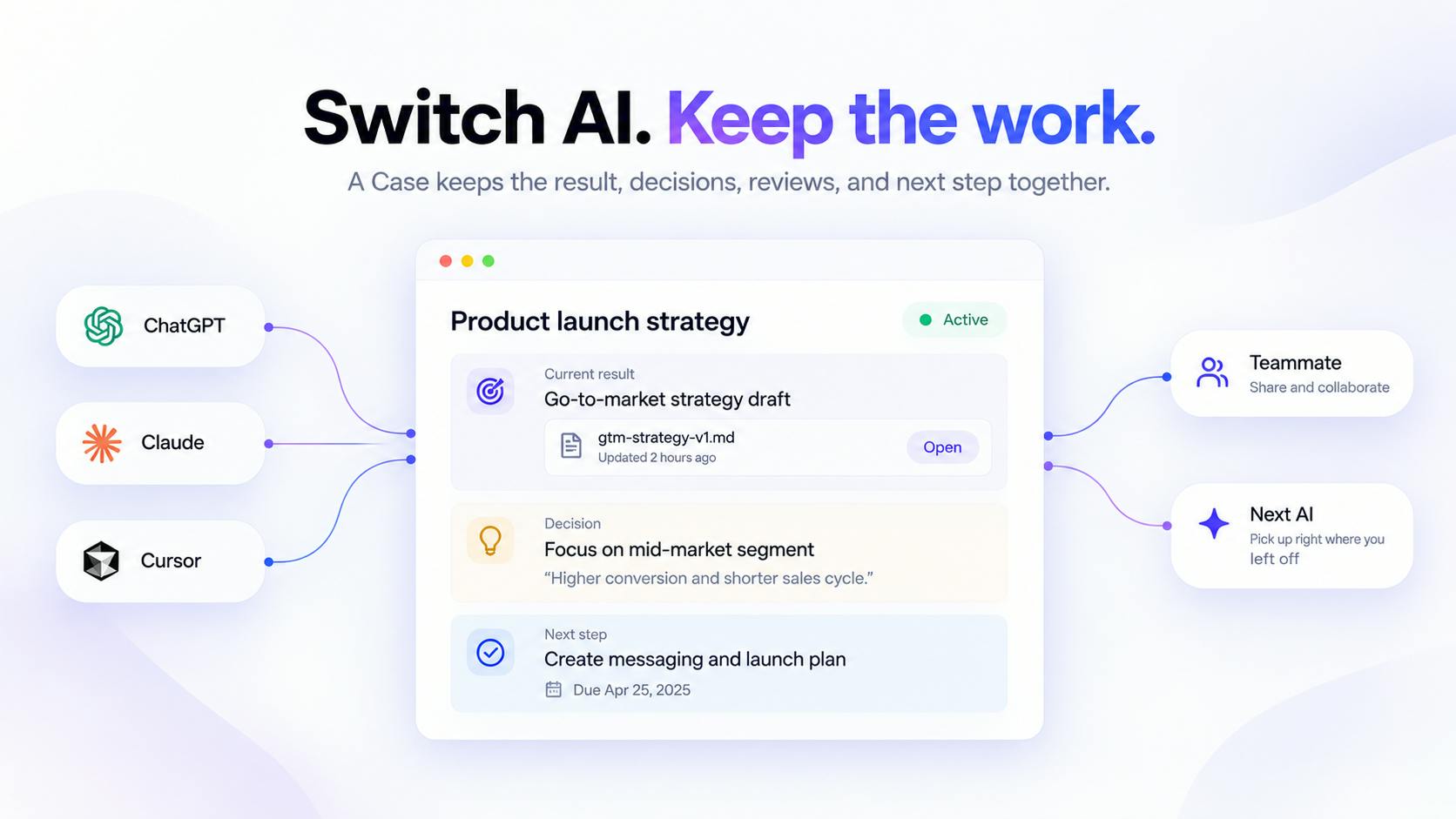
The Core Idea: Wrapping AI Work in a "Case"
The centerpiece of Epismo OS is a container called a "Case." It doesn't just store final outputs — it also captures the decision-making process behind those outputs, review records, and next-action plans.
This design philosophy is worth noting. When teams use AI tools, what's typically lost isn't the "answer" itself, but the context around why that answer was reached. When you switch tools or hand off work to a colleague, the implicit reasoning, rejected alternatives, and review comments usually stay buried in chat logs — or disappear entirely. Epismo structures and preserves all of that, theoretically breaking the inefficient cycle of repeated re-briefing.
This idea of "structured preservation of decision context" has roots in knowledge management theory. Traditional document tools like Notion and Confluence only save final outputs. The concept of a "decision log" has long existed in software engineering as ADRs (Architecture Decision Records) — documenting why a particular technical choice was made, what alternatives were considered, and why they were ultimately rejected. Epismo's Case container can be seen as extending this practice to AI collaboration: archiving not just results, but reasoning paths. This is especially valuable for organizations that require compliance auditing, accountability tracing, or institutional knowledge transfer — such as legal, consulting, and healthcare sectors — where why a decision was made matters just as much as what the decision was.
Collaboration Without Repeated Re-Briefing
One of the product's key selling points is eliminating the need to re-explain context when switching between AI tools or team members.
For cross-tool workflows, this is a very real friction point. Suppose a team uses Tool A to generate a first draft and wants to refine it with Tool B — they typically have to copy-paste the entire background all over again. If a Case can serve as a unified work artifact carrying complete context as it moves between tools, switching costs drop significantly. At its core, this is about building a layer of "memory" and "continuity" on top of a fragmented AI tool ecosystem.
Auto Review: Automated Review Without Touching the Original
Epismo also offers an Auto Review feature. It performs a fresh review of saved outputs, flagging potential issues while leaving the original content untouched.
The "preserve the original" detail reflects a nuanced understanding of collaborative workflows. In team environments, reviews and edits should be traceable and comparable — not silently overwritten. Auto Review adds a quality-control layer, giving teams an extra check on AI-generated content while maintaining version accountability. This is especially important in professional work where auditability and version management are non-negotiable.
Product Positioning and Market Reception
Epismo OS was built by Maker Hiroki and is listed on Product Hunt under three categories: Productivity, SaaS, and Artificial Intelligence. It launched to 79 upvotes and ranked 9th for the day, with 2 comments.
By the numbers, this is a product that has gained some early traction but hasn't broken out yet. The "AI work continuity" space it's entering is genuinely valuable as enterprise AI tool usage grows more diverse. That said, the challenges are clear: will teams be willing to adopt an additional "operating system" layer on top of their existing workflows, and can the product truly integrate with the input/output formats of mainstream AI tools?
The competitive landscape in the "AI work continuity" space is worth examining. Broadly, three approaches have emerged: the first is single-ecosystem lock-in (e.g., Microsoft Copilot deeply integrated with the Office suite, maintaining context through unified accounts and file systems); the second is a universal memory layer (e.g., MemGPT, Mem.ai, which attempt to give AI conversations long-term memory); the third — Epismo's approach — is a workflow encapsulation layer that doesn't replace existing tools but adds a structured work container on top of them. This third path has the advantage of being tool-agnostic, but the drawback is equally clear: it requires users to actively maintain an additional operational paradigm, creating meaningful adoption friction. Whether the product can be lightweight enough to feel "natural" rather than "one more step" is the pivotal question for this category.
Summary
Epismo OS targets a genuine pain point of the multi-AI-tool era: the loss of context and decision history. Through three mechanisms — the Case container, seamless context handoff, and Auto Review — it aims to give teams continuity and traceability in their AI work. The product's concept is clear, but whether it delivers in practice and can carve out a position in the highly competitive productivity tool market still needs real-world validation. For teams that regularly switch between multiple AI tools, it's worth a try.
Related articles

Chain of Thought Isn't Just for AI: How Humans Can Use CoT to Improve Thinking Quality
Chain of Thought isn't just a prompt trick for large models. Starting from a Hacker News discussion, this article analyzes why CoT works for human thinking too, breaks down actionable ways to transfer it, and highlights the key differences between human CoT and machine CoT.
Cloudflare Teams Up with OpenAI: Closi…
Cloudflare Teams Up with OpenAI: Closing the Loop from Vulnerability Discovery to Defense with AI
Cloudflare uses OpenAI Daybreak to investigate security vulnerabilities and generate reviewable remediation plans, while developers use Codex to boost coding efficiency and quality.

Orca Multi-Agent Orchestration in Practice: A Guide to Parallel Collaboration with Claude and Codex
Orca is Stable AI's free open-source agent workbench supporting 34 agents like Claude Code and Codex in parallel. Learn its Git worktree isolation, multi-model orchestration, and mobile management.