ernd: The Cashback Credit Card Designed for AI-Paying Businesses

ernd launches a credit card dedicated to the AI stack, offering 4% cashback and negotiating vendor partnerships to reduce enterprise AI expenses.
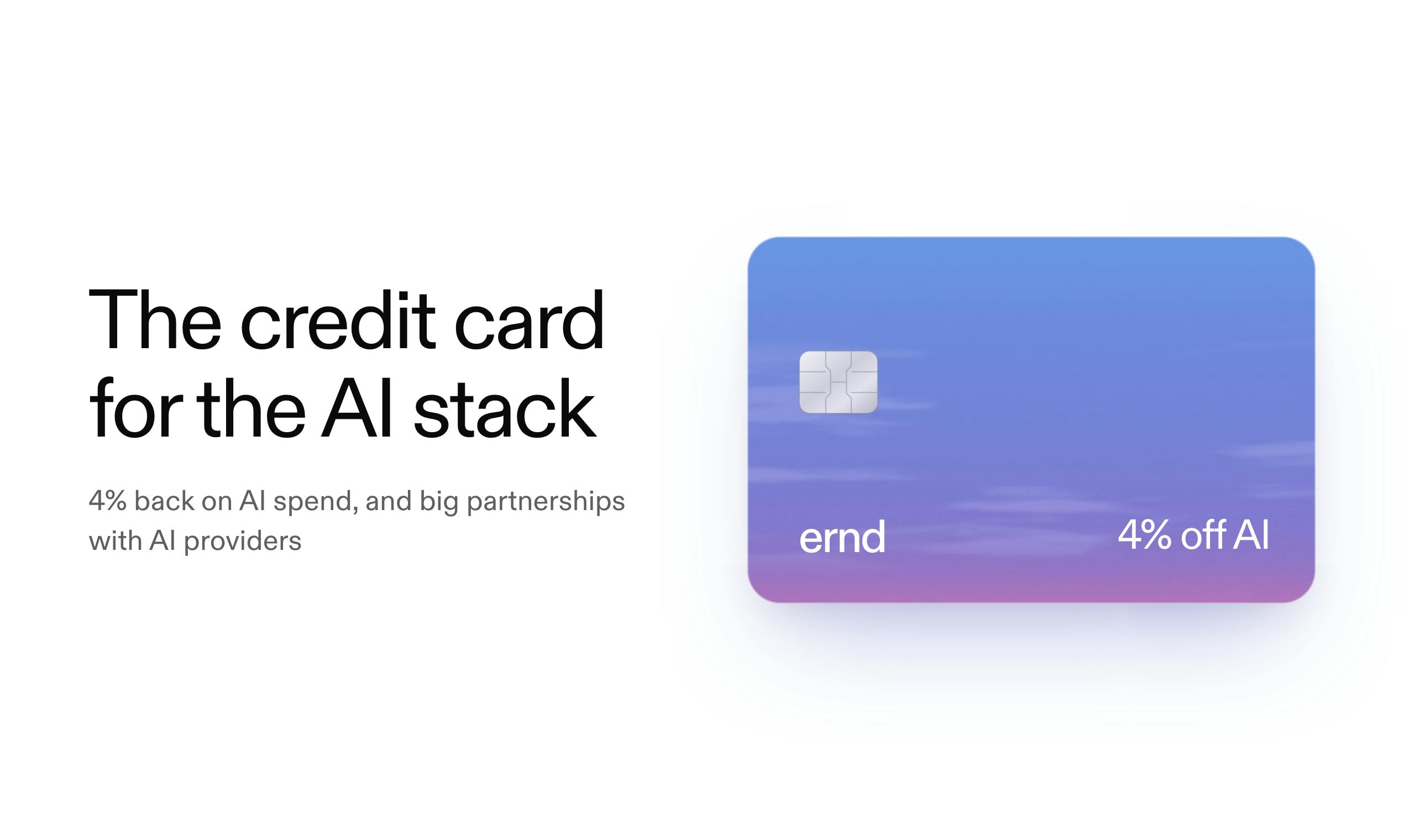
ernd is a credit card showcased on Product Hunt, positioned as "the credit card for the AI stack," with its core selling point being 4% cashback on spending at AI vendors, while the team is negotiating partnerships with AI providers to secure better pricing, faster inference speeds, and dedicated GPU resources. The article analyzes its product mechanics: the payment cashback layer and the negotiation layer reinforce each other, and the more users, the stronger the bargaining power. This model has natural appeal for AI startups and heavy users, but faces risks such as financial compliance, competition from traditional credit cards, and AI vendors' own discount strategies. Currently, partnership details are not public, and the product is in its early stages, suitable for attention from heavy AI users.
In an era where AI tools have become routine business expenses, a credit card called ernd has debuted on Product Hunt, aiming to address the pain points of companies spending on AI vendors. ernd positions itself as "the credit card for the AI stack," with its core selling point being 4% cashback on spending at AI vendors, while the team is negotiating partnerships with AI providers to secure better pricing, faster inference speeds, and dedicated GPU resources.
Why Do AI Expenses Need a Dedicated Credit Card?
The pain points of businesses paying for AI are becoming prominent. From OpenAI and Anthropic to various model APIs and cloud GPUs, AI costs are fragmented and continuously growing. Traditional corporate credit cards typically offer cashback categories around dining, travel, or office supplies, with AI spending often categorized as "other" and receiving almost no returns. ernd is capitalizing on this gap—if a company spends a significant amount on AI each month, 4% cashback represents a directly visible saving.
According to the Product Hunt page, ernd not only offers cashback but also plans to reduce AI costs through "major partnerships." This means ernd is attempting to act as an intermediary, using aggregated spending volume to negotiate better vendor terms. This model is not new in traditional corporate procurement, but a credit card specifically targeting the AI stack is still rare.
Corporate Credit Card Cashback Categories: Traditional corporate credit cards typically assign cashback rates by Merchant Category Code (MCC), such as dining, travel, and office supplies. AI vendors (e.g., OpenAI, AWS GPU instances) are often classified under "other" or "professional services" categories with very low cashback rates (usually 1% or less). ernd increases the cashback rate to 4% by specifically identifying AI vendor transactions, which requires customizing MCCs or transaction tags in collaboration with card networks and acquirers—technically more complex than ordinary cashback cards.
AI Vendor Enterprise Agreements: Large AI providers (e.g., OpenAI, Anthropic) typically offer customized contracts to enterprise customers, including volume discounts, provisioned throughput, and dedicated GPU quotas. ernd's negotiation layer essentially aggregates the spending volume of numerous small and medium-sized businesses to secure enterprise agreement terms similar to those of large customers through collective purchasing. This model has precedents in cloud service resellers (e.g., AWS MSPs), but aggregation targeting AI APIs is still emerging.
Product Mechanics and Potential Value
ernd's operating logic can be broken down into two layers. The first is the payment layer: businesses use the ernd card to pay AI vendor bills and receive 4% cashback. The second is the negotiation layer: ernd negotiates with AI providers on behalf of all users to secure better pricing, faster inference, and dedicated GPUs. These two layers reinforce each other—the more businesses use the card, the stronger ernd's bargaining power, and the more sustainable the cashback and additional benefits become.
For AI startups and businesses that heavily use AI, this model has natural appeal. Especially when model invocation costs become a fixed expense, any percentage of cashback directly improves gross margins. However, the long-term value of such products depends on the speed and quality of partnership implementation; currently, public information has not disclosed specific partners or pricing details.
Inference Speed and Dedicated GPUs: AI vendors' inference speed is limited by the load and queuing policies of shared GPU clusters. Dedicated GPU resources mean businesses obtain isolated compute power, avoiding the "noisy neighbor" effect and thereby achieving more stable low-latency responses. The "faster inference" promised by ernd could be realized in two ways: first, negotiating higher-priority API quotas with vendors; second, routing user traffic to partner vendors' dedicated endpoints. The latter requires ernd to have technical integration capabilities, not just a payment channel.
Quantitative Logic of Gross Margin Improvement: For AI startups, model invocation costs typically account for 20%-40% of revenue. 4% cashback is equivalent to reducing this cost by 4%, directly translating into gross margin improvement. If a company spends an average of $50,000 per month on AI, the annual cashback would be approximately $24,000, equivalent to a portion of a junior engineer's salary. This makes ernd's cashback substantively attractive to cost-sensitive teams.
Competition and Risks
ernd also faces obvious challenges. The intersection of fintech and AI is heating up, and traditional corporate credit card issuers may also follow suit with AI category cashback. In addition, the credit card business involves compliance, risk control, and cost of funds, and startups need to avoid mistakes in these foundational capabilities. More critically, if AI vendors themselves begin offering volume discounts or enterprise agreements, the value of ernd's negotiation layer could be diminished.
Another uncertainty is user retention. 4% cashback is a customer acquisition tool, but the switching cost of credit cards is not high. ernd needs to make businesses feel the actual efficiency gains from dedicated GPUs or faster inference in order to build a deeper moat.
Conclusion
ernd enters AI expense management with a credit card, with a clear idea that hits the mark. 4% cashback is a direct hook, while the negotiation partnerships with AI vendors point to longer-term platform value. The product is still in its early stages, and partnership details have not been made public, but the direction is worth the attention of heavy AI users. For teams with significant monthly AI spending, ernd offers an option worth evaluating.
One-line Summary
ernd launches a credit card dedicated to the AI stack, offering 4% cashback and negotiating vendor partnerships to reduce enterprise AI expenses.
Paragraph Summary
ernd is a credit card showcased on Product Hunt, positioned as "the credit card for the AI stack," with its core selling point being 4% cashback on spending at AI vendors, while the team is negotiating partnerships with AI providers to secure better pricing, faster inference speeds, and dedicated GPU resources. The article analyzes its product mechanics: the payment cashback layer and the negotiation layer reinforce each other, and the more users, the stronger the bargaining power. This model has natural appeal for AI startups and heavy users, but faces risks such as financial compliance, competition from traditional credit cards, and AI vendors' own discount strategies. Currently, partnership details are not public, and the product is in its early stages, suitable for attention from heavy AI users.
Related articles

Glasshand: Giving AI Agents a Real iPhone and Mac
Glasshand lets AI agents rent real iPhones and Macs, supporting Claude Code, Codex, and more to post, book services, and test iOS apps on real devices. This article explains how it works, its use cases, and potential boundaries.

ChatGPT Images 2.6 Released: GIF Generation, Reference Image Reuse, and 50% Speed Boost
ChatGPT Images 2.6 released: prompt-to-GIF animation with frame-by-frame editing, reusable reference images for yourself, pets, or characters, 50% faster generation, plus Flare and Sunburst API model variants and SVG export for developers.

Rerun: Turn Your AI Subscription into an AI Coworker Team
Rerun, #3 on Product Hunt, turns your ChatGPT or Claude subscription into a team of AI coworkers that run on schedules or triggers, each with tools, a computer, and a shared workspace. It asks before risky actions, is open source (AGPL v3), and supports self-hosting.