ESP-Mosaico: A Modular Hardware Development Board Built for AI Agents
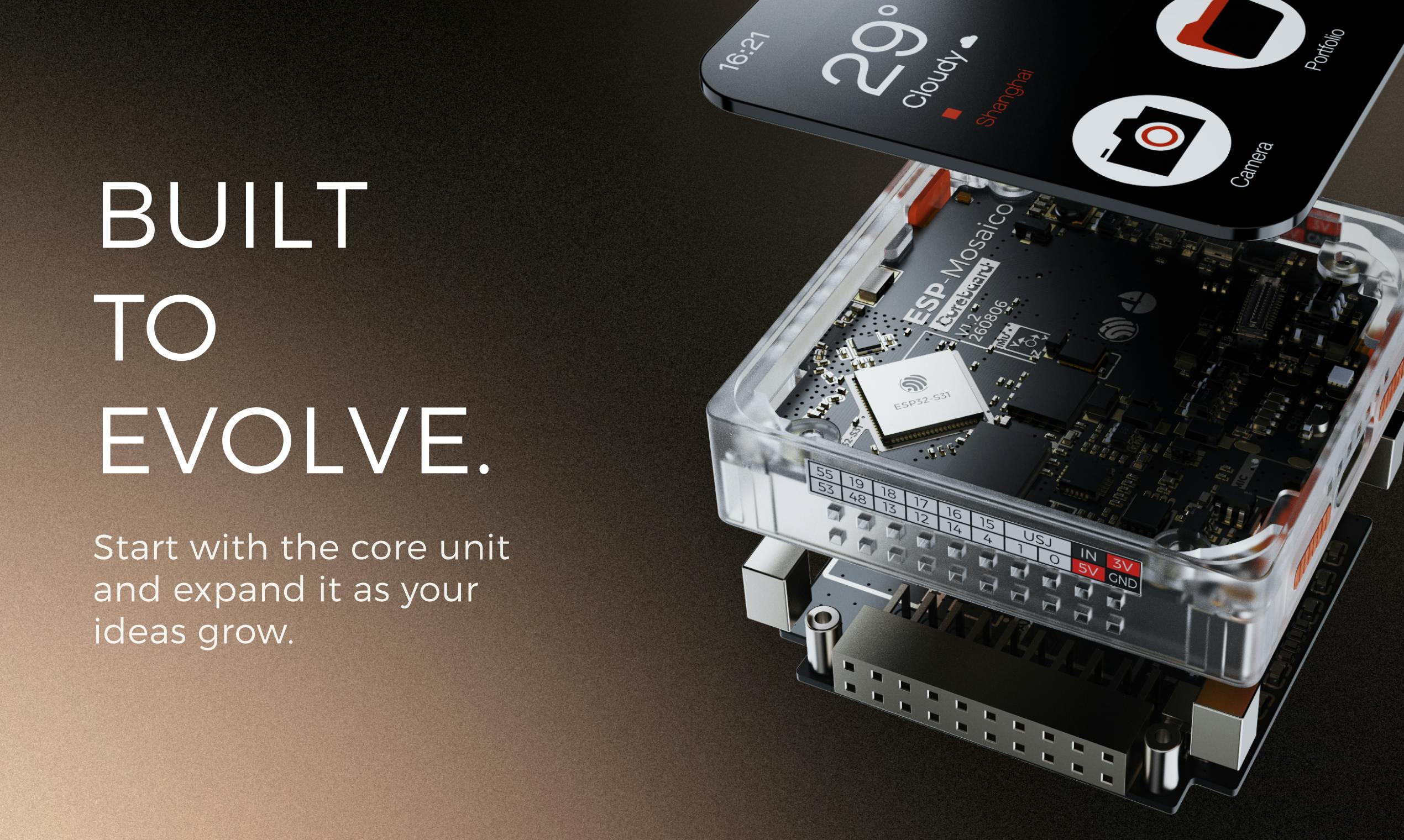
ESP-Mosaico launches a modular ESP32 board for AI Agents, letting Agents participate directly in hardware development.
ESP-Mosaico is a modular development board based on the ESP32-S31, ranked #10 on Product Hunt, positioned as a hardware platform for Coding Agents. It emphasizes module expansion and multi-board splicing, aiming to turn hardware configuration into Agent-manageable parameters, with Chat Coding and Vibe Coding modes. The article raises three concerns: unclear ESP32-S31 toolchain maturity, physical iteration latency, and low community discussion. It recommends waiting for early user cases.
When AI Agents Step Off the Screen, ESP-Mosaico Wants to Hand Them a Board
Most AI coding tool stories stop at code generation and software deployment. ESP-Mosaico, ranked #10 on Product Hunt, proposes a more radical direction: letting AI Agents build hardware directly. This modular development board based on the ESP32-S31 claims to be designed specifically for Coding Agents, covering the complete hardware development workflow from ideation to deployment, testing, and iteration.
In terms of positioning, ESP-Mosaico is not just another development board aimed at human beginners—it treats AI Agents as the "first developer." With expandable modules, multi-board splicing support, and two interaction modes (Chat Coding and Vibe Coding), it attempts to lower the barrier from idea to physical device.
Core Design: Modularity and Multi-Board Splicing
ESP-Mosaico's hardware form revolves around two key concepts: expandable modules and multi-unit splicing. Modularity means Agents can combine sensors, actuators, and other peripherals according to task requirements; multi-unit splicing allows multiple development boards to work together, providing a foundation for more complex physical devices.
The intent behind this design is clear—the most time-consuming parts of hardware development are often not writing code, but selecting the right sensors, handling pin conflicts, and repeated soldering and debugging. If modularity is thorough enough, Agents can manage hardware configuration as parameters rather than starting from a bare board every time. However, the officially disclosed module list and splicing protocol details are limited, and actual expansion capabilities remain to be verified.
ESP32-S31 is a chip model in Espressif's ESP32 series. The ESP32 series itself includes multiple sub-series (such as ESP32-S2, S3, C3, C6, etc.), with significant differences in processor architecture, wireless protocol support, GPIO count, and memory configuration across models. For AI Agents, chip model differences directly affect the SDK interfaces and pin definitions invoked when generating code, so the maturity of toolchain support for specific models is a prerequisite for hardware automation.
"Multi-board splicing" in the embedded field typically refers to using inter-board buses (such as I2C, SPI, or dedicated backplane connectors) to let multiple controllers work together, each responsible for different peripherals or tasks. This architecture can overcome single-board pin and compute limitations, but it also introduces new problems such as inter-board communication protocols, address conflicts, and timing synchronization, placing higher demands on the Agent's configuration management capabilities.
Chat Coding and Vibe Coding: Two Paths of Human-AI Collaboration
ESP-Mosaico offers two usage modes. Chat Coding leans toward conversational development, where users describe requirements in natural language and the Agent generates and flashes code; Vibe Coding is closer to "feeling-driven" rapid prototyping, emphasizing low-friction idea realization.
These two concepts are not new in themselves, but they are worth attention in the context of hardware development. Vibe Coding in software has already exposed the problem of uncontrollable code quality, and the risks are higher in hardware—incorrect pin connections can directly burn out modules. Whether ESP-Mosaico has built-in hardware safety constraints on the Agent side (such as voltage detection and pin validity checks) is not answerable from publicly available information. This is precisely the key to whether "designed for Agents" can hold up.
Vibe Coding is a concept proposed by Andrej Karpathy in 2025, referring to a programming approach where developers describe intent in natural language, AI generates code, and they themselves only exercise high-level control—emphasizing "going with the flow" while downplaying line-by-line review. After gaining popularity in software, critics pointed out that it tends to produce code that is hard to maintain or even contains hidden defects.
Migrating this model to hardware development physically amplifies the risks: software bugs at most cause program crashes, while hardware errors can cause short circuits, overvoltage, or permanent component damage. Therefore, Agent systems for hardware typically require additional constraint layers, such as pin function validity checks, voltage domain verification, and static rule review before flashing. Whether these mechanisms exist in ESP-Mosaico is a core dimension for evaluating its reliability.
Three Practical Questions Worth Watching
First, the ecosystem maturity of ESP32-S31. The original text mentions this chip model, but the ESP32 series has many variants, and the specific specifications and toolchain support for the S31 have not been fully detailed in public channels. For Agents, toolchain stability directly determines whether automatically generated code can compile and flash successfully.
Second, the physical latency of the Agent feedback loop. Software Agents can verify code in milliseconds, while hardware Agents must wait for flashing, power-up, and sensor readings to stabilize. If the iteration cycle is measured in minutes, Vibe Coding's "speed" is diminished in hardware scenarios.
Third, community traction of 79 votes and 3 comments. As #10 on Product Hunt that day, this data shows the product has gained initial attention, but discussion volume is low and effective community feedback has not yet formed. The value of modular hardware depends heavily on the ecosystem, and real usage reports from early users matter more than the launch itself.
Product Hunt rankings are based on daily user votes, and #10 typically means the product received some exposure on launch day, but the vote scale (e.g., 79 votes) is in the small-to-medium range. For hardware products, community discussion volume reflects real demand better than vote counts: the ecosystem value of modular hardware depends on the richness of third-party modules and user-contributed project cases, which take months or longer to accumulate. Sparse early comments mean a lack of independently verified usage feedback, and the product's claimed capabilities cannot yet be externally confirmed.
Who Should Pay Attention to This Board
If you are experimenting with AI Agents interacting with the physical world, ESP-Mosaico provides a ready-made experimental platform, saving the work of designing a carrier board from scratch. For hardware entrepreneurs, its modular approach is worth referencing—treating "Agent operability" as a hardware design constraint rather than an afterthought.
But the more rational attitude at this stage is to wait and see. The information disclosed on the product page is concentrated at the conceptual level, with verifiable details lacking on module ecosystem, Agent integration methods, and actual development experience. It's not too late to judge whether it's "the Arduino moment for Agents" after the first batch of developers share real project cases.
One-line Summary
ESP-Mosaico launches a modular ESP32 development board for AI Agents, attempting to let Agents participate directly in hardware development.
Paragraph Summary
ESP-Mosaico is a modular development board based on the ESP32-S31, ranked #10 on Product Hunt that day, positioned as a hardware platform designed specifically for Coding Agents. It emphasizes module expansion and multi-board splicing, attempting to turn hardware configuration into Agent-manageable parameters, and offers two human-AI collaboration modes: Chat Coding and Vibe Coding. The article notes that the product concept is appealing, but there are three practical concerns: unclear ESP32-S31 toolchain maturity, physical latency in hardware iteration that undermines Vibe Coding's speed advantage, and low community discussion with a lack of real feedback. The author believes it is worth referencing for those experimenting with Agent-physical world interaction, but recommends waiting at this stage for the first batch of users' actual project cases.
Related articles

Chain of Thought Isn't Just for AI: How Humans Can Use CoT to Improve Thinking Quality
Chain of Thought isn't just a prompt trick for large models. Starting from a Hacker News discussion, this article analyzes why CoT works for human thinking too, breaks down actionable ways to transfer it, and highlights the key differences between human CoT and machine CoT.
Cloudflare Teams Up with OpenAI: Closi…
Cloudflare Teams Up with OpenAI: Closing the Loop from Vulnerability Discovery to Defense with AI
Cloudflare uses OpenAI Daybreak to investigate security vulnerabilities and generate reviewable remediation plans, while developers use Codex to boost coding efficiency and quality.

Orca Multi-Agent Orchestration in Practice: A Guide to Parallel Collaboration with Claude and Codex
Orca is Stable AI's free open-source agent workbench supporting 34 agents like Claude Code and Codex in parallel. Learn its Git worktree isolation, multi-model orchestration, and mobile management.