ESP32's Hidden SDR Capabilities Uncovered: The Software-Defined Radio Potential of a Dirt-Cheap Chip

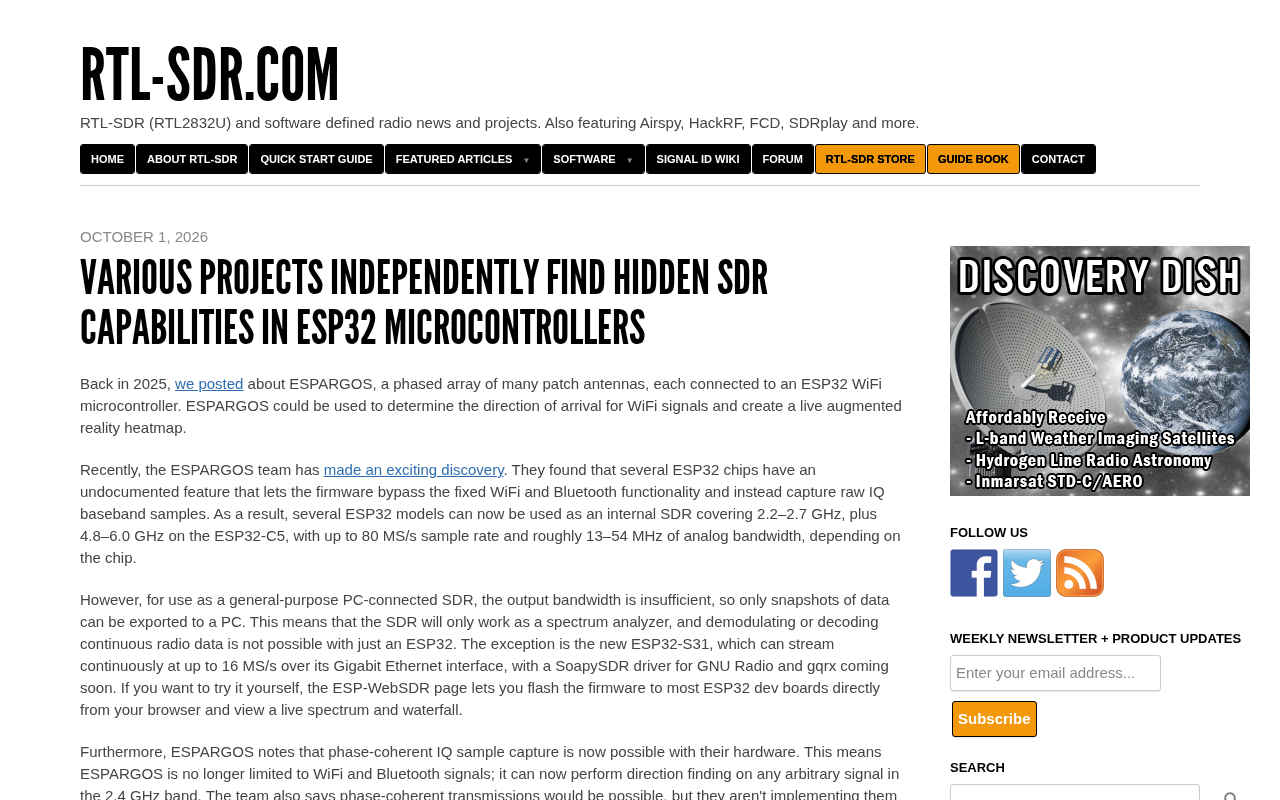
Multiple independent projects reveal that the ESP32 chip harbors hidden SDR capabilities via low-level register access.
Multiple independent developers have discovered undocumented Software-Defined Radio (SDR) capabilities within the ESP32's Wi-Fi/Bluetooth RF subsystem. By accessing low-level registers through reverse engineering, they can extract raw I/Q data in non-standard modes, giving this inexpensive IoT chip limited signal capture and processing potential. Independent corroboration from separate teams adds credibility to the findings, which could spawn open-source toolchains for education, amateur radio, and IoT security research — though hardware limitations and RF compliance risks mean the ESP32 is best suited for learning and proof-of-concept use, not professional RF work.
A Chip That Costs Pennies — With Software-Defined Radio Hidden Inside
In the embedded development world, the ESP32 has long been celebrated for its exceptional value — Wi-Fi, Bluetooth, and a dual-core processor all packed into a chip that costs just a few dollars. But recent discoveries from multiple independent projects have thrust this tiny chip back into the spotlight among radio enthusiasts: the ESP32 apparently harbors hidden Software-Defined Radio (SDR) capabilities that can be unlocked.
The topic gained 233 upvotes and 41 comments on Hacker News, and sparked discussions in the RTL-SDR community as well. Multiple developers, working independently and without knowledge of each other's efforts, each managed to uncover undocumented low-level functionality within the ESP32's RF subsystem.
What Is SDR, and Why Does This Discovery Matter?
The core idea behind Software-Defined Radio (SDR) is replacing hardware-based signal processing — traditionally done by dedicated analog circuits — with software. In plain terms, a conventional radio requires different hardware circuits to receive different frequency bands, while an SDR can flexibly demodulate and process a wide variety of wireless signals simply by adjusting software parameters.
For years, the entry point into SDR has been devices like the RTL-SDR — USB dongles repurposed from digital TV tuners. The ESP32, meanwhile, already contains the RF transceiver circuitry needed for Wi-Fi and Bluetooth. If developers can directly access those low-level RF registers, the chip could theoretically gain some degree of raw signal capture or transmission capability — and that's exactly what these projects set out to explore.
Where Do These Hidden Capabilities Come From?
The ESP32's Wi-Fi/Bluetooth RF front-end was never designed for general-purpose SDR use. However, registers related to its ADC, digital down-conversion, and RF calibration exist in a space that can be accessed outside the official SDK. Through reverse engineering and direct register manipulation, developers found that they could extract raw I/Q data or perform limited signal processing in non-standard modes. This means a consumer-grade IoT chip has been granted experimental potential approaching that of professional RF tools.
The RTL-SDR takes its name from Realtek's RTL2832U chip — originally a USB digital TV tuner demodulator that was discovered in 2012 to be capable of outputting raw I/Q sample data, accidentally becoming the foundation of affordable SDR. RTL-SDR devices typically sell for $10–$30 USD and cover a receive range of roughly 500 kHz to 1.7 GHz, making them the de facto standard hardware for amateur radio operators and SDR beginners. Part of what makes the ESP32's potential so exciting is this context: its retail price is even lower than an RTL-SDR dongle, and millions of IoT developers likely already have one on hand — no additional hardware purchase required.
I/Q data (In-phase/Quadrature) is the fundamental data format of software-defined radio. Any RF signal can be decomposed into two mutually orthogonal components (90° phase difference) — I and Q — which together fully describe the signal's amplitude and phase. A Digital Down Converter (DDC) shifts a high-frequency RF signal down to baseband for subsequent digital signal processing. The ESP32's Wi-Fi transceiver chain already performs these operations internally during normal operation. The breakthrough developers achieved was finding a way to bypass the upper protocol stack and intercept the raw I/Q stream directly from an intermediate stage — and that is the technical essence of its SDR capability.
Independent Corroboration Across Multiple Projects
The most intriguing aspect of this story is the word "independently." Different developers, without any coordination, each arrived at the same hidden layer of the ESP32's RF subsystem. This kind of multi-party cross-validation typically signals that the capability is genuinely real — not an isolated fluke.
From the perspective of the technical community, discoveries like this tend to rapidly catalyze open-source toolchains. Once someone publishes a method for accessing the underlying registers, the community iterates quickly around it, producing experimental projects covering spectrum analysis, signal sniffing, protocol reverse engineering, and more.
Potential Applications and Real-World Limitations
On the optimistic side, the ESP32's SDR potential opens the door to an extremely low-cost wireless experimentation platform. For education, amateur radio (HAM), and IoT security research, the appeal of doing spectrum sensing or signal experiments with a chip that costs next to nothing is self-evident.
That said, a dose of realism is warranted: the ESP32's RF front-end bandwidth, sensitivity, and linearity are all optimized for specific protocols like Wi-Fi and Bluetooth, and fall far short of what professional SDR equipment can offer. It is better suited as a learning tool and proof-of-concept platform than as a serious RF measurement instrument. Furthermore, using these hidden features for signal transmission may raise radio spectrum compliance issues — users should be mindful of local regulations.
What This Means for the Embedded and Radio Communities
Stories like this — where an old chip reveals new capabilities — fundamentally reflect the value of the open-source hardware community: when enough people persistently dig into a cheap, widely deployed chip, they inevitably uncover surprises that go beyond the official documentation. The ESP32's massive installed base means any new discovery can be rapidly replicated and extended by thousands of developers worldwide.
On the regulatory side, most countries strictly control unauthorized RF transmissions. China's Ministry of Industry and Information Technology (MIIT), the U.S. Federal Communications Commission (FCC), and equivalent bodies worldwide all require RF transmitting devices to obtain type approval. Modifying a device's RF parameters outside its certified configuration may violate applicable regulations. The ESP32's official firmware is certified, but manipulating RF transmission through low-level register access falls outside the scope of that certification — transmitting on public spectrum could cause interference and carry legal risk. Accordingly, this type of experimentation is best conducted inside a shielded enclosure, at very low power over short distances in a controlled environment, or limited to receive-only use.
Conclusion
The uncovering of the ESP32's hidden SDR capabilities is yet another demonstration of what consumer hardware can achieve when driven by a motivated community. While it cannot replace professional SDR equipment, it opens a new door to radio experimentation and embedded learning at a cost that is almost negligible. For developers with an insatiable curiosity, that is precisely what makes open-source hardware so compelling.
Related articles

Is the Agent Harness Dead? Cursor's Early Engineer Breaks Down the Real Architecture of AI Coding Agents
Cursor early engineer Jediah breaks down the real architecture of the agent harness: why "the harness is dead" is only half right, how the data flywheel lets the harness obsolete itself, and how Grokbot, software factories, and primitive design open new frontiers for agents.
Python Visitor Pattern and Better Alternatives Explained
A deep dive into Python's visitor pattern and four alternatives: method pattern, pattern matching, dictionary mapping, and functools.singledispatch. Choose the best decoupling design by change frequency.

357 Days of Deep Experience: Why Omarchy Made Me Stop Distro-Hopping
A 357-day deep dive into Omarchy: 59-second install, out-of-the-box audio and GPU support, the Quattro QuickShell rewrite migration pains, and why Arch users should try it.