Etsy Cracks Down on AI Slop: Addressing Buyer and Seller Anxieties

Etsy tightens AI content rules, balancing tech adoption with protecting its handmade platform character.
Etsy announces stricter rules limiting AI use in product listings to curb "AI slop." Buyers can't tell which listings involve AI; sellers fear their original work is diluted alongside AI mass-produced goods. Etsy avoids a blanket ban, seeking balance between tech tools and platform character. But vague definitions, high enforcement costs, and reliance on voluntary disclosure remain key challenges. Long-term, the platform needs mechanisms to identify and reward original value to sustain the "handmade premium."
Handmade e-commerce platform Etsy is tightening its control over AI-generated content. According to an official announcement, the platform will introduce stricter rules limiting the use of AI in product listings to reduce the proliferation of "AI slop." This move directly addresses growing anxieties on both sides of the marketplace: buyers struggle to distinguish which listings involve AI-generated content, while sellers worry that their original work being displayed alongside AI mass-produced items dilutes the perceived value of handmade craftsmanship.
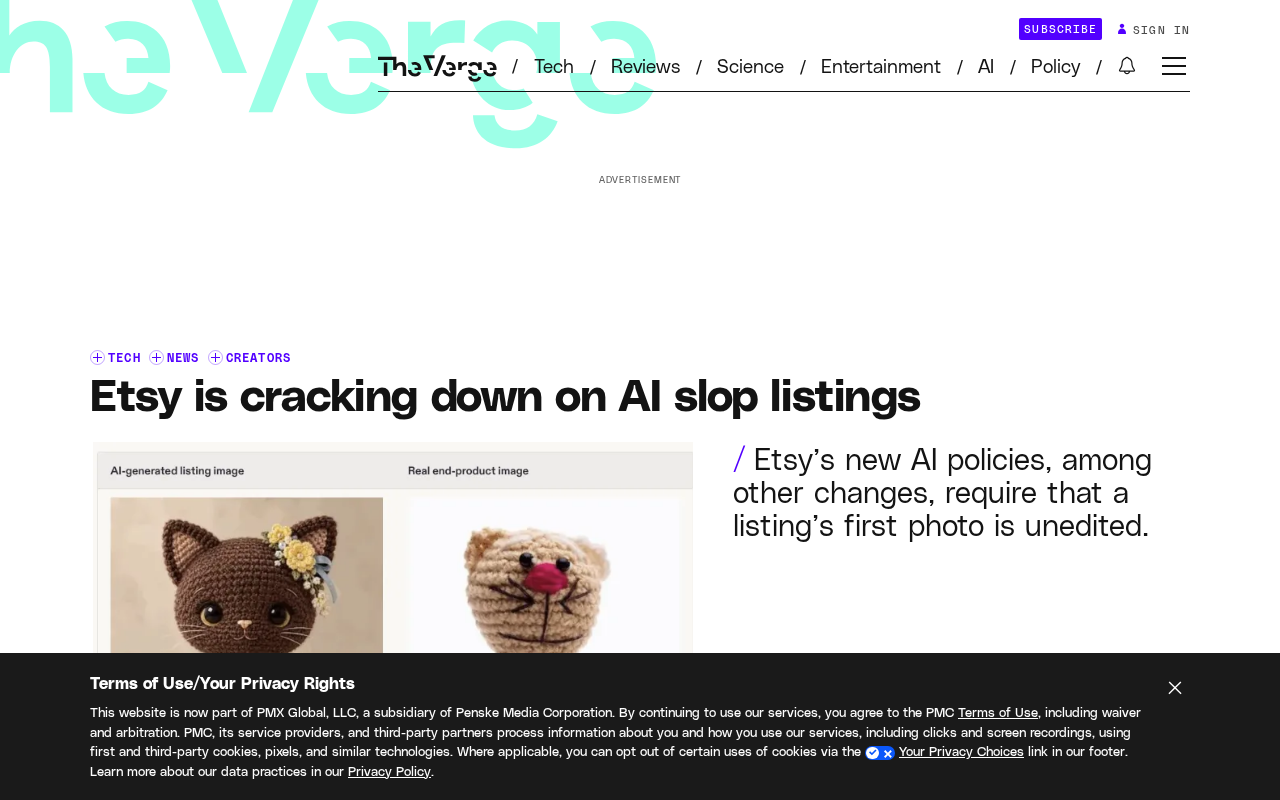
Anxiety Flows Both Ways: Buyers Can't Tell, Sellers Fear Being Dragged Down
Etsy's announcement candidly identifies the core of the problem. Many active buyers report that they "can't tell which listings involve AI-generated content" — a direct blow to the trust foundation the platform depends on for survival. The appeal of handmade e-commerce lies in the authenticity and uniqueness of "made by human hands." Once buyers begin to doubt the origins of products, the entire platform's differentiation positioning starts to erode.
Sellers' concerns are equally concrete: they "worry about their work appearing alongside listings that use AI." This concern is not unfounded. When algorithmic recommendations and search rankings fail to effectively separate AI content, creators who carefully hone their craft may be drowned out by a flood of low-cost, high-volume AI products. Etsy's rule adjustment is essentially an attempt to repair this fraying chain of trust.
"AI slop" is a derogatory label that has spread rapidly across the English-speaking internet since 2024, specifically referring to content or products mass-produced with generative AI that are粗糙 in quality and lacking original intent. The key distinction from "AI-assisted creation" lies in motivation and investment: the former grabs search traffic and recommendation slots at extremely low cost, while the latter still centers on human design and craftsmanship. This concept is particularly jarring in the Etsy context because the platform has long marketed itself as "handmade, vintage, and unique," with product pages typically featuring creator stories, process photos, and buyer reviews — forming a narrative around authenticity. The influx of AI slop is not just an aesthetic problem; it also changes the information density of search results. When large numbers of homogeneous products use similar title keywords and generated images, buyers' filtering costs rise, and original sellers are forced to compete for the same exposure slots against products with no real production process. Understanding this term helps grasp the public opinion backdrop and the boundaries of governance targets behind Etsy's rule adjustment.
Behind the Tightening Rules: Platform Identity vs. the AI Flood
Etsy is not the only platform grappling with AI content governance, but its situation is particularly delicate. As a marketplace centered on "handmade, vintage, and unique," Etsy's product narratives rely heavily on "creator stories" and "the making process." The large-scale influx of AI-generated content creates inherent tension with this narrative.
The platform's wording this time is worth noting: it has not imposed a blanket ban on AI, but instead emphasizes "stricter rules" to regulate how AI is used in product listings. This suggests Etsy is trying to find a balance between embracing technological tools and protecting the platform's character. However, how the specific rules will be implemented — how to define "AI-generated," how to review, how to handle violations — has not been fully detailed in the announcement, leaving room for observation in subsequent enforcement.
Governance Challenges: Blurry Definitions and Enforcement Costs
Defining "AI slop" is itself a challenge. A product may involve AI to vastly different degrees from design conception to final product: an image entirely generated by AI and printed directly is fundamentally different in nature from using AI to assist in generating a design sketch before handcrafting. If Etsy wants to distinguish precisely, it needs a clear content disclosure and review mechanism — which comes at no small operational cost.
Another practical issue is the compliance burden on sellers. Requiring sellers to proactively disclose AI usage relies on voluntary reporting, and some will inevitably slip through; meanwhile, proactive platform detection of AI content carries the risk of false positives. How to strike a balance between protecting original sellers and not overburdening compliance costs is an area Etsy will need to continuously calibrate after its rules take effect.
Content disclosure is a common mechanism platforms use when governing AI-generated content: requiring sellers to proactively declare the degree and stage of AI involvement when publishing listings — for example, whether AI was used to generate the main product image, description copy, or design sketches. This is typically paired with a tagging system and search filters, allowing buyers to filter or block by "degree of AI involvement." The advantage of this mechanism is that it shifts the judgment cost to the sellers who best understand the production process, with the platform only needing to conduct spot checks afterward; the limitation is that it relies on voluntary reporting, making it difficult to promptly identify those who intentionally conceal. Another approach is proactive detection on the platform side, including image forensics models, text watermark identification, and metadata analysis — but for products that have undergone secondary editing or been printed as physical goods, recognition accuracy drops significantly. As a result, most platforms ultimately adopt a hybrid model of "disclosure + spot checks + reporting," which explains why Etsy's announcement emphasizes "stricter rules" rather than a blanket ban — the enforceability of rules is often more critical than their severity.
Long-Term Impact on the Creator Ecosystem
From a broader perspective, Etsy's move reflects a common challenge facing handmade e-commerce platforms in the AI era: when production costs are dramatically lowered by AI, what does the platform rely on to maintain the "handmade premium"? Tightening rules is only the first step; the deeper challenge lies in building a mechanism that makes original value identifiable and rewardable.
For sellers, this may also be a signal: in an environment where AI tools are increasingly widespread, clearly presenting the production process and reinforcing creator identity may become an effective strategy for differentiating from AI mass-produced goods. For buyers, if the platform can provide more transparent information about AI usage, the certainty of shopping decisions will also increase. How effective Etsy's rule adjustment will be remains to be seen, but at least it acknowledges the problem exists and has begun to address it.
One-line Summary
Etsy tightens AI content rules, seeking a balance between embracing technological tools and protecting its handmade platform character.
Paragraph Summary
Etsy has announced it will introduce stricter rules limiting the use of AI in product listings to curb the proliferation of "AI slop." The platform's announcement notes that buyers struggle to determine which listings involve AI-generated content, while sellers worry that original work displayed alongside AI mass-produced goods dilutes the value of craftsmanship. Etsy has not imposed a blanket ban on AI but is trying to find a balance between technological tools and platform character. However, vague definitions of AI involvement, high review and enforcement costs, and reliance on voluntary seller disclosure remain core difficulties for rule implementation. In the long run, the platform needs to establish mechanisms that make original value identifiable and rewardable in order to maintain the "handmade premium."
Related articles

Understanding DeepSeek in 3 Minutes: The Rise from a Quant Hedge Fund to an Open-Source AI Leader
DeepSeek's history in 3 minutes: from High-Flyer Quant's compute build-up to V2's MLA inference cost cuts, V3's $5.576M training bill, R1's open-source global shock, and V4 with a $7B Series A.

Local Creative Writing Model Showdown: Fine-tuned Qwen3.8 27B Wins, DeepSeek v4.1 Underwhelms
Bilibili creator tests seven local creative writing models: Hemingway and HumanLike Chat based on Qwen3.8 27B perform best, DeepSeek v4.1 is plain, Dongfang Shuo ranks last with confused characters. Includes three test prompts, scores, and usage advice.

Liang Wenfeng's Three Big Bets: Why Did DeepSeek Open-Source Its 82% Gross Margin?
Why did DeepSeek open-source DeepInfer, its 82% gross margin inference framework, and then launch a hundred-billion funding round? An analysis of Liang Wenfeng's three big bets and the open-source strategy.