EU Accuses TikTok's Algorithm of Creating a 'Rabbit Hole Effect,' Potentially Violating Platform Rules
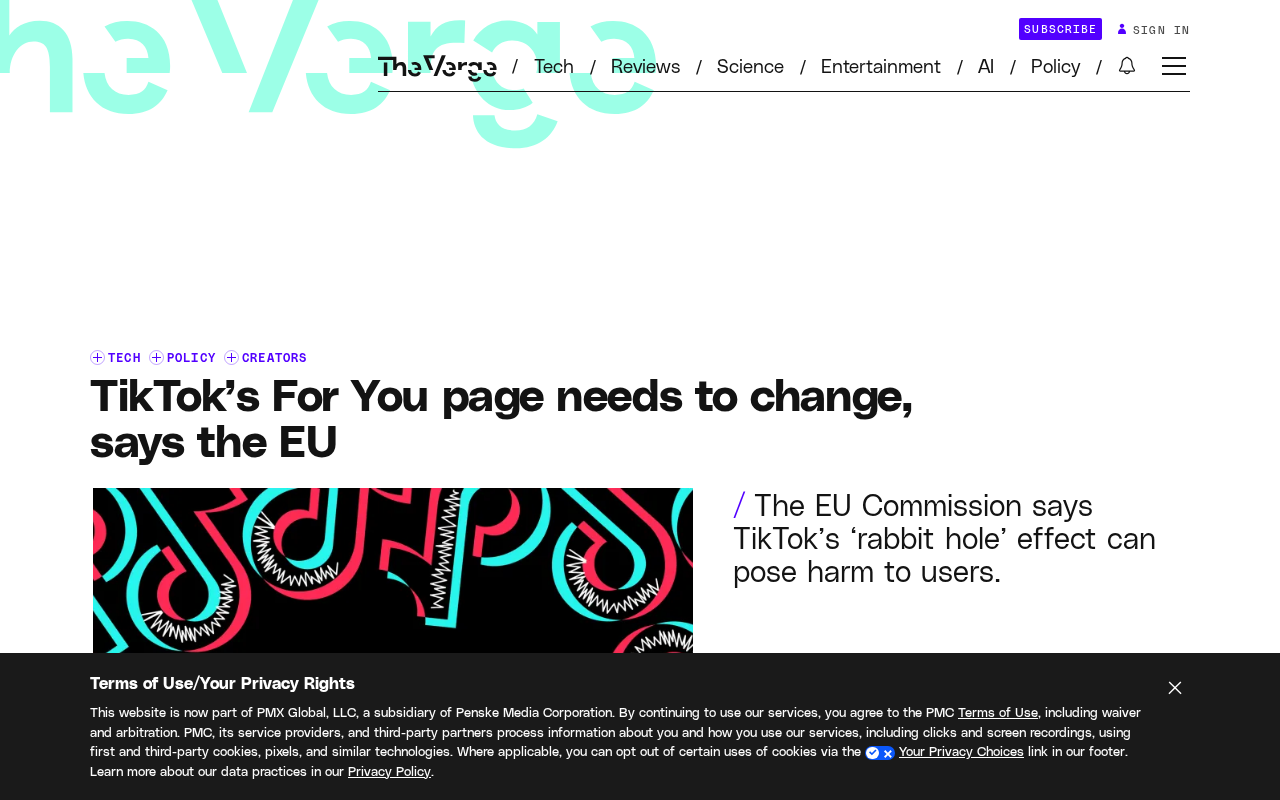
The EU has formally accused TikTok's recommendation algorithm of creating a 'rabbit hole effect,' violating online platform rules.
The European Commission has filed formal charges against TikTok's 'For You' algorithm, arguing that its endless repeated pushing of content related to sadness, isolation, or body image may harm users' mental health, with the core issue being the algorithm-driven 'rabbit hole effect.' The accusation comes after months of investigation and continues the EU's tightening regulation of large online platforms, based on compliance obligations requiring platforms to assess and mitigate systemic risks. The article notes that recommendation algorithms, as hard-to-penetrate 'black boxes,' are themselves becoming a regulatory focus; TikTok is not alone in facing such pressure, with Meta and YouTube also under scrutiny. Algorithm governance has entered deep waters, with platforms needing to balance user engagement and content diversity while regulators need to establish operable assessment standards.
EU Takes Aim at TikTok's Algorithm: Recommendation System Accused of Creating a 'Rabbit Hole Effect'
The European Commission has recently filed formal charges against TikTok's recommendation algorithm, arguing that its "For You" page may violate the EU's online platform rules. In an announcement released on Friday, regulators stated that TikTok's algorithm may harm users by "endlessly and repeatedly pushing" content related to sadness, isolation, or body image.
At the heart of the accusation is the algorithm-driven "rabbit hole effect"—where the recommendation system continuously feeds users similar content, drawing them into an increasingly extreme or negative information stream. The European Commission believes this phenomenon is particularly pronounced on TikTok's "For You" page, especially when users encounter content related to emotional distress or body anxiety, with the algorithm persistently amplifying exposure to such themes.
Why Algorithmic Recommendation Has Become a Regulatory Focus
Recommendation algorithms have long been the core competitive advantage of social media platforms, and also the "black box" that regulators find hardest to penetrate. TikTok's algorithm is renowned for its precision and immersion, capable of rapidly adjusting content distribution based on signals such as user dwell time and interaction behavior. Yet it is precisely this highly efficient content-matching capability that has regulators concerned about its potential systemic impact on users' mental health.
The European Commission's accusation does not target any specific category of content but rather the operating mechanism of the algorithm itself: when the system detects that a user is interacting with emotionally charged content, does it push similar content without restraint, thereby creating "endless repeated exposure"? For adult users, this mechanism may be merely a matter of experience, but for vulnerable groups such as adolescents, it could have far-reaching consequences.
The Technical Logic Behind the 'For You' Page
TikTok's "For You" Page (FYP) is not a single model but a recommendation pipeline composed of multiple stages including recall, ranking, and re-ranking. The system integrates user behavioral signals (completion rate, likes, comments, shares, quick swipes, etc.), content features (video tags, audio, visual elements), and collaborative filtering signals to generate a personalized information stream for each user in real time. Its notable characteristics are strong cold-start capability and a short feedback loop—every minor interaction from the user immediately influences subsequent pushes. This "instant reinforcement" mechanism is precisely the source of regulatory concern: if a user pauses even briefly on emotionally charged content, the algorithm may interpret it as an interest signal and increase the exposure weight of similar content.
Platform Rules and Compliance Pressure
This accusation is yet another signal of the EU's tightening regulation of large online platforms. Under the EU's online platform rule framework, platforms are obligated to assess and mitigate the risks their systems may pose, including the impact of algorithmic recommendation on users' physical and mental health. The European Commission believes that TikTok has failed to fully fulfill this obligation, with compliance gaps in the design and operation of its recommendation system.
You may not have noticed that this accusation comes months after the EU launched its investigation into TikTok. Regulators clearly waited until they had gathered sufficient information before advancing the investigation to the formal charge stage. For TikTok, this means its operations in the European market will face stricter scrutiny, with algorithm transparency, risk assessment mechanisms, and user protection measures all likely to become priorities for subsequent remediation.
Risk Assessment Obligations Under the Digital Services Act (DSA)
The online platform rule framework underpinning the EU's accusation is centered on the Digital Services Act (DSA). Adopted in 2022 and fully applicable in 2024, the regulation designates platforms with over 45 million monthly active users as "Very Large Online Platforms" (VLOPs), which must fulfill stricter systemic risk assessment and mitigation obligations. Specifically, VLOPs must annually assess the risks posed by their recommendation systems, content moderation, and other design choices to users' mental health, protection of minors, and quality of public discourse, and take reasonable measures to reduce those risks. The European Commission's accusation against TikTok is based on the view that there are compliance gaps in its algorithm design and risk assessment—not merely targeting a specific piece of violating content. This marks a shift in regulatory logic from "content accountability" to "system accountability."
Industry Impact: Algorithm Governance Enters Deep Waters
TikTok is not the only platform facing such pressure. From Meta to YouTube, the potential impact of recommendation algorithms on users' mental health has become a shared concern among regulators worldwide. The EU's accusation against TikTok may serve as a reference for similar actions against other platforms in the future.
The deeper issue is that the "rabbit hole effect" created by algorithmic recommendation is difficult to eliminate with simple rules. Platforms need to find a balance between user engagement and content diversity, while regulators need to establish operable assessment standards. The outcome of this contest will directly affect how future social media products design their recommendation strategies and how users can maintain autonomy within their information streams.
For content creators and ordinary users alike, this event also reminds us: recommendation algorithms are not neutral information pipelines—every push is a choice. When choices become systematized and scaled, their social impact is no longer merely a technical issue.
The Difference Between the 'Rabbit Hole Effect' and Filter Bubbles
The "rabbit hole effect" and "filter bubble" are often used interchangeably, but they emphasize different things. Filter bubbles emphasize that users, due to personalized recommendations, are less exposed to heterogeneous information, forming information cocoons; the rabbit hole effect, by contrast, emphasizes a progressive path toward extremization—the system not only pushes similar content but also tends to gradually escalate intensity, causing users to slide unknowingly from mild interest toward increasingly negative or extreme content tiers. For TikTok, its short-video format and high feedback frequency make this progression harder for users to perceive and harder for regulators to quantify. This is why regulators emphasized the dynamic mechanism of "endless repeated pushing" in their accusation, rather than static content categories.
Related articles
 Tech Frontiers
Gemini Omni 1.2 Flash: AI Video Moves Toward Draft-Style Editing
Google's Gemini Omni 1.2 Flash update enables conversational, draft-style editing of the same video—swap scenes while keeping products, adjust lighting while keeping characters. Clips up to 15s, 720p costs 30% less than the previous Flash—ideal for e-commerce ads, previs, and short-asset production.

Codex Tutorial: One-Command Install and Run Your First Task
Codex tutorial: one-command install and run your first task. Covers the four Codex forms, sandbox and approval guardrails, AGENTS.md and MCP configs, cloud network policy, and the iron rule of human review—everything you need to get started with this autonomous coding agent.
 Tech Frontiers
Localix: An Open-Source Agentic Development Environment with Multi-Model and Local AI Integration
Localix is an MIT open-source Agentic Development Environment (ADE) supporting seamless Claude Code plugin loading, multi-model cloud and local execution, Mini Apps extensions, and agent context management—an open AI collaboration workbench for developers.