EU DSA Enforcement Escalates: Feed Choice and Addictive Design Take Center Stage

The EU DSA pushes feed design into the regulatory spotlight, requiring non-personalized options for very large platforms and preliminarily scrutinizing addictive design like infinite scroll.
The EU's Digital Services Act is bringing how large online platforms shape user attention into regulatory view. According to the European Commission's policy page, platforms with over 45 million EU users can offer a non-personalized feed, letting users choose between algorithmic recommendations and chronological ordering. Meanwhile, the Commission preliminarily finds that Meta's Facebook and Instagram may violate the DSA due to addictive design features such as infinite scroll, autoplay, and highly personalized recommendations, and it had previously issued investigation findings against TikTok involving similar design issues. The 45 million user threshold means not all company websites or apps face mandatory requirements, but the directional signal is clear: recommendation transparency, user control, and engagement feature design are becoming substantive considerations. Product teams should review whether their designs are clear, purposeful, and centered on clear user benefits.
The EU's Digital Services Act (DSA) is pushing the question of how large online platforms shape user attention to the forefront of regulation. According to the European Commission's official policy page, platforms with more than 45 million EU users can offer a non-personalized feed, letting users choose between algorithmic recommendations and chronological ordering. At the same time, the Commission has launched high-profile enforcement actions targeting design features that may induce users to stay on a platform for extended periods.
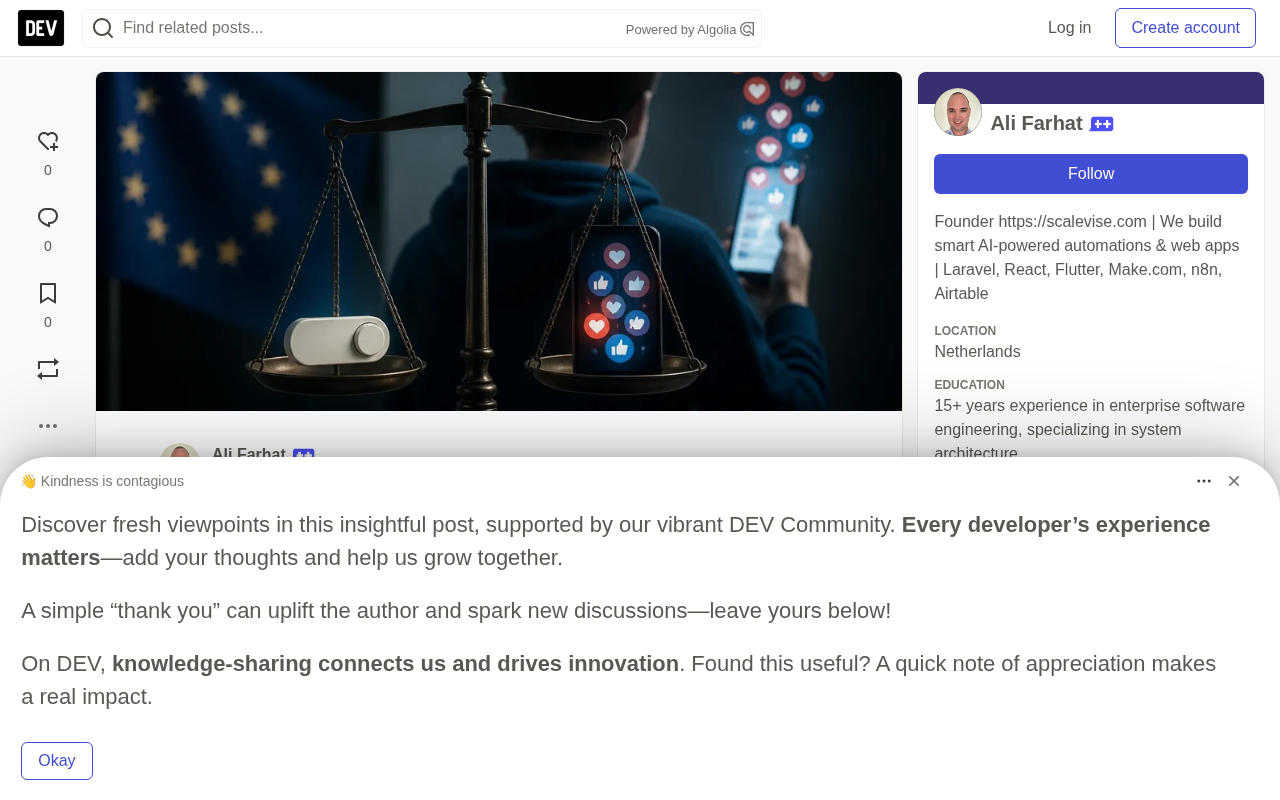
The deeper significance of this shift is that feed design is no longer just a commercial decision about product and user engagement. For platforms that meet the DSA's largest-scale threshold, it is increasingly tied to user choice, well-being, and regulatory scrutiny.
What the Commission Confirmed and What It Is Investigating
The European Commission's DSA information page shows that platforms with more than 45 million EU users can offer a non-personalized recommendation option. Put simply, users can choose whether to view algorithmically recommended content or browse their feed in chronological order. This is a substantive change to how large social and content platforms present content: ranking based on predicted interests can no longer be the only experience available to users.
Another enforcement development explains why this issue has become more prominent. The Commission published preliminary findings that Meta's Facebook and Instagram may violate the DSA regarding addictive design features, including infinite scroll, autoplay, and highly personalized recommendations. It is important to emphasize that these are preliminary findings, not a final ruling.
The Commission had previously also issued investigation findings against TikTok involving similar design issues. Taken together with the feed control option, the EU is examining two dimensions at once: how recommendation mechanisms are explained and controlled, and whether interface patterns contribute to excessive use.
| Development | Target or Scope | What Verified Materials Confirm | Status |
|---|---|---|---|
| Non-personalized feed option | Platforms with more than 45 million EU users | Users can choose between algorithmic recommendations and chronological ordering | Confirmed on the Commission's DSA policy page |
| Addictive design investigation | Meta's Facebook and Instagram | Commission preliminarily finds possible DSA violations involving infinite scroll, autoplay, and highly personalized recommendations | Preliminary findings |
| Earlier design-related investigation | TikTok | EU action involves similar design issues | Earlier investigation findings |
Why This Distinction Matters for Businesses
The 45 million EU user threshold is noteworthy. The verified materials clearly place the feed option in the context of very large platforms and do not establish that every company website, app, or online service must add a chronological feed, remove infinite scroll, or deploy specific screen-time tools.
However, smaller product teams should not ignore the direction of this trend. Businesses building services for audiences in Europe can view these developments as a design signal: engagement features should be understandable, users should have meaningful control in relevant contexts, and product choices that deliberately extend attention may face more scrutiny as the regulatory conversation advances.
For marketers, the practical implications are equally clear. Recommendation-driven feeds are valuable for content discovery, but businesses should not assume that users spending more time in an interface is automatically a better outcome. User experiences that make content choices more transparent may help build trust, even if this reduces reliance on opaque ranking.
The difference between preliminary findings and final rulings: In EU competition and digital regulatory proceedings, the Commission typically first issues "preliminary findings," giving the party under investigation an opportunity to respond in writing and remedy the situation, before a formal decision may be made and fines or behavioral remedies imposed. Therefore, the Meta case described here is still at an early stage and has not produced final legal consequences. For businesses, this distinction means the relevant judgments do not yet constitute a compliance precedent, but can serve as an early risk warning signal.
What Product Teams Should Review Now
Existing materials do not provide a unified DSA compliance checklist, nor do they support cost estimates or a mandatory set of audit tools. Businesses can still use the confirmed developments to ask focused product questions:
- Does the service use personalized recommendations, autoplay, or continuous scrolling?
- Can users understand that a recommendation mechanism, rather than chronological order, determines what they see?
- Where feed ranking forms a core part of the experience, are there credible user control options?
- Are engagement features designed around clear user benefits, rather than simply keeping people active for longer?
These questions are particularly relevant for companies developing social, media, community, or content discovery products. They are not a substitute for legal advice, and the Commission's preliminary findings against Meta should not be viewed as a final ruling or as proof that all similar features violate the DSA.
Businesses that rely on personalized experiences also need a pragmatic balance. Completely removing recommendations is not the implication of the Commission's regulatory approach. The clearer takeaway is that user choice and the impact of design patterns are becoming substantive considerations alongside relevance and engagement.
The DSA's "Very Large Online Platform" (VLOP) regime: The DSA sets tiered obligations based on a platform's user scale in Europe. Platforms with more than 45 million monthly active users are designated as VLOPs by the European Commission and must undergo stricter risk assessments, transparency reporting, and external audits. The non-personalized recommendation option is one representative obligation among them. Platforms below the threshold are still subject to the DSA's general rules, but the intensity of obligations is markedly different, which is why the "45 million threshold" is repeatedly emphasized in this article.
"Addictive design": This is not a single term in the DSA text itself, but rather a collective reference in regulatory practice to a category of interface patterns—designs that extend usage time and weaken users' ability to stop on their own through means such as infinite scroll, autoplay, continuous push notifications, and strong personalization. Article 25 of the DSA prohibiting "dark patterns," along with Articles 34-35 requiring VLOPs to assess and mitigate risks to physical and mental well-being, form the legal basis for the Commission's scrutiny of such designs.
Frequently Asked Questions
What kind of feed choice does the EU DSA support for large platforms?
According to the European Commission, platforms with more than 45 million EU users can offer a non-personalized feed. Users can choose between algorithmic recommendations and chronological ordering.
Has the European Commission issued a final DSA ruling against Meta regarding addictive design?
No. What the Commission published are preliminary findings that Facebook and Instagram may violate the DSA due to features such as infinite scroll, autoplay, and highly personalized recommendations.
Does the confirmed feed option apply to every company website or app in Europe?
The verified materials place this option in the context of platforms with more than 45 million EU users and do not establish a universal requirement for every website or app.
Why are infinite scroll and autoplay drawing attention under the DSA?
The Commission's preliminary findings against Meta list infinite scroll, autoplay, and highly personalized recommendations as addictive design features under investigation. The broader concern is user well-being and platform accountability.
Conclusion
The DSA's influence is increasingly evident in the details of digital product design. The confirmed feed choice option for the largest platforms, combined with preliminary enforcement actions around infinite scroll, autoplay, and personalized recommendations, shows that user attention and control are now core issues for major services in Europe. For other businesses, the priority is to examine whether their own engagement designs remain clear, purposeful, and defensible as expectations evolve.
Related articles

JobRunner MCP Server: AI Agents Can Now Fix Failed Java Jobs
JobRunner launches an open-source MCP server enabling AI agents to view cluster status, diagnose failures, and recover Java jobs—incident response from any cloud coding environment or existing agent.

MLAI Digital Launches 9 Security Agents: MCP Server Safeguards the Full Lifecycle of Agentic AI
MLAI Digital launches Security MCP Server with nine built-in specialized security agents covering vulnerability discovery, attack simulation, prompt injection detection, API and infrastructure assessment, and accelerated remediation—embedding security validation across the full Agentic AI lifecycle from development to production.

Running Isaac Lab on H100 GPUs: Exploring Better Approaches
Exploring optimization methods for running Isaac Lab on NVIDIA H100 GPUs, including MIG configuration, mixed precision, TensorRT acceleration, and community experience to improve robotics simulation and reinforcement learning efficiency.