Evaluating LLM-Generated World Models: Mechanical Validity Is Not Semantic Fidelity

LLM-generated world models score high on mechanical validity but lack structural fidelity—executable does not mean correct.
The study systematically evaluated five LLMs' ability to generate Partially Observable Stochastic Game (POSG) formal world models from natural language descriptions, building a 44-scenario benchmark spanning games, situations, and culture and analyzing 410 first-round generations. In the games track, 134 of 135 generated models passed the mechanical validity audit, but average structural F1 was only 0.366 and only 28 exactly matched the reference; in the culture track, explicit country names changed generated structure while automated semantic scores barely moved. The study concludes that mechanical validity is necessary but not sufficient, and structural deviations can affect downstream neuro-symbolic reasoning and planning, requiring integrated evaluation of structural consistency and semantic criteria.
Introduction: When LLMs Become World-Model Builders
Neuro-symbolic reasoning systems rely on formalized world models for planning, verification, and safety reasoning. However, constructing such models from open-ended natural language descriptions is extremely difficult—especially in multi-agent settings, where the same situation may admit multiple reasonable formalizations. A recent study systematically evaluated the ability of five LLMs to generate formal world models as Partially Observable Stochastic Games (POSGs), and raised a key question: Is mechanical validity sufficient to guarantee that a model faithfully reflects the original decision problem?
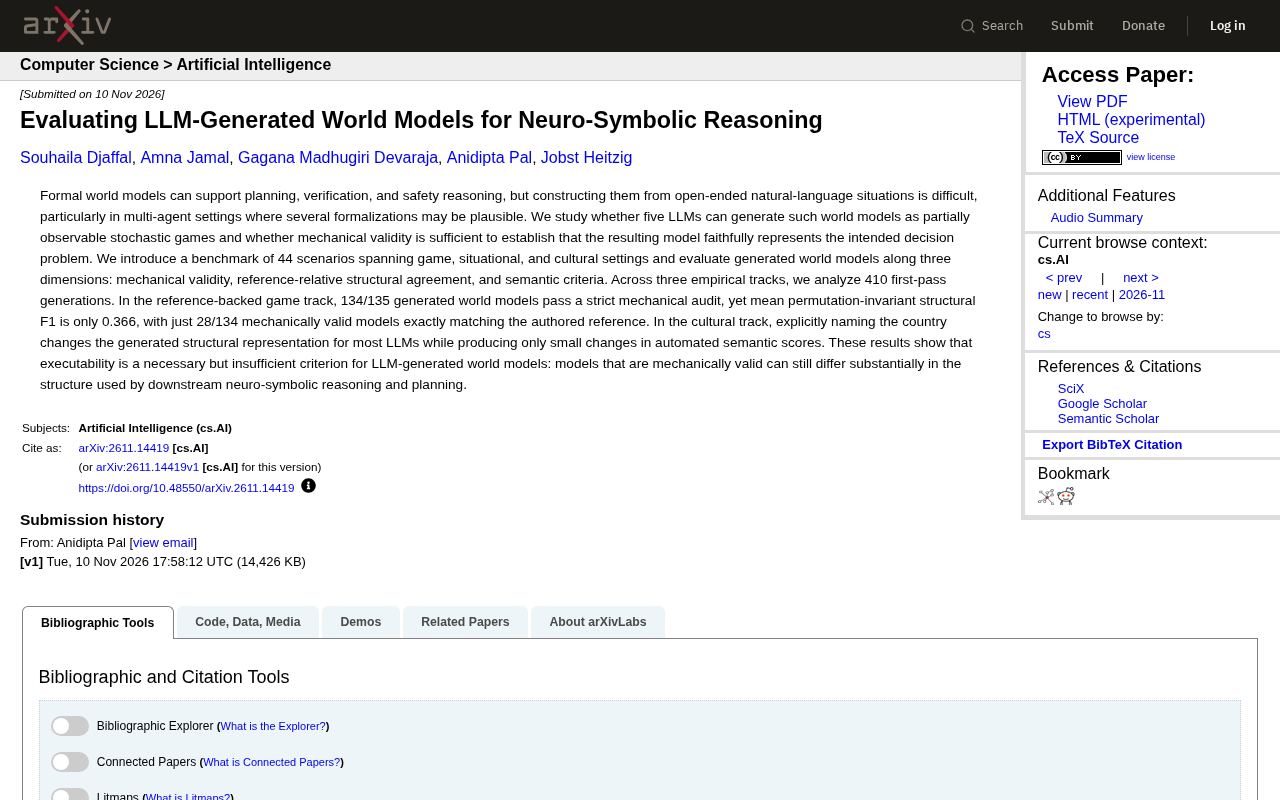
The study built a benchmark of 44 scenarios spanning three categories—games, situations, and culture—and evaluated the generated world models along three dimensions: mechanical validity, reference-relative structural consistency, and semantic criteria. Through an empirical analysis of 410 first-round generations, the study revealed an alarming finding: executability is only a necessary condition, not a sufficient one.
Partially Observable Stochastic Game (POSG) is a formal framework in multi-agent reinforcement learning and game theory used to describe decision problems in which multiple agents interact in uncertain environments. Unlike fully observable Markov decision processes, in a POSG each agent receives only local observations of the global state, and state transitions and environmental behavior are stochastic. A POSG typically consists of a state set, each agent's action set, observation functions, transition probability functions, reward functions, and an initial state distribution. POSGs are well suited as a representation for world models because they can simultaneously capture three core features of the real world: concurrent multi-agent decision-making, information incompleteness, and environmental uncertainty. As a result, they are widely used in formal verification and planning research for safety-critical systems.
Evaluation Framework: Rigorous Testing Along Three Dimensions
Mechanical Validity: Can the Model "Run"?
Mechanical validity checks whether a generated world model conforms to the formal definition of a POSG—whether elements such as states, actions, observations, and transition probabilities are complete and syntactically correct. In the reference-based games track, 134 of 135 generated models passed the strict mechanical audit, an extremely high pass rate. This indicates that LLMs are already quite mature at mastering formal syntax.
Structural Consistency: Degree of Agreement with the Reference Model
The study used a permutation-invariant structural F1 score to measure structural similarity between generated models and human-authored reference models. Despite near-perfect mechanical validity, the average structural F1 was only 0.366, and only 28 (of the 134 mechanically valid models) matched the reference model exactly. This means that most models, while "runnable," deviate significantly in internal structure from the intended decision problem.
Permutation-invariant structural F1 score is a metric for comparing the similarity of two structured models. Its core idea is that precision and recall are computed without depending on the specific ordering of elements; instead, they are based on set matching of structural elements (such as states, actions, and transition relations). The emphasis on "permutation invariance" is because the same POSG can be equivalently written with many different orderings of elements, and direct position-by-position comparison would produce spurious differences. Structural F1 combines precision (the proportion of elements in the generated model that match the reference) and recall (the proportion of elements in the reference model that are covered by the generated model), with values between 0 and 1—higher values indicate closer structure. This metric can reveal models that are mechanically valid but whose internal organization deviates from the reference, making it an important tool for evaluating the fidelity of generated world models.
Semantic Criteria: Automated Semantic Scoring
In the culture track, the study observed an interesting phenomenon: when country names were explicitly specified, most LLMs changed their generated structural representations, yet automated semantic scores changed very little. This suggests that semantic scoring may fail to capture important differences at the structural level, further highlighting the necessity of multi-dimensional evaluation.
Key Findings: The Limits of Mechanical Validity
Structural Deviation Behind a High Pass Rate
The 134/135 mechanical validity pass rate in the games track may look optimistic, but the structural F1 of only 0.366 and exact matches of only 28/134 reveal a serious problem. For downstream neuro-symbolic reasoning and planning tasks, structural deviations can lead to completely different decision behavior. A mechanically valid model may cause an agent to produce plans that contradict the designer's intent.
Sensitivity to Cultural Context
Results from the culture track show that LLMs are sensitive to contextual cues (such as country names) and adjust their generated structural representations, but this adjustment is not adequately reflected in automated semantic scores. This suggests that relying solely on semantic similarity metrics may mask substantive changes at the structural level, and structure is precisely the core on which symbolic reasoning depends.
Implications for Neuro-Symbolic Reasoning
This study issues an important warning to the AI community: when using LLMs to generate world models that support neuro-symbolic reasoning, "the model is executable" cannot be the only acceptance criterion. Comprehensive evaluation incorporating structural consistency and semantic criteria is needed. In scenarios such as multi-agent systems and safety-critical applications, subtle deviations in model structure may be amplified into serious safety or planning errors.
Future directions may include: developing stronger structural alignment constraints, designing structure-aware semantic metrics, and introducing human feedback or symbolic verification loops into the LLM generation process. Current results show that LLMs still have clear shortcomings as world-model builders and require more refined evaluation and improvement methods.
Neuro-symbolic reasoning is an AI paradigm that integrates neural networks with symbolic logical reasoning: neural networks extract patterns and representations from perceptual data, while symbolic systems perform interpretable deduction, planning, and verification over formalized knowledge (such as logic rules and world models). Its advantage lies in combining learning ability with the verifiability of reasoning, which is why it attracts considerable attention in safety-critical scenarios. However, the conclusions of symbolic reasoning depend heavily on the structural correctness of the input world model—if the model's states, actions, or transition relations do not match the real problem, the symbolic engine will still produce plans that are "logically correct" yet contrary to the designer's intent. This is precisely the fundamental reason the study emphasizes structural fidelity rather than mere mechanical validity: the reliability ceiling of a neuro-symbolic system is constrained by the structural quality of the world model it relies on.
Conclusion
Through a systematic evaluation of 44 scenarios and 410 generations, the study demonstrates that LLM-generated world models perform excellently on mechanical validity but fall significantly short on structural fidelity. Mechanical validity is a necessary but not sufficient condition—a conclusion with profound implications for the reliability of neuro-symbolic reasoning systems and one that points to a key direction for future research.
Related articles

Bin's Live Stream Highlights: Hilarious Interactions from "You Came at the Right Time" to "I'll Support You From Now On"
Bin's hilarious live stream highlights: from "You came at the right time" to "I'll support you from now on," featuring Championship skins, wigs, and other game memes that showcase Bilibili's unique streaming culture.

Hunter Rescues Educated Youth: The Mountain-Chasing System Launches a New Warm-Hearted Viral Drama Formula
Bilibili's early-access period short drama *Everyone Thinks I'm a Poor Hunter* opens with a snowy-night rescue of an educated youth. Hunter Chen Shan activates the mountain-chasing system, using realistic hypothermia first-aid details and mutual-probing character dynamics to deliver a warm-hearted period drama without the sleaze.

Riemann Hypothesis Proven by AI? The Truth Has Nothing to Do With Your Reality
34-year-old mathematician Levent Alpöge claims to have proven the Riemann Hypothesis and Generalized Riemann Hypothesis with Claude, releasing 17 million lines of formal verification code. This article sorts out the facts, debunks myths about RSA collapse and new material revolutions, and analyzes the true significance of mathematics-AI collaboration.