Even Amazon Struggles to Meet Net-Zero Pledges — What Does That Mean for Corporate Climate Commitments?

Amazon's net-zero struggle exposes the systemic barriers large companies face in delivering on climate commitments.
Using Amazon as a lens, this article examines the deep challenges large corporations face in fulfilling net-zero pledges. Amazon's operations span e-commerce, cloud computing, and logistics, leaving a carbon footprint across every link of a global supply chain. The hardest obstacle is Scope 3 emissions — indirect emissions from suppliers and consumers that typically make up the vast majority of a company's total footprint yet remain largely outside its direct control. The article also explores the boundaries of corporate climate responsibility, arguing that climate change is a systemic, society-wide problem that no single company can solve alone — requiring coordinated action from policymakers, supply chain partners, and consumers alike.
Amazon's Net-Zero Pledge Faces a Reality Check
As one of the world's largest companies, Amazon's every move on carbon neutrality is treated as an industry bellwether. When a corporate giant with vast resources, technology, and capital finds itself struggling to figure out how to eliminate its carbon emissions entirely, a sharp question emerges: if even Amazon doesn't know how to do it, who can?
This isn't mere cynicism — it points to the systemic challenges that large tech and retail companies face when trying to deliver on their climate commitments. Net-zero pledges sound clear and straightforward on paper, but bridging the gap between stated goals and real-world implementation means navigating complex supply chains, energy structures, and technological bottlenecks.
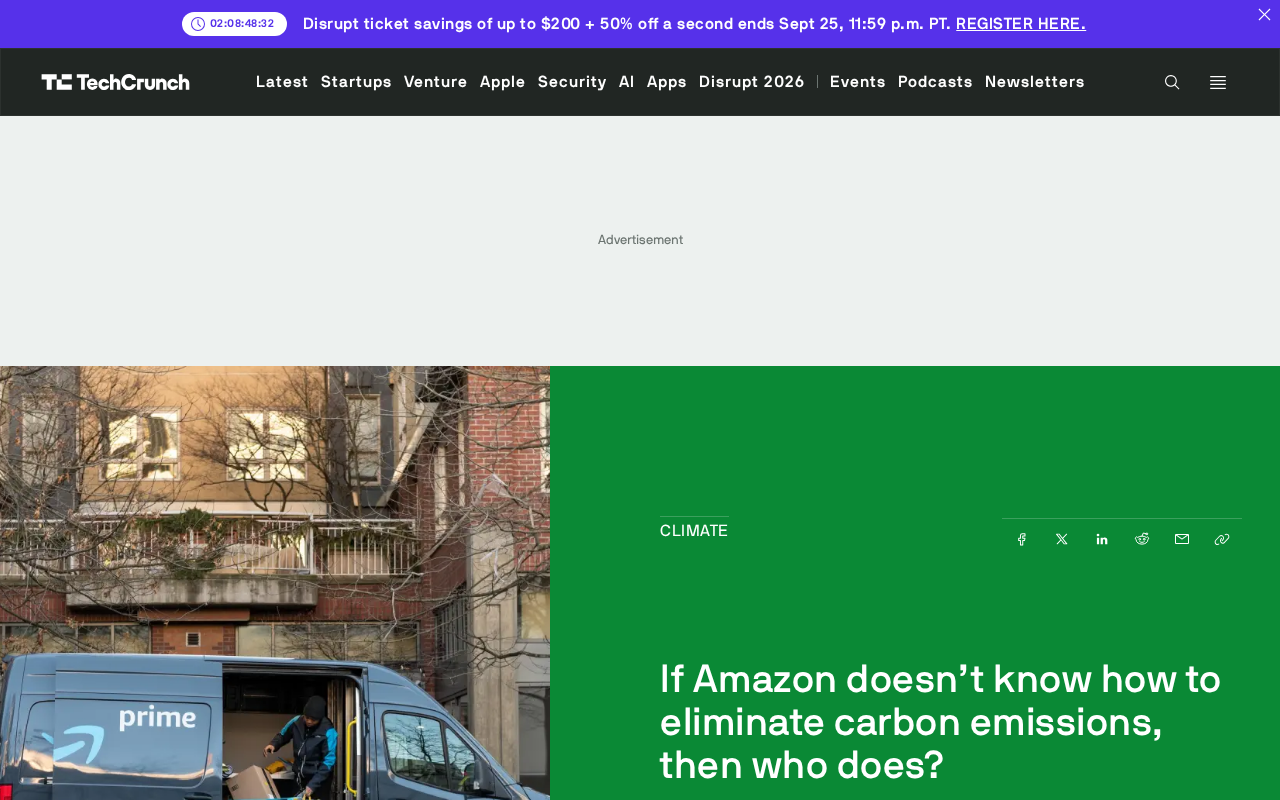
In 2019, Amazon co-founder Jeff Bezos launched "The Climate Pledge," committing the company to reach net-zero carbon emissions by 2040 — a full decade ahead of the 2050 target set for businesses under the Paris Agreement. The initiative has since been signed by hundreds of companies. The terms "net-zero" and "carbon neutral" are often used interchangeably, but there's an important distinction: carbon neutrality typically allows companies to offset hard-to-eliminate emissions by purchasing carbon credits, while net-zero holds companies to a stricter standard — requiring deep cuts to absolute emissions first (generally 90% or more), with only the remaining residual emissions offset through carbon removal methods such as direct air capture or natural carbon sinks. Third-party bodies like the Science Based Targets initiative (SBTi) have established more rigorous criteria for what qualifies as "net-zero," meaning corporate pledges are now subject to greater external scrutiny.
The Bigger the Company, the Heavier the Responsibility?
Amazon's business spans e-commerce, cloud computing, logistics and delivery, hardware manufacturing, and more. That sprawling footprint means its carbon emissions are distributed across the globe — from the electricity consumed by data centers, to vast networks of warehouses and transportation, to the production activities of upstream suppliers. Every link in the chain is a source of emissions.
The general expectation from the public and regulators is clear: the larger the company, the greater its responsibility to reduce emissions. But scale also makes reduction harder. Everything is interconnected, and any single emissions-reduction measure may involve tens of thousands of partners and extraordinarily complex operational changes. This is the core tension the question raises — the friction between responsibility and capability.
Why Net-Zero Targets Are So Hard to Execute
The reason net-zero commitments are so difficult to fulfill comes down to a fundamental reality: not all of a company's emissions are directly generated by the company itself. The industry typically categorizes emissions into three scopes: Scope 1 (direct emissions), Scope 2 (emissions from purchased energy), and Scope 3 (emissions across the value chain, upstream and downstream). For companies like Amazon, Scope 3 typically accounts for the overwhelming majority of total emissions — and it's precisely the part that companies have the least direct control over.
Suppliers' energy choices, how consumers use products, and end-of-life product management are all outside a company's full control. Achieving true net-zero requires not just internal transformation but coordinated change across an entire industry ecosystem — far beyond what any single company can accomplish on its own.
The Scope 1/2/3 emissions framework was developed by the Greenhouse Gas (GHG) Protocol and is now the most widely used international standard for corporate carbon accounting. Scope 1 covers direct emissions from sources owned or controlled by the company, such as company vehicles and on-site fuel combustion. Scope 2 covers indirect emissions associated with purchased electricity, heat, or steam. Scope 3 encompasses all other indirect emissions across the company's value chain — including upstream activities like raw material sourcing and supplier manufacturing, as well as downstream activities like consumer product use and end-of-life disposal. For most retail and tech companies, Scope 3 emissions typically account for 70% to 90% or more of their total carbon footprint. In Amazon's case, this includes the manufacturing activities of hundreds of thousands of third-party sellers, the electricity consumed by millions of customers running workloads on AWS servers, and the tailpipe emissions from outsourced logistics networks. Because these emissions occur outside the company's legal boundaries, they can't be directly measured or mandated — companies can only exert indirect influence through procurement standards, supplier training programs, or financial incentives. This is the most operationally intractable challenge in pursuing net-zero.
Who Gets to Define "Reasonable Responsibility"?
Another key question raised in this discussion is: to what extent should Amazon be held accountable for delivering on its net-zero pledge? This gets at the deeper problem of where corporate climate responsibility ends.
On one hand, companies that voluntarily make commitments are obligated to be held to them. On the other hand, climate change is fundamentally a systemic, society-wide challenge — placing all the pressure on individual companies is neither realistic nor fair. A sensible path forward may involve companies doing everything within their power to drive change, while policymakers, supply chain partners, and consumers all play their part to create a coordinated response.
What Amazon's Struggle Tells the Rest of the Industry
Amazon's situation mirrors that of many large companies. When even industry leaders are making slow, difficult progress on emissions reduction, it's a reminder that corporate climate pledges cannot be delivered on good intentions alone — they require pragmatic roadmaps, verifiable progress, and multi-stakeholder collaboration mechanisms.
For those watching the climate space, the more productive question isn't "who can actually do this?" but rather "how do we steadily close the gap?" Carbon neutrality is not a finish line to be crossed in one leap — it's a long-term journey that demands sustained investment and institutional support.
Related articles

Chain of Thought Isn't Just for AI: How Humans Can Use CoT to Improve Thinking Quality
Chain of Thought isn't just a prompt trick for large models. Starting from a Hacker News discussion, this article analyzes why CoT works for human thinking too, breaks down actionable ways to transfer it, and highlights the key differences between human CoT and machine CoT.
Cloudflare Teams Up with OpenAI: Closi…
Cloudflare Teams Up with OpenAI: Closing the Loop from Vulnerability Discovery to Defense with AI
Cloudflare uses OpenAI Daybreak to investigate security vulnerabilities and generate reviewable remediation plans, while developers use Codex to boost coding efficiency and quality.

Orca Multi-Agent Orchestration in Practice: A Guide to Parallel Collaboration with Claude and Codex
Orca is Stable AI's free open-source agent workbench supporting 34 agents like Claude Code and Codex in parallel. Learn its Git worktree isolation, multi-model orchestration, and mobile management.