Even Sam Altman Isn't Immune: Meta Executive Uses AI Deepfakes to Promote Product

Meta's Chief AI Officer used a deepfake video to promote AI agent Muse, exposing platform governance and likeness rights challenges.
Meta Chief AI Officer Alexandr Wang posted an AI-generated promotional short video on Instagram to build buzz for the consumer AI agent Muse. The video featured deepfaked likenesses of tech leaders including Zuckerberg and Altman, with no clear labeling. The core tension: Meta pushes AI content labeling standards while its own executive posts an unlabeled fabricated video in the platform feed—and the person faked is the CEO of competitor OpenAI, with clear commercial intent. The article discusses the structural contradictions of platform governance, the boundaries of celebrity likeness rights and informed consent, and the trust cost of using deepfakes to market consumer AI products, noting that the real challenge for watermarking and provenance solutions lies in the willingness to execute rather than the technology.
Meta Description
Meta Chief AI Officer Alexandr Wang posted an AI-generated short video on Instagram to promote the company's consumer AI agent Muse, featuring deepfaked likenesses of Zuckerberg and OpenAI CEO Sam Altman—an episode that highlights the awkwardness of social platforms' AI content governance and the boundary issues around celebrity likeness rights.
Article Content
Meta Chief AI Officer Alexandr Wang posted an AI-generated short video on Instagram to promote the company's consumer-facing AI agent Muse. The video featured the likenesses of Meta CEO Mark Zuckerberg, OpenAI CEO Sam Altman, and other tech leaders—except these likenesses were all deepfakes. The news itself serves as a rather ironic footnote: when a platform executive personally resorts to deepfakes for marketing, the boundary issues surrounding AI-fabricated content are once again thrust into the spotlight.
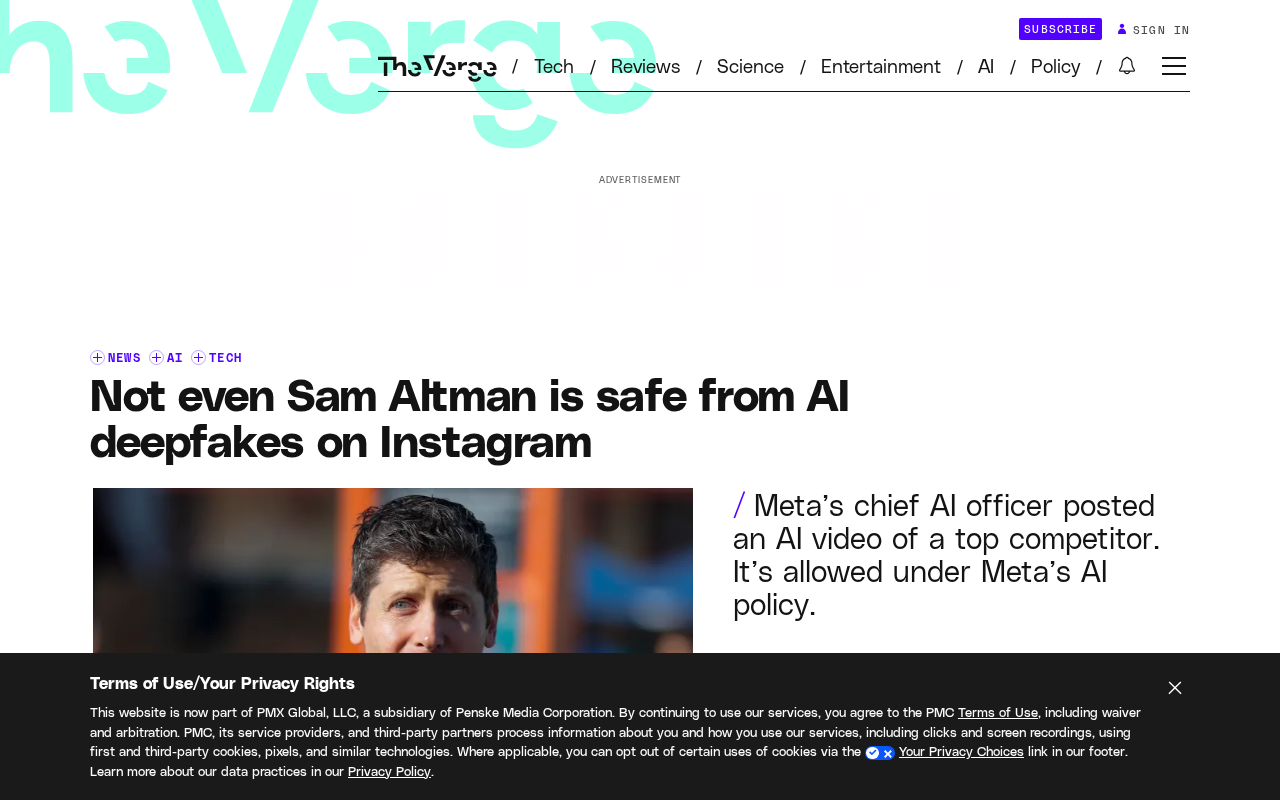
Incident Recap: A Promotional Clip Sparks Discussion
According to the original report, Alexandr Wang posted the short video to Instagram earlier in November, with the core purpose of generating buzz for Muse. Muse is Meta's consumer-facing AI agent product. The video was AI-generated, featuring industry icons such as Zuckerberg and Altman—but these individuals did not actually participate in the filming; their likenesses were synthesized by models.
What's particularly intriguing is the contrast in identities. Wang is Meta's Chief AI Officer, and Meta is Instagram's parent company; Altman, meanwhile, heads OpenAI, Meta's direct competitor in the AI race. In other words, a piece of content released by a platform executive, using the fabricated likeness of a competitor's CEO for promotion, appeared brazenly in the platform's own feed.
This is not an isolated case. The report noted that Instagram is already flooded with deepfake content posted by users, and Wang's video is merely the latest—and most newsworthy—example.
Why This Matters
The Awkward Position of Platform Governance
On one hand, Meta continues to invest in AI content labeling and provenance technology, promoting standards for marking AI-generated content; on the other hand, its own executive used an unlabeled fabricated video for product promotion. This tension exposes a structural dilemma in platform governance: the rules are set by the platform, and the platform itself is often the party hardest to constrain by those rules.
For ordinary users, the problem feels more immediate. When fabricated content comes from a verified executive account, the visual quality is convincing enough to pass as real, and the distribution context is the everyday information feed, users have almost no sufficient clues to judge authenticity. The risk of deepfakes lies not in how advanced the technology itself is, but in the fact that it has descended into the most ordinary social scenarios.
Content Credentials is an open technical standard promoted by the Coalition for Content Provenance and Authenticity (C2PA), which embeds cryptographically signed provenance information in file metadata so that images and videos carry verifiable records of "who created it, with what tool, and through what edits" as they circulate. Adobe, Microsoft, Google, and others have announced support, and Meta has also stated it will integrate related labeling into its products. But its limitations are equally obvious: metadata can be stripped during screenshots, transcoding, or re-uploads, and it relies on publishers to actively enable it. This means that a synthesized clip casually posted by an executive account, if not actively tagged with credentials, is difficult for ordinary users and platform moderation systems to automatically identify—there is a clear gap between the technical completeness of the standard and its actual coverage.
Celebrity Likeness and the Boundaries of Consent
The synthesis of public figures like Altman and Zuckerberg into commercial promotional content touches on issues of likeness rights and informed consent. Public figures typically have a stronger desire for control over the commercial use of their likeness, and AI generation makes such control extraordinarily difficult—models can easily reproduce a person's facial features and speaking style at a cost that is almost negligible.
There is also a more subtle dimension here: a competitive relationship exists between the person being faked and the publisher. When fabricated content is used to promote a competing product, it is no longer just "memeing" or creative expression—it carries a clear commercial intent. Such cases are likely to become frequently cited examples in subsequent discussions about the compliance boundaries of AI-generated content.
The legal boundaries of likeness rights and deepfakes vary widely across countries. The United States currently relies mainly on state laws (such as California's AB 730 and Tennessee's ELVIS Act) and proposals like the NO FAKES Act, which focus on prohibiting unauthorized use of a person's likeness for commercial or misleading purposes; the EU's AI Act requires disclosure of deepfake content. However, there is usually room for defense when a public figure's likeness is used for "satire, parody, or creative expression," with the key judgment being whether there is a commercial purpose and whether it may cause confusion. In this case, the fabricated likeness was used to promote a competing product, making the commercial intent relatively clear, but if the publisher claims this is "joke marketing," the legal characterization would still be disputed—which is precisely why such cases tend to be cited repeatedly.
The Marketing Dilemma of Consumer AI Products
As a consumer-facing AI agent, Muse's promotional approach itself illustrates the intensity of competition in this space. Using celebrity deepfakes for viral传播 can indeed generate buzz in the short term, but the cost is binding the product to labels like "fabrication" and "misleading." For AI assistant products that need to build user trust, whether this marketing choice is worth it is questionable.
The product positioning of Muse and consumer AI agents deserves some clarification. So-called consumer-facing AI agents typically refer to personal assistant-type products that can execute cross-application tasks on behalf of users and proactively initiate interactions. Unlike chatbots that only provide conversation, they require higher user trust and broader authorization scope. For this reason, brand image is strongly tied to "reliability." Using deepfakes to generate buzz, while consistent with the viral logic of social media, may lead potential users to question the product's credibility by association—especially when the product itself handles users' schedules, messages, and other private data, the mismatch between marketing tone and product promises becomes amplified.
Going Deeper: When Fabrication Becomes the Norm
The headline of this news itself points to the crux—"Not even Sam Altman is safe." The subtext is: if even someone at the forefront of the AI industry, with the most resources to defend their rights, can be casually turned into a deepfake and posted online, then ordinary users' situations can only be imagined.
Solutions long discussed in the tech community—AI content watermarking, Content Credentials, generation provenance, and the like—are essentially attempts to attach identifiable markers to fabricated content. But judging from this short video, the real difficulty lies not in technical implementation but in the willingness to execute and the scope of coverage—as long as one high-follower account on a mainstream platform fails to label it, fabricated content can achieve considerable spread.
At the regulatory level, requirements for labeling AI-generated content are tightening in various jurisdictions, but implementation requires platform cooperation. When platform executives themselves are the publishers of fabricated content, the motivation for such cooperation is inevitably questionable.
Summary
A short video meant to build buzz for an AI product has unexpectedly become a microcosm of the current state of deepfake governance: the technical barrier has become so low that executives can use it at will, platform rules fail at their own doorstep, and the person being faked happens to be the CEO of a competitor. The discussion around AI-generated content is shifting from "can the technology do it" to "who has the right to publish, how should it be labeled, and who is responsible when something goes wrong." These three questions are probably harder to answer than any fabricated video.
Related articles

Gemini 4 Neon Released: A Balance Between Frontier Intelligence and Efficient Task Execution
Google DeepMind releases Gemini 4 Neon, focused on frontier intelligence and fast end-to-end task execution. This article breaks down its benchmark performance in coding, enterprise analysis, scientific reasoning, and cybersecurity, its four thinking levels, pricing, and safety alignment data.

Is AI the Culprit Behind Global Outages? The Trust Crisis Behind the NSA and FAA Failures
Fourth major failure in five days hits NSA classified network. Microsoft blames a software bug, FAA denies its new AI system, NSA says routine maintenance. Senator Warner suggests AI accelerates vulnerability discovery, leading to rushed fixes — while 39% of Americans already view AI negatively, exposing a deepening trust crisis.

Robot Developer Builds Custom B-rep Kernel with 3,487 Tests
A robot developer builds a custom B-rep geometry kernel with 3,487 tests, exploring why robotics needs dedicated CAD tools and the barriers to building one.