Event Cameras for Metal 3D Printing Melt Pool Monitoring: A Deep Dive into the First Public Benchmark SynAM-E

SynAM-E is the first public event camera benchmark for metal AM melt pool monitoring, achieving near-frame accuracy at 1/380 the readout volume.
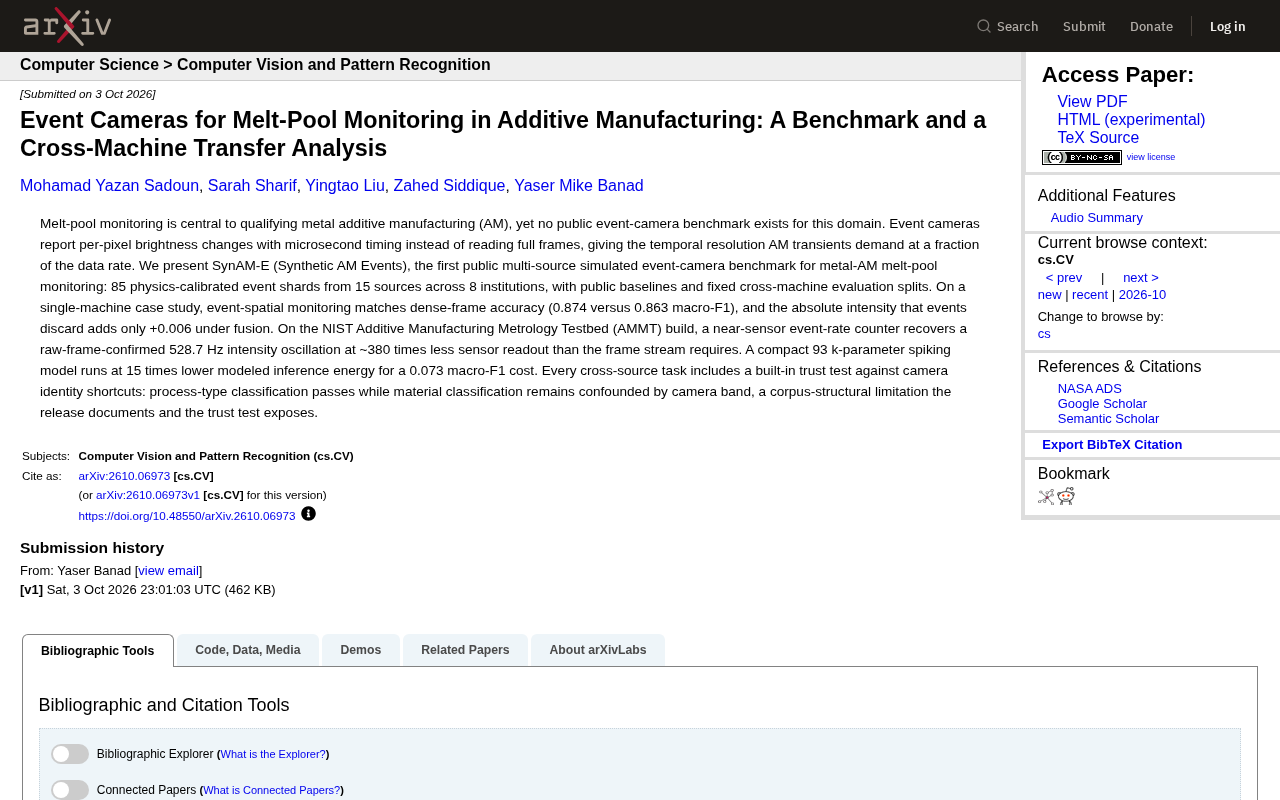
This study proposes applying event cameras to metal additive manufacturing (AM) melt pool monitoring and introduces SynAM-E — the first public benchmark dataset in the field — comprising 85 physically calibrated event shards from 15 data sources across 8 institutions. Event-based monitoring achieves a macro F1 of 0.874 (vs. 0.863 for dense frames) at roughly 1/380th the sensor readout, while successfully reconstructing a 528.7 Hz intensity oscillation. A compact 93K-parameter spiking neural network delivers 15× energy efficiency at a 0.073 F1 cost. Built-in trust tests honestly expose that material classification remains confounded by camera spectral bands, reflecting a rigorous approach to benchmark trustworthiness.
Metal Additive Manufacturing (AM) requires robust melt pool monitoring as a core prerequisite for achieving industrial-grade quality certification. Melt pool transients often occur on the microsecond scale, and traditional frame cameras struggle to simultaneously deliver high temporal resolution and manageable data throughput. A new study published on arXiv proposes replacing traditional frame cameras with Event Cameras for melt pool monitoring, and introduces SynAM-E — the first publicly available benchmark dataset in this domain.
Why Event Cameras Are Well-Suited for Melt Pool Monitoring
Traditional cameras read out complete frames at a fixed frame rate, transmitting full-frame data regardless of whether the scene has changed. Event cameras operate on an entirely different paradigm: instead of capturing full frames, they only report brightness changes at individual pixels, each timestamped at microsecond precision.
This characteristic is particularly valuable for additive manufacturing. During laser melting, the melt pool undergoes intense, high-frequency intensity fluctuations — transient signals that are critical indicators of print quality. Event cameras can deliver the temporal resolution required for AM transients at a much lower data rate. In other words, they capture faster dynamics with less data. This "on-demand transmission" mechanism translates directly into significantly reduced readout bandwidth and power consumption in near-sensor processing scenarios.
Event cameras draw inspiration from biological retinas. Each pixel independently and asynchronously monitors the logarithmic change in its own brightness. Once the change exceeds a preset threshold, the pixel immediately outputs an event containing its spatial coordinates, a timestamp (microsecond precision), and polarity (brightness increase or decrease). Because output is only generated when brightness changes, virtually no data is produced in static scenes, while fast motion or rapid intensity changes yield dense event streams. This is fundamentally different from traditional frame cameras, which expose and read out full frames at a fixed rate regardless of scene activity. Event cameras can achieve dynamic ranges exceeding 140 dB (compared to ~60 dB for typical frame cameras), making them especially well-suited for high-contrast scenes like laser melt pools — where an extremely bright laser spot coexists with dark surrounding substrate — effectively preventing information loss due to overexposure.
SynAM-E: The First Public Multi-Source Simulation Benchmark
The research team noted that no public event camera benchmark dataset previously existed in this field — a gap that SynAM-E (Synthetic AM Events) is designed to fill.
The benchmark is substantial in scope: it contains 85 physically calibrated event shards, drawn from 15 data sources across 8 institutions, along with publicly available baseline models and fixed cross-machine evaluation splits.
The multi-source, multi-institution data structure is designed not only to evaluate model performance on individual devices, but more importantly to test generalization across different printing machines — one of the most challenging problems for real-world industrial deployment. Fixed evaluation splits ensure that results are comparable across different research efforts.
Key Experimental Results: Accuracy and Energy Efficiency
The study validated the event camera approach through several experiments, with compelling numbers.
Accuracy on Par with Dense Frames
In a single-machine case study, event-based spatial monitoring achieved a macro F1 score of 0.874, essentially matching — and slightly exceeding — the dense frame baseline of 0.863. Interestingly, the absolute intensity information that event cameras naturally discard contributed only a marginal +0.006 improvement when fused back in. This indicates that for this task, the event data alone captures the vast majority of discriminative information.
Drastic Reduction in Readout with Signal Fidelity Preserved
In a build experiment on the NIST Additive Manufacturing Metrology Testbed (AMMT), a near-sensor event rate counter successfully reconstructed a 528.7 Hz intensity oscillation, which was subsequently confirmed by the raw frame data. Critically, this was achieved with sensor readout roughly 1/380th of that required by a frame-based data stream. This means that near two orders of magnitude of data burden are eliminated while retaining the key high-frequency signal.
Energy Efficiency of Spiking Neural Networks
The study also evaluated a compact Spiking Neural Network (Spiking Model) with just 93,000 parameters. This model achieved 15× lower inference energy cost compared to the reference approach, at the cost of a 0.073 reduction in macro F1. This trade-off presents an attractive option for edge-side, real-time online monitoring — trading a modest accuracy penalty for dramatically reduced energy consumption.
Spiking Neural Networks (SNNs) are a class of neural networks that mimic the "integrate-and-fire" mechanism of biological neurons. Unlike traditional Artificial Neural Networks (ANNs), where neurons continuously output continuous floating-point activations, SNN neurons only fire a discrete "spike" when their membrane potential accumulates beyond a threshold, remaining silent otherwise. This makes SNNs extremely computationally efficient on sparse inputs — a large proportion of neurons remain silent at any given moment, requiring no multiply-accumulate operations. The sparse, asynchronous event streams produced by event cameras align naturally with the sparse spike-based computation of SNNs, and the combination is considered a canonical paradigm of neuromorphic computing. Dedicated neuromorphic chips (such as Intel Loihi and IBM TrueNorth) can run SNN inference at energy costs orders of magnitude lower than GPUs — the hardware foundation underlying the 15× efficiency advantage reported in this work.
An Honest "Trust Test": Confronting Dataset Limitations
One particularly commendable aspect of this research is its built-in trust test, designed to detect whether models rely on shortcut features such as camera identity.
When data comes from multiple different devices, models may take the easy route — rather than genuinely learning the physical characteristics of the melt pool, they may "cheat" by recognizing which camera captured the data. The study found that process-type classification passed the trust test, indicating the model had indeed learned transferable features; however, material classification remained confounded by camera spectral bands, revealing a limitation inherent in the dataset's corpus structure.
Rather than glossing over this issue, the research team explicitly documented this limitation and exposed it publicly through the trust test. This kind of transparency about dataset bias is more valuable for an intended field-standard public benchmark than chasing impressive-looking metrics alone.
Shortcut learning is a pervasive problem in machine learning: models perform well on training sets by exploiting spurious statistical regularities rather than genuine physical discriminative features. In multi-device datasets, different cameras' noise patterns, spectral response curves (i.e., "camera bands"), or resolution differences often co-occur with the process or material captured by that device. If a particular material happened to be imaged exclusively by a specific camera model, the model may simply learn to identify the camera's fingerprint rather than the material's actual thermal radiation characteristics. The trust test works by deliberately constructing evaluation splits — for example, concentrating the same camera's data on one side of the train/test divide — to detect whether model performance fluctuates anomalously with changes in camera distribution, thereby revealing whether the model has relied on camera identity as a confounding variable.
Implications for Additive Manufacturing Monitoring
Taken together, SynAM-E's value extends well beyond a single dataset or model. It provides a reproducible, comparable research foundation for applying event cameras to the specific industrial scenario of melt pool monitoring in metal additive manufacturing.
Event cameras demonstrate clear potential for high-frequency transient monitoring tasks: near-dense-frame accuracy with roughly 1/380th the readout volume, and significant energy efficiency gains through spiking models. The built-in cross-machine evaluation and trust test mechanisms push the field forward — from "it runs" toward "it can be trusted and transferred." For a metal 3D printing industry pursuing real-time quality certification, this is a technology path worth serious attention.
Related articles

Workbuddy for Absolute Beginners: How a Desktop AI Agent Fits Into Real Workflows
A beginner's guide to the Workbuddy desktop AI agent: installation, claiming credits, file management, and building automated workflows—compared with CodeX for fit and cost, helping professionals shift from AI question-askers to AI managers.

OpenAI's New Agent Stack: Computer Use, Decisions API, and Ultra-Fast Workflows
OpenAI Dev Day unveiled a new agent stack: Computer Use outperforms humans, Decisions API delivers ultra-low-latency classification via Luna, Agents API opens the same Computer Use capabilities, and GPT-6.1 Sol costs only one-seventh of Astra. Core updates, benchmark data, and developer insights.

Liang Wenfeng Open-Sources DeepInfo Inference Framework, Takes On U.S. Ban
DeepSeek open-sources its DeepInfo inference framework after its models, featuring GPU/CPU cross-pipelining, small-model prediction with large-model verification, and full Huawei Ascend and NVIDIA chip support—facing the U.S. federal ban head-on. This article analyzes its significance for AI deployment and open-source strategy.