Event-Driven ML Pipelines in Manufacturing: 3 Years on AWS and 72% Cost Savings

Event-driven GPU training architecture cuts costs 72–78% over 3 years in automotive manufacturing.
This industrial practice report from automotive manufacturing documents three years of operating an event-driven cloud ML training infrastructure, supporting over 40,000 production jobs. The system uses AWS ECS with EC2 GPU capacity providers for on-demand scaling, SQS dead-letter queues for message reliability, and a Lambda dispatcher with admission control as the core scheduling mechanism. Discrete-event simulation showed that naive dispatch drops 65% of jobs, while admission control eliminates that risk entirely. The result: 72–78% cost savings versus always-on GPU infrastructure, with the simulator and Terraform module skeletons released as open source.
When Machine Learning Meets the Automotive Production Line
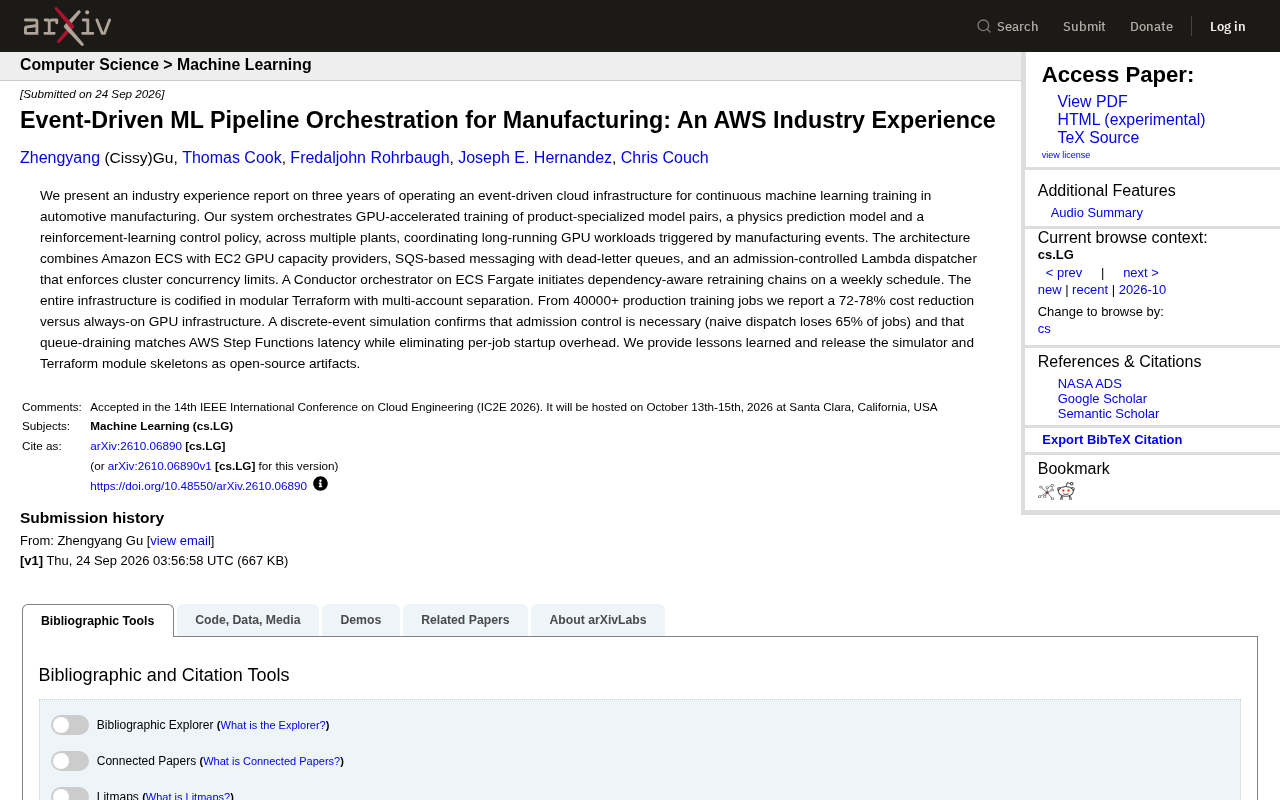
In heavy industrial settings like automotive manufacturing, machine learning models aren't a one-and-done affair. Changes in production line status, product specifications, or process adjustments all trigger the need to retrain models. An industrial practice report from arXiv (arXiv:2610.06890v1) documents a team's real-world experience operating an event-driven cloud infrastructure for continuous ML training in the automotive manufacturing domain — sustained over three years.
What makes this report valuable is that it's not a theoretical architecture exercise. It's an engineering retrospective grounded in over 40,000 production training jobs. For any team considering moving ML training workloads to the cloud — especially GPU-intensive ones — the trade-offs documented here are well worth studying.
What Problem the System Solves
The system orchestrates GPU-accelerated training for a pair of product-specific models: a physics prediction model and a reinforcement learning control policy. These two models require coordinated training across multiple factories and are triggered by manufacturing events that kick off long-running GPU workloads.
Several engineering challenges make this genuinely difficult:
- Long-running GPU jobs: Training runs are time-consuming and expensive — they can't be scheduled casually like ordinary web requests.
- Unpredictable event-driven load: Since training is triggered by manufacturing events, peak and trough loads are inherently unpredictable. Keeping GPU resources on standby leads to massive waste.
- Cross-factory dependencies: Multiple factories and multiple model pairs introduce training dependencies that require an ordered retraining chain.
In short, the team needed to strike a balance between cost and reliability — avoiding the expense of idle GPUs running year-round, while also ensuring that poor scheduling doesn't silently drop training jobs.
Architecture Breakdown: How the Components Work Together
The system's tech stack is a fairly typical combination of AWS managed services, but the way they're composed reflects deliberate design intent.
Compute and Messaging Layer
The core compute layer uses Amazon ECS with EC2 GPU capacity providers, enabling GPU instances to scale on demand rather than remain always-on. Messaging is handled by SQS, configured with a dead-letter queue (DLQ) to catch failed messages and prevent silent job loss.
EC2 Capacity Providers are an ECS elasticity mechanism that allows a cluster to automatically scale EC2 instances up or down based on task queue depth. Unlike Fargate's per-task billing, EC2 capacity providers are better suited for GPU instances — hardware-specific workloads with non-trivial startup costs. ECS can spin up GPU instances when tasks are pending and terminate them when the queue is empty, eliminating idle billing. Dead-Letter Queues (DLQs) are SQS's error-handling mechanism: when a message repeatedly fails to be processed (exceeding the maximum receive count), SQS automatically moves it to a pre-configured DLQ rather than discarding it. For GPU training jobs that run for hours, the DLQ acts as a "holding area for failed messages" — ops teams can review failures after the fact and decide whether to re-enqueue, preventing jobs from disappearing without a trace.
Admission Control and Scheduling
This is the most critical piece of the entire architecture. The team designed a Lambda dispatcher with admission control specifically to enforce cluster concurrency limits. Why is admission control so important? The simulation data answers that question clearly.
Scheduling is handled by a Conductor orchestrator running on ECS Fargate, which initiates dependency-aware retraining chains on a weekly schedule, ensuring that models with interdependencies are trained in the correct order.
Admission Control is a mechanism that evaluates whether the system currently has the capacity to handle a request before it's actually submitted to backend resources. The core idea is: "better to queue at the gate than to crash mid-execution." In a GPU cluster context, naively converting every triggered event into a submitted training task leads to resource contention, container scheduling failures, or OOM errors — causing silent job loss. This is precisely why the simulation showed naive dispatch dropping 65% of jobs. After receiving an SQS message, the Lambda dispatcher first queries the current number of concurrent jobs in the cluster. Only if it's below a preset limit does it actually submit the task; otherwise, the message waits in the queue. This "shapes" unpredictable bursty load into a steady flow the cluster can absorb. AWS Step Functions is Amazon's managed workflow orchestration service that uses state machines to describe multi-step task dependencies and retry logic — but each state transition incurs API call overhead. By contrast, the queue-draining strategy used here pulls tasks in a loop within the worker node itself, reducing that overhead while maintaining comparable latency.
Infrastructure as Code
The entire infrastructure is codified using modular Terraform with multi-account separation. This approach is nearly mandatory for industrial-scale deployments — it provides environment isolation, clear permission boundaries, and reproducible deployments.
The Numbers: 72–78% Cost Reduction
The most striking figure in the report: compared to an always-on GPU infrastructure, this event-driven architecture achieved a 72% to 78% reduction in costs.
For GPU resources — which carry a high per-unit price — this translates to substantial real-world savings. The logic is straightforward: training jobs are event-triggered and inherently intermittent, meaning always-on GPUs spend most of their time sitting idle and billing. By scheduling on demand and autoscaling aggressively, the team compressed idle costs to a minimum.
This reinforces a principle that surfaces repeatedly in cloud cost optimization: for bursty, queueable workloads, event-driven architectures almost always outperform reserved resources — provided you can tolerate some cold-start latency and manage concurrency properly.
Simulation Validation: Why Admission Control Is Non-Negotiable
One of the most compelling engineering sections of the report is the use of discrete-event simulation (DES) to validate key design decisions.
The simulation findings are stark:
- Admission control is essential. Naive direct dispatch results in 65% of jobs being dropped — a striking figure that illustrates how uncontrolled task submission in a high-concurrency GPU environment leads to large-scale failures.
- The queue-draining strategy can match AWS Step Functions latency while eliminating per-job startup overhead — meaning the team achieved comparable latency without the added cost and complexity of per-job orchestration.
The value of this kind of comparative validation is that it transforms "we think this design is better" intuition into quantifiable, reproducible evidence.
Discrete-Event Simulation (DES) is a computational method for modeling how a system evolves over time, where the system state only changes at discrete "event" moments (e.g., task arrival, task completion, resource release) and remains constant between events. This makes DES well-suited for rapidly reasoning about queuing systems like message queues, schedulers, and server pools — without having to actually run hundreds of GPU jobs. You simply replay an event sequence in the simulator and collect metrics like job success rate, queue depth, and resource utilization. In this case, the team used three years of real manufacturing event distributions as simulation input, comparing "naive dispatch" against "admission-controlled dispatch" in terms of job failure rates — quantitatively validating the necessity of admission control without burning actual GPU resources. This is a classic use of DES in industrial system design: replacing expensive production trial-and-error with low-cost computational experiments.
Open-Source Contributions and Takeaways
Notably, the team published both the simulator and the Terraform module skeletons as open-source artifacts. This allows external teams not just to read the conclusions, but to reuse the tools and validate scheduling strategies against their own scenarios.
Several lessons from this practice report are worth distilling:
- Admission control beats optimistic submission: For scarce resources like GPUs, upfront concurrency limits are more reliable than after-the-fact retries.
- Dead-letter queues are a safety net for long-running jobs: Failed messages need a clear destination; without one, debugging becomes extremely painful.
- Simulate before going to production: Using discrete-event simulation to validate scheduling strategies surfaces design flaws before real money is on the line.
- Multi-account + Terraform is the industrial baseline: Isolation and reproducibility pay large dividends in cross-factory, multi-environment deployments.
For teams building MLOps platforms — especially for manufacturing or other event-driven domains — this report, grounded in over 40,000 real production jobs, offers a battle-tested reference architecture.
Related articles

How Big Can Stars Really Get? The Physical Limits of the Largest Stars
Red supergiants are the largest stars by volume, with radii up to 2,000 times the Sun, engulfing the inner solar system. But there is no precise upper limit on stellar size—models predict up to 15,000 solar radii. The most massive blue stars are far smaller than red supergiants—biggest and heaviest are two different things.

Apple HomeView Smart Display Full Feature Breakdown: Wall-Mount or Desktop, $299
Apple launches HomeView, a $299 smart display with wall-mount and desktop options, 12MP camera for facial recognition, smart home control, music playback, and recipe step-by-step cooking. Full breakdown of watch faces, apps, privacy, and cooking integration.

Where Did the Promised New Studio Go? Craft Computing Answers After Five Years
Craft Computing's host responds to viewer questions: the new studio promised five years ago was shelved as construction costs soared from $30,000 to $75,000, and was replaced by a 168-square-foot garage conversion.