Every Signal: Company Due Diligence in One Hour, Every Number Sourced
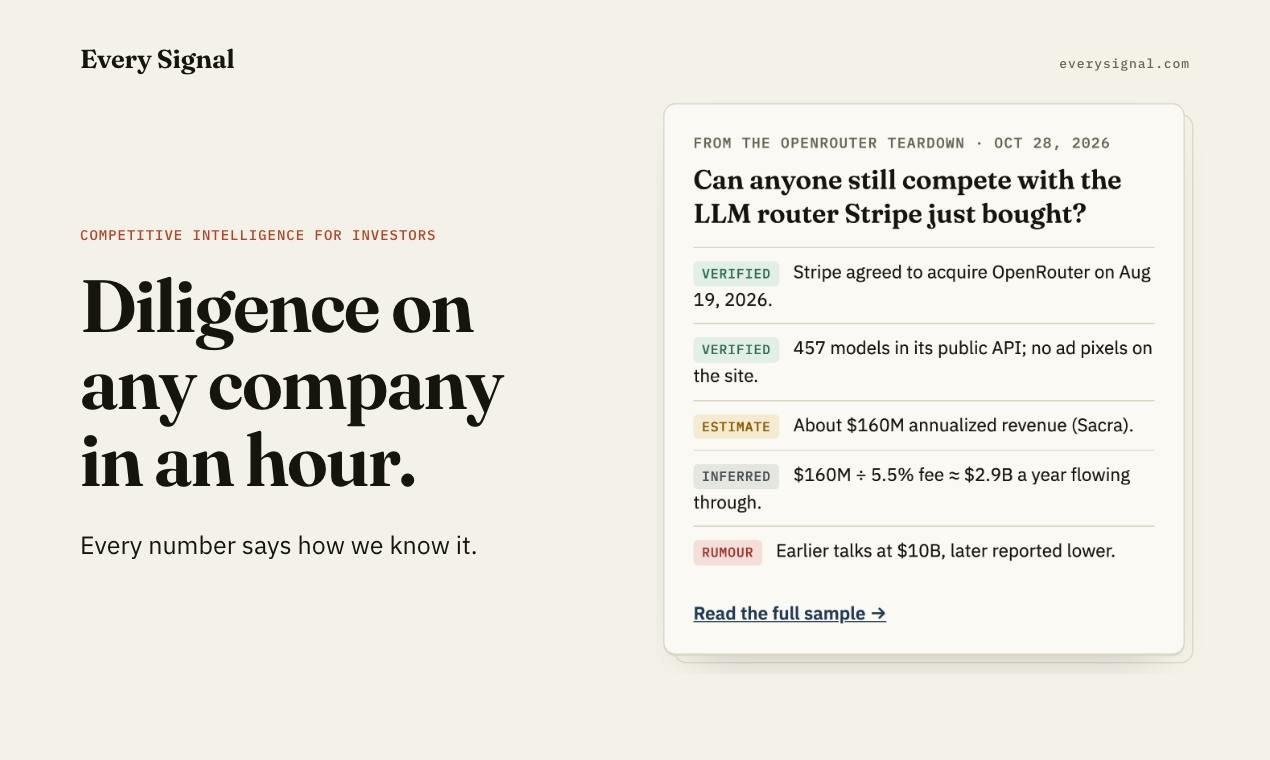
Every Signal uses four-tier confidence labeling and continuous monitoring to compress company due diligence into one hour.
Every Signal is a due diligence tool based on a research agent. After users enter a company name and questions, they receive a breakdown report within an hour covering traffic, ad placement, tracking stack, pricing, revenue estimates, competitors, and industry regulations. Its core design labels each data point with one of four confidence levels—verified, estimate, inferred, or rumour—addressing the opacity of AI report credibility, and continuously monitors target company changes after the initial report. The tool primarily targets small investment teams, independent analysts, growth marketers, and entrepreneurs, but estimation conclusions like revenue projections are subject to methodological bias and are better used as order-of-magnitude references rather than precise figures.
When Due Diligence Shrinks from Weeks to an Hour
Anyone doing investment or competitive analysis knows the drill: to understand a company, you need to open a dozen tabs—traffic estimation tools, ad intelligence platforms, job boards, financial reports, press releases—and then stitch the fragments into a coherent picture. This often takes days, and the reliability of each data point varies wildly.
A new tool on Product Hunt, Every Signal, aims to change that. Its pitch is straightforward: enter a company and the questions you want answered, and a research agent returns a sourced breakdown covering traffic, ad spend, tracking stack, pricing, revenue estimates, competitors, and industry regulations. According to the official description, the whole process can be completed within an hour.
The product received 77 upvotes on Product Hunt, ranked #17 for the day, with 4 comments. Not explosive growth, but it targets a real, high-frequency pain point—information gathering in investment research and business analysis.
Core Mechanism: Tagging Every Number with a Confidence Level
Four-Tier Confidence Classification
Every Signal's most distinctive design is its four-level labeling of information sources: verified, estimate, inferred, rumour.
This may seem like a small feature, but it addresses the biggest trust barrier for AI research tools. LLM-generated analysis often sounds confident, and readers struggle to distinguish which claims come from official disclosures and which are model extrapolations. Exposing confidence levels explicitly hands judgment back to the user: you can trust only verified data, or treat rumours as leads for further verification.
Confidence grading is not new in intelligence analysis, but productizing it and embedding it into AI generation workflows is a recent attempt by research agents. In traditional investment research, analysts mark data sources with footnotes or appendices, but this approach makes it hard to quantify uncertainty. Every Signal's four-tier labeling borrows from the intelligence community's "credibility assessment" frameworks (such as NATO's Admiralty Code, which rates source reliability separately from information credibility), though simplified to focus more on "how the information was derived." For users, understanding the boundaries between the four tiers matters: verified typically means data directly from official disclosures or publicly verifiable sources; estimate is a projection based on models or assumptions; inferred is a conclusion derived from indirect clues; rumour is unconfirmed information from non-authoritative channels.
Coverage Dimensions and Revenue Estimation
Based on the product description, the output focuses on growth and monetization: traffic structure, ad placement, website tracking stack (which can reveal which analytics or marketing tools the target uses), pricing system, and revenue estimates based on this data. Competitor and regulatory analysis completes the picture of market positioning.
Revenue estimates naturally fall into the estimate tier—they depend on traffic and conversion assumptions, and different methodologies yield widely different results. Every Signal's approach is to clearly label this estimation process rather than passing it off as fact.
A website's tracking stack refers to third-party analytics, advertising, and tag management tools embedded in a company's site or product, such as Google Analytics, Meta Pixel, Hotjar, etc. By identifying these scripts, external observers can infer the target's marketing channels, data collection capabilities, and technical preferences. This information is usually obtainable from public page source code or browser extensions, making it verifiable indirect evidence. Revenue estimation often uses a "bottom-up" approach: first estimate traffic, then combine industry-average conversion rates, average order value, and repeat purchase rates to derive a revenue range. Since conversion rates and average order values often lack public data, models must make assumptions, so these conclusions inherently carry significant uncertainty—different methods can yield order-of-magnitude differences.
Continuous Monitoring: From One-Off Report to Dynamic Tracking
One easily overlooked line in the product description: "Then it watches for changes." This means that after generating the initial report, it continuously monitors changes in the target company.
This design pushes the tool from "one-off due diligence" to "continuous intelligence." For users tracking competitors or portfolio holdings, static reports depreciate quickly—when the target changes pricing, switches ad channels, or launches a new tracking tool, the old report becomes partially outdated. Automatic change monitoring acts as a freshness mechanism for the report.
However, the official description doesn't specify the trigger granularity, notification method, or update frequency of monitoring. This capability can currently only be inferred from the product page, and actual performance requires hands-on verification.
Who Should Use It, and Where Are the Limits
Target Users
Judging from the feature set, the most direct beneficiaries are small investment teams, independent analysts, growth marketers, and entrepreneurs. These users need to quickly build a cognitive framework for an unfamiliar company but often lack the budget for multiple professional data terminals.
Points to Watch
The output quality of research agents depends heavily on the accessibility of underlying data sources. Traffic estimation and ad intelligence data come from a few mature suppliers in the industry, and deviations between sources are already significant. Every Signal labeling sources is a correct step, but users still need to judge: is this verified based on official financial reports, or on scraping from a third-party database?
Additionally, revenue estimation involves mathematical assumptions (average order value, conversion rate, repeat purchases). If these are entirely auto-filled by the model, errors could be considerable. Treating them as order-of-magnitude references rather than precise figures is a safer approach.
Traffic estimation and ad intelligence data come from multiple suppliers in the industry, such as SimilarWeb, Semrush, Sensor Tower, etc., each based on different panels, crawlers, and partnered data sources. Estimates often deviate by 20%-50% or even more. Therefore, even if Every Signal labels something as verified, users need to confirm whether the underlying source is an official financial report, a third-party database, or model inference—an official "verified" label does not equal "absolutely accurate," only that the information source is relatively reliable. For revenue estimates, users are advised to ask the tool to display key assumptions (such as conversion rate, average order value) and conduct their own sensitivity analysis, avoiding treating a single estimate as a decision basis.
Summary
Every Signal enters the second half of AI research tool competition: no longer about who can generate longer reports, but who can make information more traceable and verifiable. The four-tier confidence labeling and continuous monitoring both point in this direction.
For users who need frequent lightweight due diligence, such tools can significantly compress the time cost of information gathering. But they replace the gathering and organizing work of junior researchers, not judgment itself—which numbers are credible and which assumptions are reasonable still require human decision-making.
(End)
Related articles

AI Code Generation Is Getting Cheaper—Validation Is the Real Challenge
Code generation is getting cheaper, and the bottleneck is shifting to validation. Drawing on Satya Nadella's interview, this piece analyzes coding agents' specifications, multi-model review, separation of permissions, organizational changes, and how engineers can turn a single fix into reusable team capability.

Saparo: The Shopping AI Agent That Stacks Discounts Automatically, Topping Product Hunt
Saparo is an AI shopping agent that automatically stacks discounts, topping Product Hunt. It finds the same item, matches sizes, combines promo codes and cashback, ranks by total cost including shipping and taxes, and leaves final payment to the user.

Tripmojo: The AI Travel Agent That Checks You In
Tripmojo is the #2 AI travel agent on Product Hunt: it syncs booking emails into a shared itinerary and lets Mojo attempt check-in, save boarding passes, and flag delays.