Evidence Core: Open-Source Code-First BI Framework with AI-Driven Real-Time Data Analytics

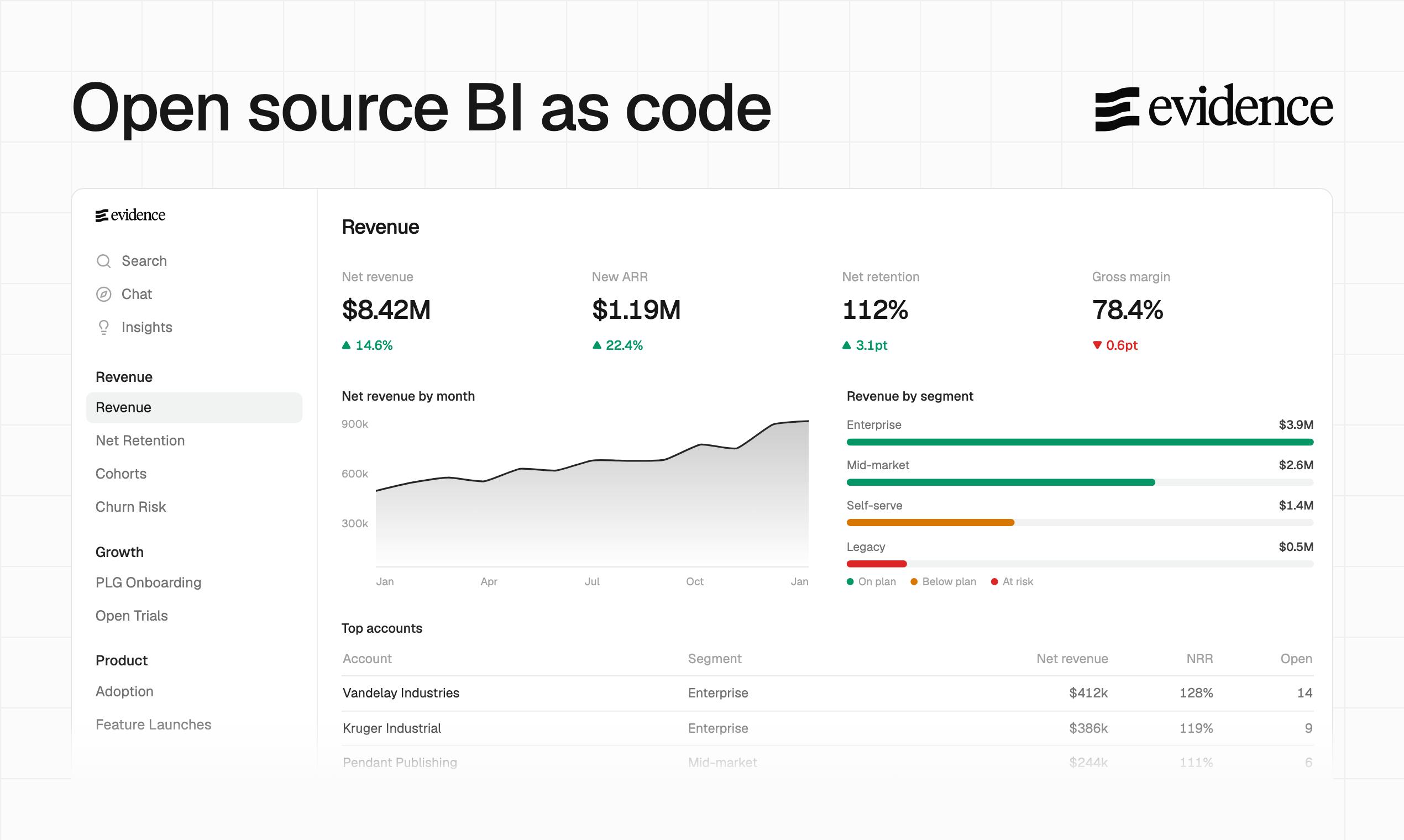
Evidence Core is an open-source code-first BI framework designed for AI coding agents and free deployment.
Evidence Core is an open-source Business Intelligence framework that takes a Code-First approach, defining all metrics, dashboards, and reports as version-controlled code. Designed to work seamlessly with AI coding agents like Cursor and GitHub Copilot, it enables lightweight deployment to platforms like Vercel or Netlify at zero cost. It represents the emerging Analytics as Code paradigm shift in the BI industry.
When BI Meets the Code-First Philosophy
Traditional Business Intelligence (BI) tools typically rely on complex drag-and-drop graphical interfaces, leading to scattered metric definitions, difficult version management, and high collaboration costs. Evidence Core aims to break this pattern—it's an open-source BI framework that enables developers to build complete business intelligence applications using a "Code-First" approach.
The Code-First philosophy originated in software engineering, first widely adopted in ORM frameworks (such as Entity Framework). It refers to using code as the Single Source of Truth for system configuration and logic, rather than relying on graphical interfaces or configuration files. In the BI space, traditional tools like Tableau and Power BI follow a GUI-First model—users create visualizations through drag-and-drop operations, with underlying logic encapsulated in proprietary format files that are difficult to version control and automate testing. Code-First BI exposes this logic as human-readable text files (such as YAML, SQL, Markdown, etc.), enabling integration into modern software development workflows.
On Product Hunt, Evidence Core ranked 11th on its launch day with 82 votes, categorized under open source, data science, and data visualization. Its core philosophy is simple yet powerful: Build your entire business intelligence platform as a code repository (repo) and deploy it anywhere for free.
Evidence Core's Key Features: Everything as Code
Metrics, Dashboards, and Reports—All Defined in Code
Evidence Core's biggest highlight is that all BI elements—Metrics, Dashboards, Reports, and Themes—are entirely defined as code. This brings significant advantages to data teams:
- Version controllable: All analytical logic can be managed in Git, enabling complete change tracking and team collaboration.
- Validatable: Metric definitions can be verified before deployment, reducing data errors.
- Previewable: See changes in real-time through the Evidence CLI.
- Servable: Publish analytics applications with a single command.
Git is today's most mainstream distributed version control system, originally created by Linus Torvalds for Linux kernel development. In traditional BI tools, dashboard modification history is typically stored in the tool's own database, lacking fine-grained diff capabilities and making branch development and Code Review difficult to implement. Once BI assets are managed in Git, teams can use Pull Request mechanisms to review metric definition changes, isolate experimental analyses through branches, and quickly roll back to any historical version when issues arise. This practice has been validated as a best practice in the dbt (data build tool) community.
This model transforms data analysis from "click operations" to "engineering practice," deeply integrating with modern software development DevOps workflows.
Built for AI Coding Agents
Evidence Core's subtitle "Build live analytics with coding agents" reveals another layer of ambition—embracing the AI programming era. Since the entire BI platform exists as text files, it's naturally suited for collaboration with AI coding assistants like Cursor and GitHub Copilot.
AI Coding Agents refer to AI systems capable of understanding natural language instructions and autonomously writing or modifying code. Current representative products include GitHub Copilot (based on OpenAI Codex), Cursor (an AI-native IDE integrating multiple large language models), and Devin (claiming to be the first AI software engineer). These tools fundamentally work by reading and generating text files—they can understand code context, follow project conventions, and produce code that meets specifications. Therefore, any system that exists in plain text form inherently has an advantage for collaboration with AI agents. For BI systems, if a dashboard definition is a .md or .yaml file rather than a binary format, AI can directly read, understand, and modify it.
Developers (or even AI agents) can describe requirements in natural language and have AI directly generate or modify metric definitions and dashboard layouts. This "code as interface" design makes Evidence Core an ideal vehicle for AI-driven data analytics.
Free Deployment and the Cost Advantage of Open-Source BI
Evidence Core emphasizes "deploy it anywhere, for free." Since it produces static or lightweight analytics applications, users can host them on platforms like Vercel, Netlify, or GitHub Pages, dramatically reducing BI infrastructure operational costs.
This deployment approach benefits from an architecture philosophy similar to Jamstack. Jamstack (an abbreviation for JavaScript, APIs, and Markup) is a modern web development architecture whose core idea is pre-rendering pages as static files at build time and fetching dynamic data through APIs at runtime. This means BI applications don't need expensive application servers—static files can be distributed globally via CDN with extremely fast access speeds and minimal operational costs. Compared to traditional BI platforms that typically require dedicated servers, database connection pools, and complex permission management systems, this lightweight deployment approach reduces infrastructure costs from hundreds or even thousands of dollars per month to near zero.
As an open-source project, Evidence Core frees teams from expensive commercial BI licensing fees (such as Tableau and Power BI's per-seat pricing) while retaining full control over underlying logic. Current mainstream commercial BI tools typically use per-seat pricing: Tableau Creator licenses cost approximately $75 per user per month, Power BI Pro is $10 per user per month (Premium versions are higher), and Looker's enterprise edition pricing is even more expensive. For a 50-person data team, annual BI tool licensing fees alone could reach tens or even hundreds of thousands of dollars. Additionally, these tools usually require additional server resources and specialized administrators. Open-source alternatives like Apache Superset, Metabase (community edition), and Evidence Core offer zero-licensing-fee options, though they require teams to have sufficient technical capability for deployment and maintenance.
For small-to-medium teams and technically-oriented enterprises that prioritize data sovereignty and cost control, this is undoubtedly highly attractive.
Who Should Use Evidence Core?
Given its positioning, the following types of users are likely to benefit most:
- Data engineers and analysts: Those accustomed to working with code who pursue reproducible and collaborative analytical workflows.
- Technical startup teams: Those with limited budgets who want to build professional-grade BI platforms at low cost.
- AI workflow practitioners: Those who want to incorporate data analysis into AI coding agents' automated workflows.
- Open-source enthusiasts: Those who prefer self-hostable, vendor-lock-in-free solutions.
In contrast, non-technical business users who rely on pure visual drag-and-drop operations may face a learning curve.
Industry Significance: The Paradigm Shift of Analytics as Code
Evidence Core represents an emerging trend in business intelligence—Analytics as Code. This aligns with the recent movements of "Infrastructure as Code" and "Configuration as Code," essentially abstracting complex business logic into manageable, automatable code assets.
The concept of Infrastructure as Code (IaC) was popularized around 2013 by Chad Fowler, with representative tools including Terraform, Ansible, and Pulumi. Its core value lies in transforming infrastructure configuration from manual operations into auditable, repeatable, and automatable code. Subsequently, Configuration as Code (such as Kubernetes' YAML declarative configuration), Policy as Code (such as Open Policy Agent), and Pipeline as Code (such as Jenkinsfile) emerged in succession, forming a technical philosophy of "Everything as Code." Analytics as Code is an extension of this trend into the data analytics domain. The success of dbt (data build tool) proved the value of codifying SQL transformation logic, while Evidence Core goes further by bringing the visualization layer and metrics layer under code management, completing the final piece of the full analytics pipeline codification puzzle.
At a time when AI coding capabilities are rapidly advancing, this code-based BI framework perfectly aligns with how agents work. It's foreseeable that future data analysis may no longer be about "opening a tool and manually configuring," but rather "describing requirements to AI, which then generates and maintains the entire analytics codebase." Evidence Core stands at the forefront of this transformation.
Summary
With its three defining characteristics—open source, code-first, and AI-friendly—Evidence Core offers a brand-new path for the business intelligence space. It doesn't aim to replace all traditional BI tools, but rather provides a flexible, low-cost, collaborative data analytics framework tailor-made for technical teams and AI workflows. For teams willing to embrace the "Analytics as Code" philosophy, Evidence Core is well worth exploring and trying out.
Related articles

The Truth About American College Party Culture: The Risks Schools Won't Admit
Behind American college party culture, the administration's "don't ask, don't tell" attitude is amplifying freshman risks. This article analyzes how the pandemic strengthened Greek dominance, freshmen's difficulty accessing safety information, and the chain reactions caused by a culture of denial.

OpenAI Reportedly Raising $30B at $1.25T Valuation Ahead of IPO
OpenAI is planning a $30B funding round at a possible $1.25T valuation, paving the way for an IPO. If completed, it would set a private company valuation record. This article analyzes the funding size, pre-IPO logic, and industry signals.

a16z Crypto Rebrands as a16z Frontier: Pivoting to Frontier Tech as Blockchain Investment Retreats
a16z's Chris Dixon-led crypto division rebrands from a16z Crypto to a16z Frontier, expanding into broader frontier tech. We analyze the blockchain investment retreat behind the rebrand and its impact on the crypto VC industry.