EviGauge Premier: Agent-Native Audit and Security System Launching Soon

EviGauge Premier announces an Agent-native audit and security system, but public information is limited and capabilities remain unverified.
EviGauge Premier is an upcoming Agent-native audit and security system that claims to be built from the ground up, going beyond traditional text-log-based monitoring tools to understand Agents' multi-step decision chains and assess behavioral risk. The team says it consulted AI practitioners from Deloitte, IBM, PWC, and others, targeting compliance and security pain points in enterprise-grade Agent deployments. However, only a Reddit post and a registration link exist so far, with no technical whitepaper, open-source code, or customer case studies — both actual capabilities and the depth of involvement behind these titles remain to be verified. The project will host an online launch event with discounts, and as the Agent audit space heats up, the market will provide the answer.
When Agents Start Acting Autonomously, Who Audits Them?
A noteworthy new project is emerging. According to Reddit community reports, a project called EviGauge Premier — an "Agent-Native Audit and Security System" — has announced its upcoming official launch, along with plans to host an online launch event.
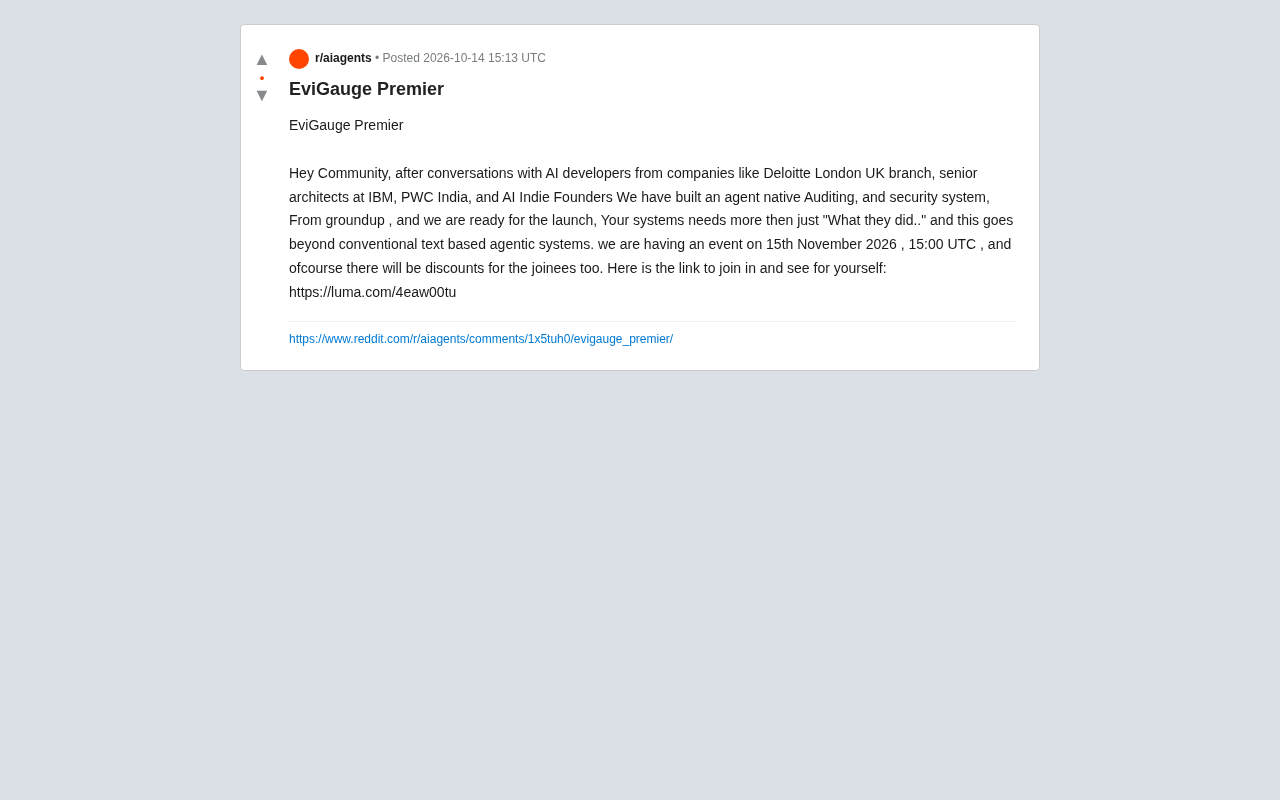
The project's positioning is fairly clear: it is not a traditional text-based Agent management system, but rather an audit and security infrastructure rebuilt from the ground up for Agent scenarios. According to the development team, existing systems can only answer "what did the Agent do," while EviGauge Premier attempts to address questions beyond that level.
Who Is Behind the Build?
According to the team, EviGauge Premier's design process involved consultations with professionals from multiple parties, including AI developers at Deloitte London, a senior architect at IBM, a technology lead at PWC India, and several independent AI entrepreneurs.
This cross-institutional background suggests the product may be targeting compliance and security pain points in enterprise-grade Agent deployments. As major consulting firms and tech companies push Agents into production environments, audit capabilities are shifting from "optional" to "mandatory." However, the team has only posted anonymously on Reddit so far — specific technical details and architectural designs have not been disclosed, and the actual depth of involvement behind these titles remains to be verified.
Compliance and Audit Requirements in Enterprise-Grade Agent Deployments As regulations such as GDPR and the EU AI Act advance, enterprises deploying autonomous Agents in production environments must meet requirements for explainability, traceability, and accountability. For example, the financial and healthcare industries require all automated decisions to be logged and auditable. Traditional security tools struggle to cover the reasoning black box of Agents, leading to compliance risks. Therefore, "compliance and security pain points" are not empty words — lacking audit capability means enterprises cannot prove to regulators that Agent behavior conforms to standards, which directly hinders the large-scale adoption of Agents in critical industries.
What Does "Agent-Native" Mean?
EviGauge Premier's core selling point is the concept of "Agent Native." The team emphasizes that their system is built "from the ground up," rather than adapted on top of existing logging or monitoring tools.
This points to a genuine technical divide: traditional audit tools rely on text logs and post-hoc analysis, but Agent behavior is often multi-step, cross-tool, and dynamically decided. Simply recording what an Agent "said" or "which APIs it called" makes it difficult to reconstruct the complete decision chain. A true Agent audit system needs to understand intent, track context, and assess behavioral risk — which is precisely the direction EviGauge Premier is attempting to pursue.
What Is an Agent? In the AI context, an Agent refers to an AI system capable of autonomously perceiving its environment, formulating plans, invoking tools, and executing multi-step tasks to achieve goals. Unlike single-turn Q&A chatbots, Agents possess memory, planning, and tool-calling capabilities — for example, they can autonomously search for information, write and run code, and operate a browser to book tickets. Precisely because their behavior chains are long and dynamic, an Agent's decision-making process is difficult to fully reconstruct using traditional logs. This is exactly where the audit challenge lies — not only knowing what it "did," but understanding "why it did it."
The Core Difference Between Traditional Auditing and Agent Auditing Traditional IT auditing relies on system logs, API call records, and transaction tracing — essentially "post-hoc forensics" targeting deterministic, reproducible operational workflows. Agent decision-making, however, is probabilistic, context-dependent, and characterized by multi-step reasoning; the same instruction may produce different behavioral paths. Therefore, Agent-native auditing requires real-time intent inference, decision chain reconstruction, and causal analysis of risky behavior — rather than simply recording "which tools were called." This is also a frontier challenge in the current Agent security field, with no mature standards yet established.
Launch Timing and How to Participate
The team plans to host an online launch event where participants can enjoy discount offers. Event details and registration are managed through the Luma platform.
For developers focused on Agent security and compliance, this may be a new option worth watching. But a caveat: the project's public information is currently extremely limited — no technical whitepaper, no open-source code, no customer case studies, just a Reddit post and a registration link. Those interested are advised to attend the event to learn more before evaluating whether it fits their needs.
The Agent audit space is heating up, and whether EviGauge Premier can deliver on its promise of "going beyond traditional text-based systems" — the market will provide the answer.
Related articles

Chain of Thought Isn't Just for AI: How Humans Can Use CoT to Improve Thinking Quality
Chain of Thought isn't just a prompt trick for large models. Starting from a Hacker News discussion, this article analyzes why CoT works for human thinking too, breaks down actionable ways to transfer it, and highlights the key differences between human CoT and machine CoT.
Cloudflare Teams Up with OpenAI: Closi…
Cloudflare Teams Up with OpenAI: Closing the Loop from Vulnerability Discovery to Defense with AI
Cloudflare uses OpenAI Daybreak to investigate security vulnerabilities and generate reviewable remediation plans, while developers use Codex to boost coding efficiency and quality.

Orca Multi-Agent Orchestration in Practice: A Guide to Parallel Collaboration with Claude and Codex
Orca is Stable AI's free open-source agent workbench supporting 34 agents like Claude Code and Codex in parallel. Learn its Git worktree isolation, multi-model orchestration, and mobile management.