EviSeek: An Evidence-Centric Framework for Embodied Active Information Seeking

EviSeek makes embodied agents interact purposefully by explicitly identifying required evidence, boosting accuracy and cutting token usage.
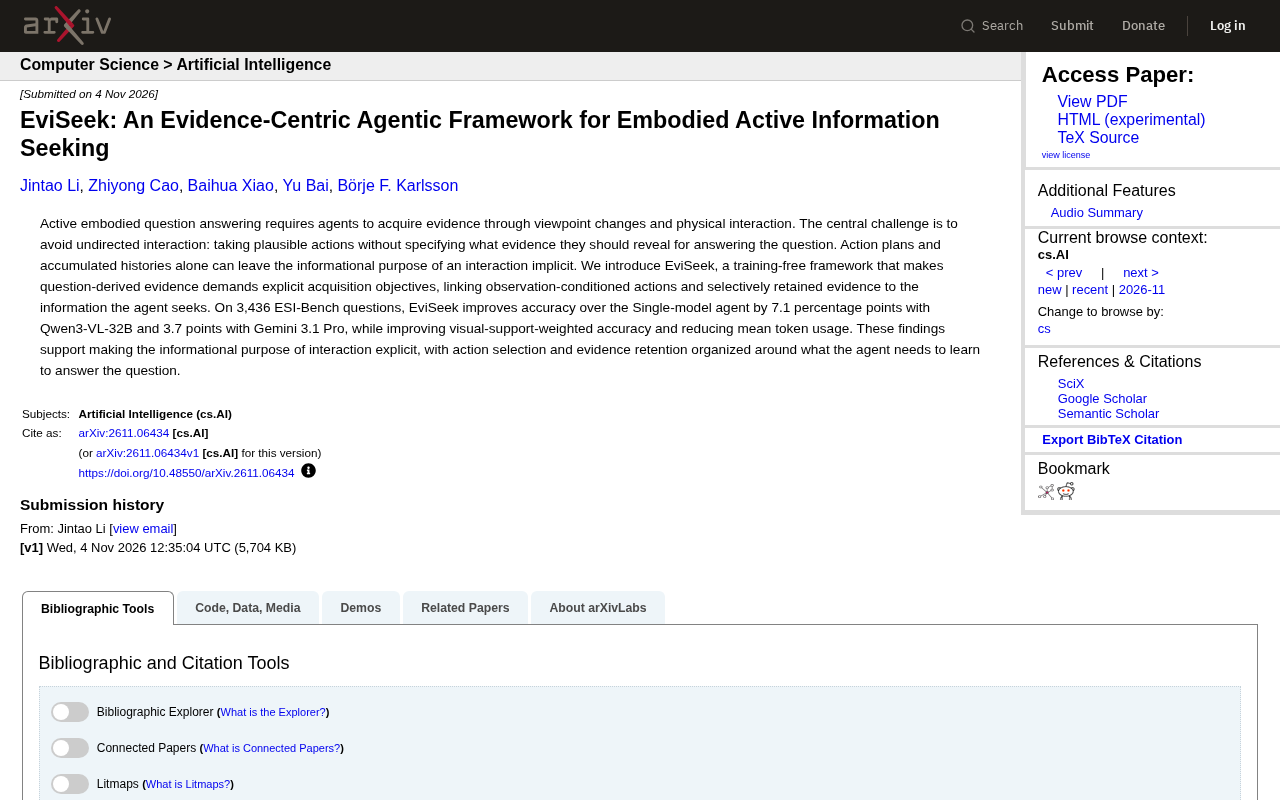
The article introduces EviSeek, a training-free framework for active embodied question answering that turns question-derived evidence needs into explicit acquisition goals. It consists of explicit evidence needs, observation-conditioned action selection, and selective evidence retention, and can adapt to different VLMs. On 3,436 ESI-Bench questions, it improves Qwen3-VL-32B accuracy by 7.1 points and Gemini 3.1 Pro by 3.7 points, while improving visual-support-weighted accuracy and reducing average token consumption. The article frames this as a shift from action-policy optimization to explicit modeling of interaction goals, though generalization and complex-question support remain open questions.
Embodied agents answering questions often need to gather information by moving their viewpoint or interacting with the environment. However, avoiding "aimless" interactions—taking actions that seem plausible but are not clearly directed at the evidence needed—has remained a core challenge in this field. The recently proposed EviSeek framework offers a new approach to this problem by having agents explicitly identify the evidence a question requires.
The Core Pain Point of Active Information Seeking: Implicit Interaction Goals
In Active Embodied Question Answering tasks, an agent must actively explore a 3D environment, gathering information by changing viewpoints or physically interacting, and ultimately answer a question. Conventional methods typically rely on action plans or accumulated observation history to guide behavior, but the paper points out that with only this information, the "information goal" of an interaction often remains implicit. An agent may execute a series of seemingly reasonable actions without clarifying what evidence those actions should reveal to support the answer. Such undirected interaction is not only inefficient but may also introduce irrelevant information that interferes with reasoning.
EviSeek's starting point is precisely to turn "question-derived evidence needs" into explicit acquisition goals. In other words, before acting, the agent first clarifies: to answer this question, what do I need to see? This goal is then used to link observation-conditioned action selection with selectively retained evidence, forming an evidence-centric closed loop.
Active Embodied Question Answering (AEQA) is a task setting at the intersection of embodied intelligence and visual question answering. Unlike static image QA, in AEQA the agent is placed in a 3D environment (such as a simulated room or a real scene), and the initial viewpoint usually cannot cover all the information needed to answer the question, so it must actively collect evidence through actions such as moving, turning, approaching, or manipulating objects. The difficulty of this task lies in the coupling of "exploration—reasoning—answering": the agent must decide where to look, judge whether the information it sees is sufficient to support an answer, and complete all of this within a limited number of steps. Common benchmarks such as ESI-Bench are built around such scenarios, using a large number of questions to test an agent's spatial exploration and evidence integration capabilities.
The EviSeek Framework: Training-Free, Evidence-Driven
EviSeek is a framework that requires no additional training, and its core design revolves around three key components:
- Explicit evidence needs: Parse the question to determine the type of information needed to answer it, and treat this as an explicit acquisition goal. For example, if the question concerns the color of an object, the evidence need might be "obtain visual information about the surface of that object."
- Observation-conditioned action selection: Based on the current observation and the evidence goal, the agent selects actions that can reveal the required evidence (such as adjusting the viewpoint or moving closer), rather than exploring blindly.
- Selective evidence retention: The agent retains only observation information relevant to the evidence goal and filters out irrelevant content, thereby reducing information redundancy and computational burden.
This framework does not rely on additional model training; instead, it is implemented through prompt engineering and a structured reasoning process, so it can be flexibly adapted to different vision-language models (VLMs).
Vision-Language Models (VLMs) are large-scale multimodal models that accept both image and text inputs and output text, such as the Qwen-VL series and the Gemini series. In embodied question answering, a VLM typically plays the role of "looking at the current frame + reading the question + deciding the next action or giving an answer." The reason EviSeek emphasizes being "training-free" is that it does not update the VLM's weights; instead, it uses prompts and a structured process to guide the model at inference time to first clarify the evidence need, then select an action, and finally filter observations. The advantage of this approach is that it can be directly applied to VLMs from different vendors and of different scales without collecting new data to fine-tune each model; the cost is that performance is to some extent limited by the underlying model's own instruction-following and reasoning capabilities.
Experimental Results: Higher Accuracy and Lower Token Consumption
The paper evaluated EviSeek on 3,436 questions from the ESI-Bench benchmark. The results show that, compared with single-model agents, EviSeek achieved a 7.1 percentage point accuracy improvement on Qwen3-VL-32B and a 3.7 percentage point improvement on Gemini 3.1 Pro. At the same time, visual-support-weighted accuracy also improved, and average token usage decreased.
These data indicate that making the information goal of interactions explicit not only improves answer accuracy but also increases efficiency—the agent no longer needs to process a large amount of irrelevant observation history, thereby reducing token consumption. This has positive implications for both cost control and response speed in real-world deployment.
Visual-support-weighted accuracy is a type of evaluation metric that focuses on whether an answer is supported by visual evidence. Ordinary accuracy only judges whether the final answer is correct, whereas the weighted version penalizes cases where the answer is correct but the reasoning process did not actually rely on the collected visual evidence, thereby distinguishing "lucky guesses" from "well-grounded answers." This metric is especially important for embodied question answering: an agent may guess the answer from language priors without completing effective exploration. EviSeek's improvement on this metric shows that its explicit evidence goals not only increase the correct-answer rate but also improve the correspondence between answers and the observations obtained.
Implications and Outlook: From "What to Do" to "Why Do It"
The proposal of EviSeek reflects a trend in embodied intelligence: shifting from merely optimizing action policies to explicitly modeling interaction goals. Traditional reinforcement learning or imitation learning often focuses on "what action should be executed in a given state," whereas EviSeek emphasizes "what evidence this action is meant to obtain." This shift in perspective makes agent behavior more interpretable and purposeful.
Of course, the framework has so far been validated only on specific benchmarks, and its generalization ability in more open environments, its support for complex multi-hop questions, and the robustness of evidence-need parsing still require further research. Nevertheless, EviSeek offers a concise and effective idea for embodied active information seeking: only when an agent clearly knows what it is looking for can it act more intelligently.
As vision-language models continue to grow more capable, enabling agents to acquire information efficiently and precisely in the physical world will be a key step toward general embodied intelligence. EviSeek's work undoubtedly adds a new footnote to this direction.
Reinforcement learning and imitation learning are two mainstream approaches to learning action policies in embodied intelligence. Reinforcement learning lets an agent learn through trial and error using reward signals, acquiring a policy of "taking action a in state s"; imitation learning fits an action distribution from expert demonstrations. Both typically encode "purpose" implicitly in the reward function or demonstration trajectories, and the agent itself does not explicitly express "what this step is meant to see." The idea represented by EviSeek is to add a readable layer of intent representation (evidence goals) on top of the policy, so that action selection has a clear intermediate variable to rely on and humans can more easily understand and debug the agent's behavioral logic.
One-line Summary
EviSeek makes embodied agents interact purposefully by explicitly identifying the evidence a question requires, improving accuracy and reducing token consumption.
Paragraph Summary
The article introduces the EviSeek framework, which addresses the pain points in active embodied question answering where interaction goals are implicit and actions lack clear evidence guidance. It proposes turning question-derived evidence needs into explicit acquisition goals. The framework requires no additional training and consists of three components: explicit evidence needs, observation-conditioned action selection, and selective evidence retention, and it can be adapted to different vision-language models. On 3,436 questions from ESI-Bench, EviSeek improves Qwen3-VL-32B accuracy by 7.1 percentage points and Gemini 3.1 Pro by 3.7 percentage points, while also improving visual-support-weighted accuracy and reducing average token consumption. The article argues that this reflects a paradigm shift from action-policy optimization to explicit modeling of interaction goals, though its generalization ability and support for complex questions still require further research.
Related articles
 Tech Frontiers
How Do You Stop AI Agent Emails From Sounding Like AI? One Developer's Solution
AI agent emails always sound like AI? A developer shares reright: a rewrite step that validates numbers, names, and links, preventing humanizers from tampering with key info. Test data and integration details inside.
 Tech Frontiers
Starlink Mobile: SpaceX's Carrier Ambitions and the 5G Deployment Challenge
SpaceX plans to make Starlink Mobile a mainstream carrier, deploying thousands of direct-to-cell satellites and building a terrestrial 5G network to challenge AT&T, Verizon, and T-Mobile. This article analyzes its dual-track strategy, 5G deployment challenges, and the competitive landscape.
 Tech Frontiers
OpenAI Raises Another $11 Billion, Valuation Hits $1.25 Trillion
OpenAI has raised an additional $11 billion in a new funding round at a valuation of $1.25 trillion. The deal is not yet closed and is expected to be completed in the coming weeks, further consolidating its leading position in AI.