Evlat: See at a Glance Which AI Coding Assistant Is Waiting for You

Evlat is a Mac status bar tool that uses amber dots to flag blocked AI coding sessions with one-click terminal navigation.
Evlat is a lightweight Mac-native developer tool that displays a slim status bar along the screen edge, monitoring multiple Claude Code or Codex AI coding sessions in real time. When a session is blocked by a permission request or awaiting user confirmation, its ring turns amber — click it to jump straight to the relevant terminal tab, eliminating the need to constantly switch between windows. It also supports long-running command tracking and remote server status monitoring. As a native macOS app requiring no system permissions, it balances privacy with performance. Evlat reflects a larger trend: as parallel multi-agent AI workflows rise, managing human attention becomes the new productivity bottleneck, making "meta-tools" built around AI workflows an emerging category worth watching.
When you're running multiple AI coding assistants simultaneously, a common pain point emerges: Claude Code or Codex might be stuck on a permission request or waiting for you to confirm the next step — and you have no idea, wasting precious parallel development time. A Mac-native tool called Evlat is built specifically to solve this problem.
What Is Evlat
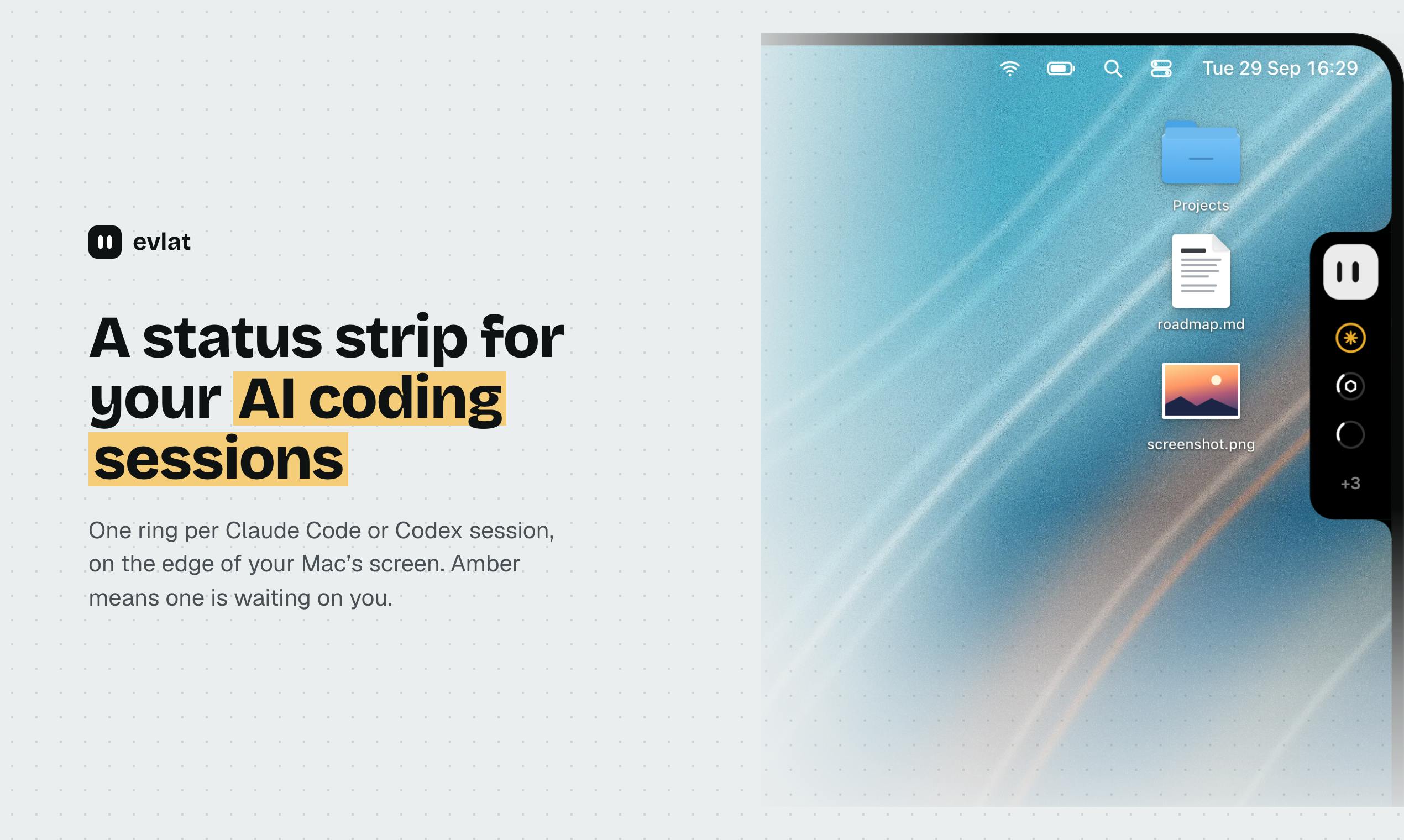
Evlat has a very focused purpose — it's a slim status bar that lives along the edge of your Mac screen, where each Claude Code or Codex session is represented by a ring (dot). Its core logic is simple and direct: when a session needs permission to proceed or is waiting for your input, the corresponding ring turns amber, signaling that a task is blocked. A single click takes you directly to the relevant terminal tab.
This design cleverly transforms "multi-session status monitoring" from a cognitive burden into a visual signal. For developers increasingly adopting "parallel AI agent development" workflows, not having to constantly switch between multiple terminal windows to check status is a genuine productivity boost.
Claude Code is Anthropic's command-line AI coding agent; Codex is OpenAI's equivalent (now integrated into the ChatGPT and API ecosystem). Both operate in "agent" mode — they don't just passively answer questions, but actively execute multi-step tasks: reading and writing files, running tests, executing terminal commands, and even requesting dependency installations or access to specific paths. Because these operations involve system permissions, agents often require manual user confirmation before executing sensitive steps (i.e., "permission requests" or "human-in-the-loop checkpoints") — which is precisely the core blocking scenario Evlat addresses.
More Than Just Session Alerts
Beyond its core AI coding assistant status monitoring, Evlat covers two additional scenarios: tracking long-running commands and monitoring remote server status. This means when you kick off a time-consuming build, test, or deployment command, you can track its progress via the screen-edge status bar without staring at the terminal waiting for it to finish.
This functional expansion evolves Evlat from an "AI agent notifier" into a more general-purpose developer attention management tool. The underlying need it addresses remains consistent — in an asynchronous, multi-task development environment, helping developers direct their attention to the right place at the right time.
Native Experience and Privacy-First Design
Evlat emphasizes two key characteristics: native and no permissions required. Being native means it's purpose-built for macOS, delivering performance, interactions, and system integration that feel at home on a Mac — not the compromises of a cross-platform framework.
"No permissions required" is a detail worth noting. Many tools that need to monitor system state or processes typically demand extensive system authorizations, which creates both privacy concerns and installation friction. Evlat claims to work without any additional permissions, lowering the barrier to adoption — a meaningful plus in today's increasingly privacy- and security-conscious environment.
Market Position and Observations
Based on Product Hunt data, Evlat has received 87 upvotes and 6 comments, ranking 18th, and was built by independent developer Omer Kala. It's categorized under Mac, Developer Tools, and Artificial Intelligence — precisely targeting the niche audience of "Mac developers using AI coding assistants."
The emergence of tools like this reflects a broader trend: as command-line AI coding agents like Claude Code and Codex become more widespread, developer workflows are shifting from "single-threaded coding" to "multi-agent collaboration." When you're running three to five AI sessions simultaneously, how to efficiently allocate human attention becomes the new productivity bottleneck. Tools like Evlat — what we might call "meta-tools" — fill exactly this gap. They don't write code directly; instead, they optimize the rhythm of collaboration between humans and AI agents.
That said, as a tool focused on a single platform with a minimal feature set, its value is highly dependent on whether users are truly operating in heavy multi-session workflows. For developers who use AI assistants occasionally, the appeal may be limited. But for power users who have deeply embedded AI agents into their daily development process, this kind of "lightweight but solving a real pain point" design hits the mark.
The concept of a "meta-tool" has historical roots in software development — early task managers, process monitoring dashboards (like htop or Activity Monitor), and multi-terminal management panels in IDEs are all essentially "tools for managing tools." As AI agents become first-class citizens in the development workflow, developers are effectively taking on two roles simultaneously: directly writing code, and "supervising and orchestrating" multiple AI sessions. This role bifurcation is creating a new category of tool needs — ones that win not by piling on features, but by reducing the cost of cognitive context-switching. Evlat is an early manifestation of this trend, and similar products may well emerge in the Windows and Linux ecosystems, or as plugins integrated into mainstream editors like VS Code.
Summary
Evlat is a classic "small but elegant" developer tool. Rather than trying to do everything, it takes one specific pain point — monitoring the status of multiple AI coding sessions — and executes it with polish and ease of use. As AI coding agents accelerate their penetration into development workflows, auxiliary tools built around AI workflows like this are likely to become a steadily growing niche category.
Related articles

Chain of Thought Isn't Just for AI: How Humans Can Use CoT to Improve Thinking Quality
Chain of Thought isn't just a prompt trick for large models. Starting from a Hacker News discussion, this article analyzes why CoT works for human thinking too, breaks down actionable ways to transfer it, and highlights the key differences between human CoT and machine CoT.
Cloudflare Teams Up with OpenAI: Closi…
Cloudflare Teams Up with OpenAI: Closing the Loop from Vulnerability Discovery to Defense with AI
Cloudflare uses OpenAI Daybreak to investigate security vulnerabilities and generate reviewable remediation plans, while developers use Codex to boost coding efficiency and quality.

Orca Multi-Agent Orchestration in Practice: A Guide to Parallel Collaboration with Claude and Codex
Orca is Stable AI's free open-source agent workbench supporting 34 agents like Claude Code and Codex in parallel. Learn its Git worktree isolation, multi-model orchestration, and mobile management.