Ex-Nvidia Executive: Physical AI Is in Its 'LEGO Era'

Ex-Nvidia exec says physical AI is in its 'LEGO era,' lacking unified standards and data; a general breakthrough will take time.
Former Nvidia executive and current VC Amulya Vishwanath said on a TechCrunch podcast that physical AI is in its 'LEGO era': sensors, actuators, ROS 2, and other modules are gradually standardizing, but fragmented interfaces and the lack of a unified integration framework make it hard to assemble general intelligent systems. She believes the industry is waiting for a 'ChatGPT moment for robots,' but the scarcity of high-quality real interaction data, the sim-to-real gap, hardware costs, and safety are major bottlenecks. Drawing on her Nvidia technical background and VC perspective, she advises entrepreneurs to focus on vertical scenarios to solve real pain points, while investors need patience for longer return cycles; general-purpose humanoid robots will take longer.
The 'LEGO Moment' of Physical AI
Former Nvidia executive and current venture capitalist Amulya Vishwanath offered a vivid metaphor on TechCrunch's Equity podcast: Physical AI is in its "LEGO era." The phrase precisely captures the current state of robotics—we have all sorts of standardized, modular "building blocks" (sensors, actuators, algorithm frameworks), but we have yet to assemble a truly intelligent, general-purpose robotic system.
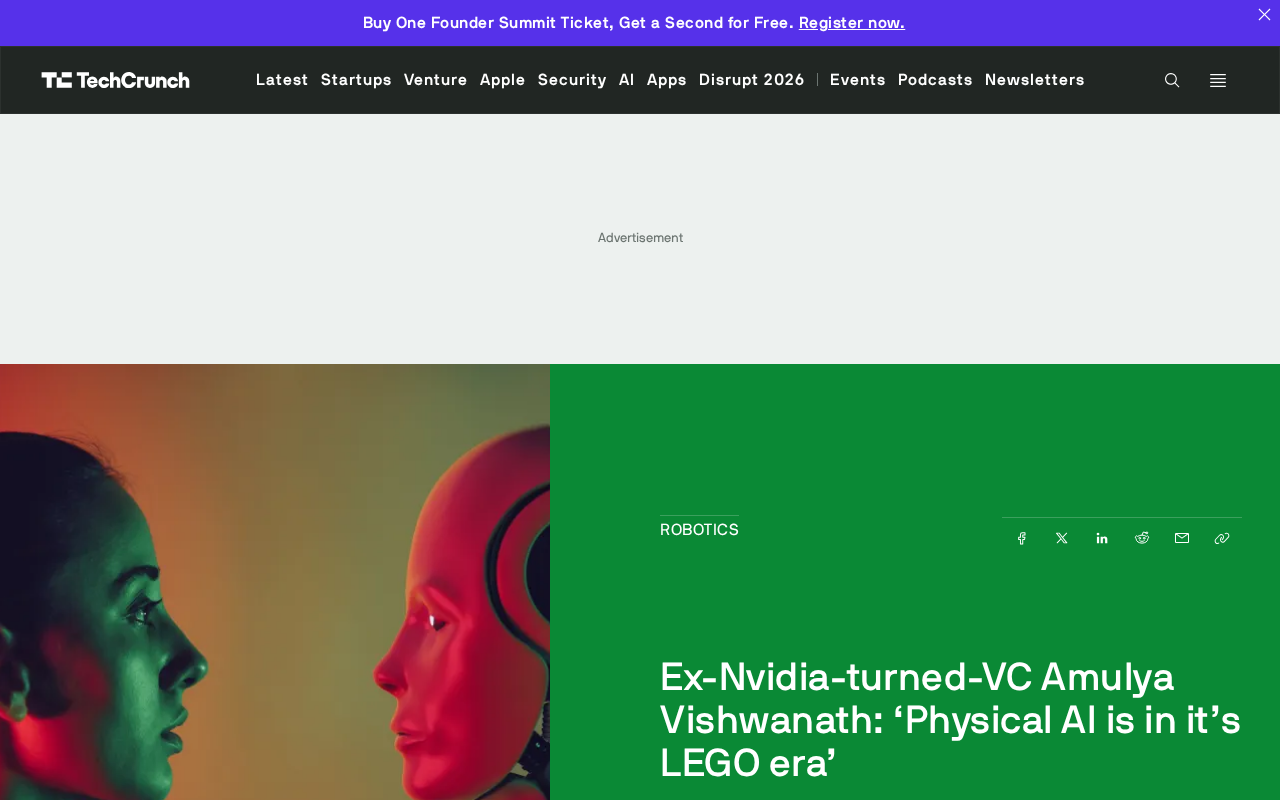
Vishwanath's core argument is that the entire industry is waiting for that "ChatGPT moment for robots." Just as large language models suddenly demonstrated astonishing general capabilities at a certain tipping point, physical AI yearns for a similar breakthrough. But in her view, we are still in an early stage—the fragmentation of hardware and software makes building complex robotic systems like assembling LEGO bricks: full of possibilities, yet lacking a unified "intelligent blueprint."
From Nvidia to VC: A Shift in Perspective from the Front Lines
Vishwanath's background gives her a unique vantage point. Her time at Nvidia gave her deep insight into the evolution of AI computing infrastructure and accelerated computing, while her transition to venture capital lets her examine the path to deployment for physical AI through the lens of capital and the startup ecosystem. This dual identity enables her to identify the gap between technological maturity and market opportunity.
She points out that the challenge of physical AI lies not only in algorithms but also in interaction with the real world. Robots need to perceive, decide, and act in unstructured environments, which is far more complex than processing text or images. Many robotics companies today focus on specific scenarios (such as warehouse logistics and manufacturing), but there is still a long way to go before generalization.
Physical AI refers to AI systems that enable agents to perceive, reason, and act in the physical world, encompassing robots, autonomous driving, drones, and embodied intelligence. Unlike digital AI that processes text and images, physical AI must contend with real-world complexities such as continuous time, partial observability, contact dynamics, and safety constraints. Nvidia has made this a strategic direction, launching the Isaac simulation platform, the Cosmos world foundation model, and Jetson edge computing hardware in an attempt to provide full-stack infrastructure for physical AI from training to deployment. The core proposition of this concept is that intelligence must be tightly coupled with interaction between body and environment, rather than relying solely on offline data training.
Why the 'LEGO Era'?
The "LEGO era" metaphor carries several layers of meaning. First, hardware modularity has increased: core components such as harmonic reducers, torque sensors, and dexterous hands are gradually becoming standardized, allowing startups to combine them like picking LEGO bricks. Second, the software stack is layered: ROS 2, simulation tools, and reinforcement learning frameworks lower the development barrier, but integration across layers remains a pain point. Third, there is a lack of unified standards: interfaces, data formats, and communication protocols from different vendors are incompatible, making it difficult to seamlessly snap the "bricks" together.
Vishwanath believes that a breakthrough in physical AI requires something like a "LEGO instruction manual"—a general framework or platform that can guide developers to quickly build complex systems. This could be the deployment of foundation models in robotics, or it could be a new middleware standard.
Sim-to-real is a core challenge in robot learning: policies trained in physics simulators (such as Isaac Sim, MuJoCo, and PyBullet) often fail when transferred to real hardware due to modeling errors. Sources of error include approximations of contact mechanics, sensor noise, actuator latency and wear, and changes in lighting and materials in the real world. Common mitigation approaches include domain randomization (randomizing physical parameters and visual appearance during training), system identification (calibrating simulation parameters with real data), and online adaptation (continuing to fine-tune after deployment). Despite this, the gap has not been fully eliminated, which is one of the important causes of the data bottleneck in physical AI.
ROS 2 (Robot Operating System 2) is the de facto open-source middleware standard in robotics, providing node communication, hardware abstraction, lifecycle management, and real-time support. It is built on DDS (Data Distribution Service) and supports distributed, multi-machine communication and Quality of Service (QoS) configuration, making it better suited for product deployment than ROS 1. However, ROS 2 itself does not prescribe upper-layer algorithms or data formats, and differences in drivers, message definitions, and coordinate frame conventions among vendors still exist—this is the technical root of why "bricks are hard to seamlessly snap together." Components in the ecosystem such as MoveIt, Nav2, and ros2_control further lower the development barrier, but they also exacerbate fragmentation of versions and interfaces.
How Far Away Is the ChatGPT Moment for Robots?
Despite the industry's enthusiasm, Vishwanath remains cautious. She notes that the success of large language models benefited from the availability of massive amounts of text data on the internet, whereas physical AI lacks high-quality robot interaction data at a comparable scale. Simulation environments can generate data, but the "sim-to-real" gap remains significant.
In addition, issues such as hardware cost, safety, and reliability also constrain the scaling of physical AI. She expects that in the coming years, more vertical-specific robots will achieve commercial success, but general-purpose humanoid robots or general-purpose physical AI systems will take longer.
Implications for Entrepreneurs and Investors
For entrepreneurs, Vishwanath's advice is to focus on specific scenarios and use engineering capabilities to solve real pain points, rather than pursuing the grand narrative of "general intelligence." For investors, she believes patience is needed—the return cycle for physical AI may be longer than for software, but once a breakthrough occurs, the barriers will also be higher.
Her views align with current investment trends in robotics: capital is flowing to companies that own core hardware technology or vertical-scenario data. The "LEGO era" of physical AI means opportunity and chaos coexist, and the ultimate winners may be the teams that both understand the properties of the bricks and can design ingenious structures.
Related articles

DeepCell: One-Click AI Generation of Documents, Spreadsheets, and Slides
DeepCell tops Product Hunt with one-click generation of documents, spreadsheets, and slides, using the .deepcell format for linked updates, designed for System 2 tasks like modeling and sales reviews.

Doneas: 15-Minute Daily Accountability Calls That Keep Indie Developers From Procrastinating
Doneas is a daily accountability tool for indie developers: plan tasks on Monday, join a 15-minute call with five builders each day, and log deliveries on a public progress page. This article analyzes its core mechanics, effectiveness, and potential issues around retention and matching.

Fastlane 2.0: Fully Automated AI Ad Campaigns, From Creative to Optimization
Fastlane 2.0 is an AI ad automation tool: enter your website and it learns your brand, generates video and image ads, and runs and optimizes them on Meta, TikTok, Instagram, and YouTube.