Ex-OpenAI Employee Accused of Bugging Office: $385K Salary and $2.2M New-Hire Grant

A former OpenAI employee accused of bugging the office had a $385K salary and $2.2M new-hire grant, sparking debate over motive.
A former OpenAI employee has drawn attention for allegedly planting a recording device in the office, with compensation details surfacing: a $385K annual salary plus a $2.2M new-hire grant. The Reddit discussion centers on a paradox—under the rational-actor assumption, such a generous package should make someone cherish their position rather than break the law, suggesting the motive may not be money. The article also notes that the information mainly comes from a Reddit post, with no details on the allegation, investigation, or response from the person involved, making the source thin. Setting aside the allegation, the numbers offer a window into the compensation structure of leading AI companies: high base salaries plus graded-vesting equity awards create a "golden handcuffs" effect and reflect real challenges in internal governance and information security.
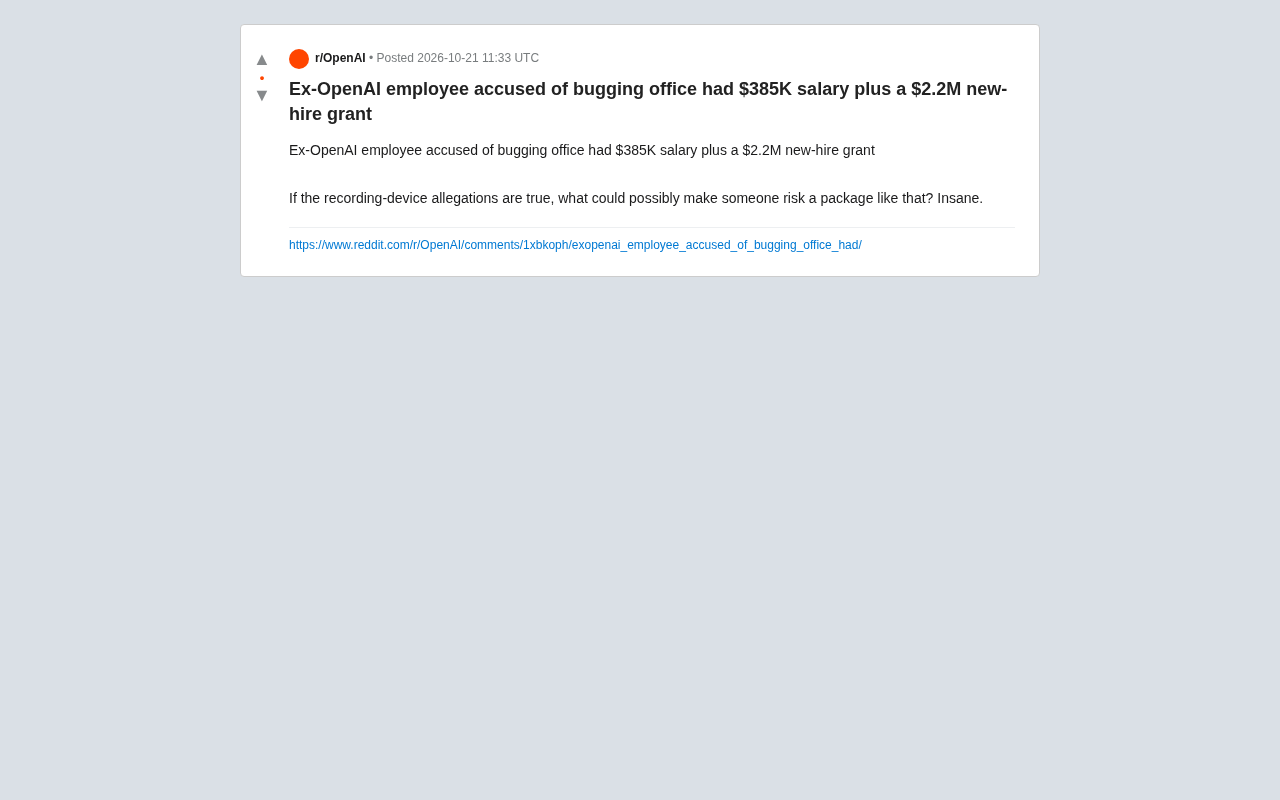
A former OpenAI employee has drawn attention for allegedly planting a recording device in the office, and their compensation details have also surfaced: a $385K annual salary plus a $2.2M new-hire grant. The discussion on Reddit cuts to the core—if the allegations are true, what would make someone risk such a generous package?
The Paradox of High Pay and High Risk
According to the leaked information, the former employee's annual base salary was $385K and they also received a $2.2M new-hire grant. Against the backdrop of fierce competition for top AI talent, such a compensation package is not unique, but combined with the "office bugging" allegation, it creates strong dramatic tension.
Reddit community reactions converge on one point: under the rational-actor assumption, such a generous reward should make someone cherish their position rather than break the law. This paradox suggests the driving force may not be money but other, more complex factors—such as an obsession with specific information, internal disputes, or a misjudgment of the consequences of one's actions.
The Informational Boundaries of the Allegation Itself
It should be clear that the content currently circulating mainly comes from a Reddit post, centered on a brief discussion about a "recording device allegation," and does not disclose specific details of the allegation, the progress of any investigation, or the response of the person involved. The original material contains only one rhetorical comment: "Insane." expressing bewilderment at the motive.
This means the discussion around this matter remains largely at the level of "the impact of the salary numbers" and "speculation about motives," rather than a full reconstruction of the event. Readers following such topics should also note the thinness of the source—social platform discussions tend to amplify drama while lacking verifiable details.
In reporting involving unresolved allegations, source reliability is a key dimension for judging informational value. Tip-off posts on social platforms such as Reddit typically lack first-hand evidence, responses from the parties involved, or details that can be cross-verified, and their content is prone to "dramatic filtering" during dissemination—that is, the parts that get amplified by upvotes and shares are often the most conflict-laden, not the most factually solid. Professional reporting usually requires at least two independent sources to cross-corroborate and gives the parties involved an opportunity to respond. Therefore, when facing such topics, readers should evaluate "the salary numbers" and "the facts of the allegation" separately: the former has a clear source, while the latter currently remains at the stage of one-sided tip-off.
A Compensation Profile of the AI Talent War
Setting aside the allegation itself, these numbers offer outsiders a window into the compensation structure of leading AI companies. Frontier labs such as OpenAI often lock in core employees by combining high base salaries with equity or signing bonuses to compete for scarce talent. A $2.2M new-hire grant is usually paid in the form of stock or graded vesting rather than a one-time cash payment.
This compensation design inherently has a "golden handcuffs" effect: the larger the award, the higher the cost of leaving. Precisely for this reason, when an employee enjoying such treatment is accused of acting against the company's interests, the outside confusion is so intense.
A new-hire grant is a one-time incentive award set by tech companies to attract key talent, usually issued in the form of restricted stock units (RSUs) or options rather than cash. Taking RSUs as an example, employees must serve at the company for a certain number of years (commonly 4) before gradually vesting, and unvested portions are automatically forfeited upon departure. This design is both "golden handcuffs" and a financial means for the company to lock in core personnel. A scale of $2.2M is not uncommon among top AI labs, but its actual value upon receipt depends heavily on the company's valuation trajectory and vesting schedule—if the company's valuation continues to rise, the appeal of this award will far exceed its book value.
Implications for the Industry and Practitioners
From an industry perspective, this controversy reflects the real challenges of internal governance and information security management at AI companies. As model capabilities improve, the security boundaries of offices, meeting rooms, and even devices become more sensitive. Regardless of whether the allegation is ultimately substantiated, strengthening physical and digital security measures in sensitive areas is an expected direction for companies.
For practitioners, the other side of high pay and high opportunity is stricter compliance requirements and higher standards of conduct. No matter how generous the compensation package, it cannot provide immunity for crossing the line. The "Insane" exclamation on Reddit is essentially an instinctive reaction to the gap between rationality and temptation.
One-line Summary
A former OpenAI employee accused of planting a recording device in the office has had high-pay details exposed, sparking discussion of a motive paradox.
Paragraph Summary
A former OpenAI employee has drawn attention for allegedly planting a recording device in the office, and their compensation details have surfaced: a $385K annual salary plus a $2.2M new-hire grant. The Reddit discussion focuses on a paradox—under the rational-actor assumption, such a generous package should make someone cherish their position rather than break the law, suggesting the driving force may not be money. The article also notes that the current information mainly comes from a Reddit post, with no disclosure of allegation details, investigation progress, or the response of the person involved, making the source relatively thin. Setting aside the allegation itself, these numbers offer outsiders a window into the compensation structure of leading AI companies: high base salaries combined with graded-vesting equity awards create a "golden handcuffs" effect and also reflect the real challenges of internal governance and information security management at AI companies.
Related articles

Workbuddy for Absolute Beginners: How a Desktop AI Agent Fits Into Real Workflows
A beginner's guide to the Workbuddy desktop AI agent: installation, claiming credits, file management, and building automated workflows—compared with CodeX for fit and cost, helping professionals shift from AI question-askers to AI managers.

OpenAI's New Agent Stack: Computer Use, Decisions API, and Ultra-Fast Workflows
OpenAI Dev Day unveiled a new agent stack: Computer Use outperforms humans, Decisions API delivers ultra-low-latency classification via Luna, Agents API opens the same Computer Use capabilities, and GPT-6.1 Sol costs only one-seventh of Astra. Core updates, benchmark data, and developer insights.

Liang Wenfeng Open-Sources DeepInfo Inference Framework, Takes On U.S. Ban
DeepSeek open-sources its DeepInfo inference framework after its models, featuring GPU/CPU cross-pipelining, small-model prediction with large-model verification, and full Huawei Ascend and NVIDIA chip support—facing the U.S. federal ban head-on. This article analyzes its significance for AI deployment and open-source strategy.