Exa 3.0 Search API Upgrade: Richer Data and Lower Costs for AI Agents
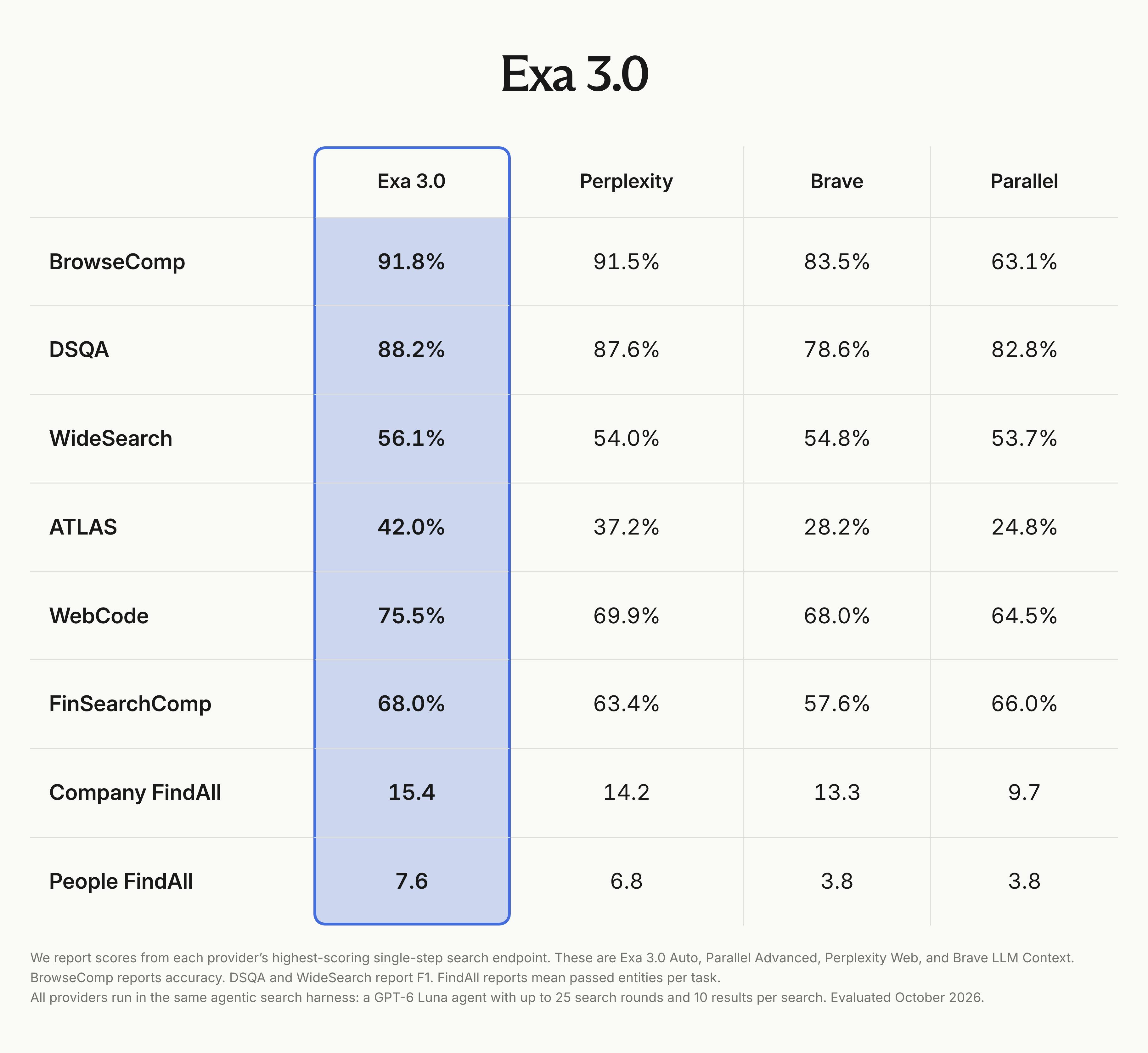
Exa 3.0 boosts AI Agent search quality and slashes costs with bigger embedding models, more documents, and Dynamic Highlights.
Exa 3.0 is the biggest quality update yet to the search API for AI Agents. It uses a larger embedding model and adds billions of documents, including 1.27 billion e-commerce listings and over 211 million local business records. Dynamic Highlights extracts only the snippets most relevant to a query, saving 95% of tokens versus full-page text. New tiers—Exa Lite at $4 and Exa Auto at $7 per 1,000 requests—are now available via API.
Exa 3.0, the search API built for AI Agents, has received a major update. Through larger embedding models, billions of newly added documents, and the innovative Dynamic Highlights technology, it significantly reduces token consumption while improving search quality. The new Exa Lite and Exa Auto tiered pricing lets developers provide richer data to AI Agents at a lower cost.
A Full Leap in Search Quality: Larger Embedding Models and Massive Document Coverage
Exa 3.0 is the largest quality update to the Exa search API to date. According to the official announcement, the new version uses a larger embedding model and adds billions of documents, including 1.27 billion e-commerce product listings and over 211 million local business records. This means AI Agents can retrieve from broader and more fine-grained data sources, delivering more precise results whether for product price comparison, local service lookups, or general knowledge acquisition.
For developers building applications on top of the search API, expanded data coverage directly increases an Agent's practical value. For example, an Agent in an e-commerce scenario can fetch product information in real time, while a local-life Agent can offer recommendations based on business data—without having to maintain multiple data sources separately.
Embedding Model refers to a neural network model that maps unstructured data such as text and images into high-dimensional dense vectors, where semantically similar content sits closer together in vector space. Search systems typically use an embedding model to encode queries and documents into vectors separately, then retrieve candidate results via vector similarity (such as cosine similarity)—a process known as semantic search or vector search. The parameter count, training data scale, and vector dimensionality of an embedding model directly affect retrieval recall and semantic generalization. Exa 3.0's adoption of a "larger embedding model" means it can capture query intent more precisely and reduce the missed and false matches caused by literal keyword matching—especially well suited to AI Agent queries with vague natural-language descriptions and complex intent.
Dynamic Highlights: Delivering Key Information with 95% Fewer Tokens
Exa 3.0 introduces Dynamic Highlights, which dynamically extracts the snippets most relevant to a query from a web page instead of returning the full page text. Official figures show this approach consumes 95% fewer tokens than returning the complete page text.
For AI Agents, token cost is a key expense in long-term operation. Dynamic Highlights not only lowers costs but also reduces interference from irrelevant information in the model's context, helping improve response speed and accuracy. Developers no longer have to make a difficult trade-off between information completeness and cost, and Agents can process search results more efficiently.
Token is the basic unit by which large language models process text; one token roughly corresponds to half an English word or one to two Chinese characters. A model's context window, API billing, and inference latency are all directly tied to token count: the longer the input, the higher the cost and the slower the response, and too much irrelevant content dilutes the model's attention, causing key information to be buried. Therefore, compressing content at the snippet level before feeding web pages to an Agent is a key means of controlling cost and ensuring quality. Dynamic Highlights is extractive content reduction—it keeps the sentences or paragraphs in the original text most relevant to the query rather than generating a rewrite, so it avoids summarization hallucinations while substantially shortening context length.
New Pricing Tiers: Exa Lite at $4 per Thousand Requests
Exa 3.0 introduces new pricing tiers that further lower the barrier to entry. Exa Lite is priced at $4 per 1,000 requests, suited to cost-sensitive scenarios or high request volumes; Exa Auto is priced at $7 per 1,000 requests and may offer more automated optimization or higher-quality results. These new tiers are now available through the API.
The tiered pricing strategy lets developers of different sizes find a plan that fits them. Startup teams or individual developers can start with Lite, while enterprises needing higher search quality can choose Auto, giving flexible cost control.
How a search API is metered typically falls into two categories: billing by number of requests and billing by volume of returned content (tokens or characters). Exa 3.0's pricing is based on "per 1,000 requests," while Dynamic Highlights sharply reduces the amount of text returned per request—together, this means a further drop in the actual cost per unit of information for developers. For Agent applications, search is often the most frequent external call in each task, and request and token volumes grow linearly with user scale. When choosing a service, developers therefore need to evaluate three dimensions at once: per-request price, returned content volume, and result quality. Tiered pricing is precisely the mechanism that lets developers make trade-offs according to their business stage.
Impact on the AI Agent Ecosystem
Exa 3.0's update reflects how search APIs are evolving toward being "optimized for AI." A richer document library, smarter snippet extraction, and more granular cost control are all designed around the real needs of Agents. As AI Agent use cases continue to expand, search APIs are no longer just about returning links—they need to provide high-quality data that models can consume directly.
Through Dynamic Highlights and tiered pricing, Exa 3.0 has found a new balance among data richness, cost, and ease of use, and is poised to encourage more developers to build intelligent agent applications based on real-time search.
One-line Summary
Exa 3.0 improves AI Agent search quality and sharply cuts costs with larger embedding models, massive document coverage, and Dynamic Highlights.
Paragraph Summary
Exa 3.0 is the largest quality update yet to the search API built for AI Agents. The new version uses a larger embedding model and adds billions of documents, including 1.27 billion e-commerce product listings and over 211 million local business records, significantly broadening the breadth and granularity of retrievable data. Its core technical highlight, Dynamic Highlights, dynamically extracts the snippets most relevant to a query from web pages instead of returning full page text, consuming 95% fewer tokens than returning complete pages—lowering Agent operating costs while reducing interference from irrelevant information in the context. On pricing, it adds two tiers: Exa Lite ($4 per thousand requests) and Exa Auto ($7 per thousand requests), covering both cost-sensitive and high-quality-demand scenarios. The update is now available through the API.
Related articles

OpenAI Partners with Shield: How the Astra Agent Revolutionizes IT Troubleshooting
OpenAI and Shield launch the Astra agent, which autonomously logs into computers and legacy systems to fix IT issues in real time, 35-40% faster than traditional models, with humans involved only when judgment is needed.

iPhone Duo Battery Life Tested: One Charge a Day Is Unavoidable, and the Large Screen Is the Culprit
iPhone Duo battery test: heavy use needs at least one charge a day, and about 30% remains after 6.5 hours of screen-on time. How often the large screen is unfolded is key; a MagSafe battery pack helps, and long-term degradation is also worth watching.

Kimi K3.1 Pro Open-Sourced: 2.8 Trillion Parameters Close In on Opus
Moonshot releases the open-source MoE model Kimi K3.1 Pro, with 2.8T total parameters and 104B activated, trailing Opus 5.5 by under 1 point on Terminal Bench 4.0.