Execlave: A Deep Dive into the Runtime Security Governance Platform for AI Agents

Execlave provides runtime security governance for AI agents with policy enforcement, kill switches, and audit trails.
Execlave is a runtime AI agent governance platform that intercepts and validates every agent action before execution, rather than auditing after incidents occur. It offers three core capabilities — runtime policy enforcement, kill switches, and audit-ready trails — helping enterprises meet SOC 2, EU AI Act, and ISO 27001 compliance requirements while maintaining control over autonomous AI systems in production.
When AI Agents Start Acting Autonomously, Who's Standing Guard?
As autonomous AI agents move from concept to production environments, a long-overlooked problem is surfacing: when agents can independently call APIs, access databases, and execute operations, how should enterprises intercept unauthorized, non-compliant, or even dangerous behaviors?
AI agents are AI systems capable of perceiving their environment, making autonomous decisions, and taking actions to achieve specific goals. Unlike traditional conversational AI (such as chatbots), agents possess tool-calling capabilities and can autonomously plan task steps, invoke external APIs, read and write databases, send notifications, and more. Between 2023 and 2024, as large language model capabilities improved and technologies like Function Calling matured, AI agents rapidly transitioned from academic concepts to engineering practice. Major AI companies including OpenAI, Anthropic, and Google have all launched Agent-related products and frameworks, making it easier than ever to build autonomously acting AI systems. However, this dramatic increase in capability brings a proportional amplification of risk.
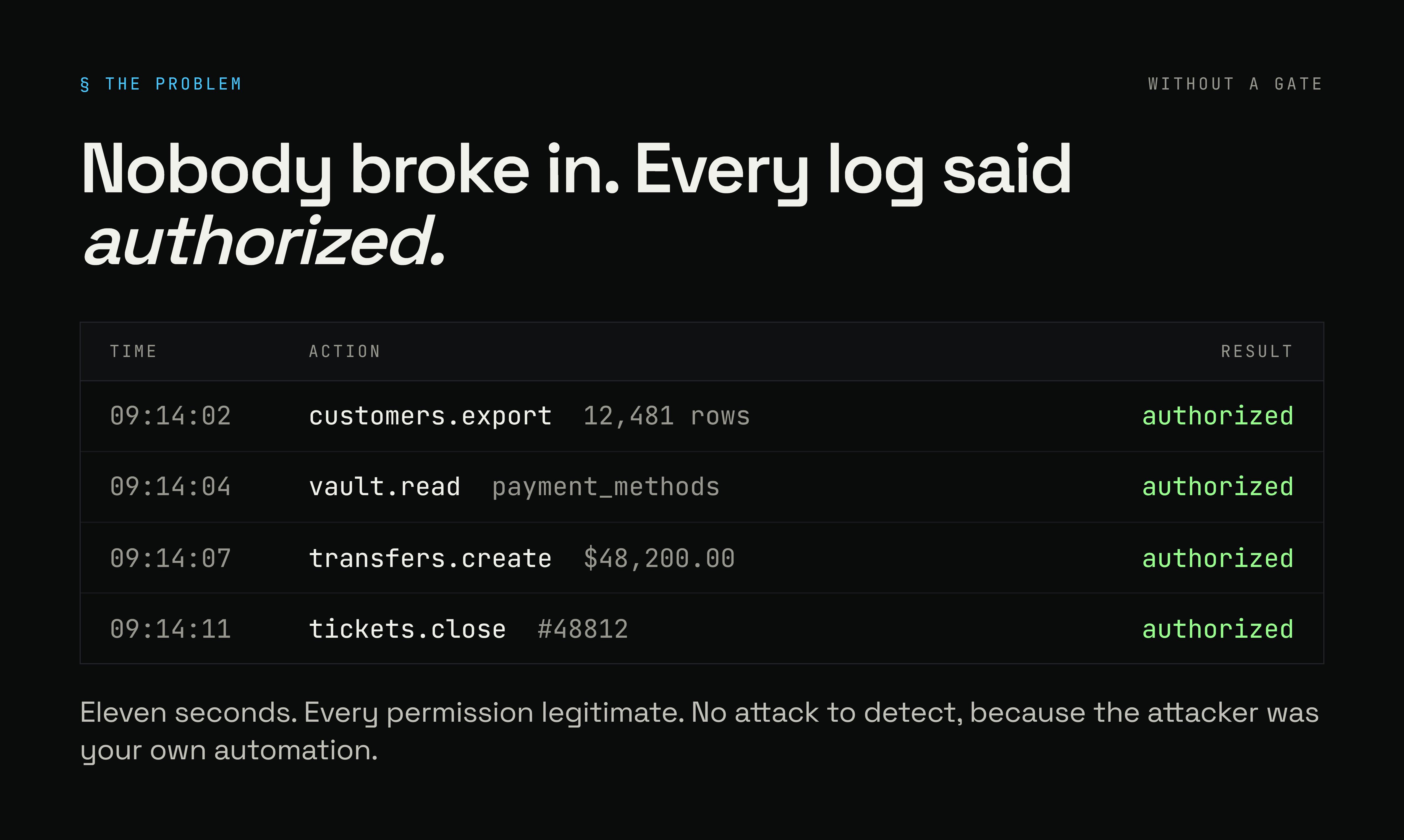
Traditional security auditing is often reactive — tracing logs and conducting post-mortems only after an incident occurs. But in the era of AI agents, a single erroneous automated operation can cause irreversible consequences in milliseconds. Execlave, a new product recently featured on Product Hunt, targets precisely this pain point, positioning itself as "The gate between your AI agents and the real world."
What Is Execlave: An AI Agent Governance and Execution Platform
Execlave is an AI agent governance and execution platform (officially described as a runtime AMP — Agent Management Platform). Its core design philosophy can be summarized in one sentence: enforce policy validation before every action is executed, rather than remediate after an incident has already occurred.
A Paradigm Shift from "Post-Incident Auditing" to "Pre-Execution Interception"
This is the most fundamental distinction between Execlave and traditional security solutions. It acts as a "gatekeeper," physically deployed between autonomous agents and enterprise production systems. Any action an agent wants to execute — whether sending an email, modifying a database record, or calling an external service — must first pass through Execlave's policy engine for review.
Only authorized actions are allowed to proceed; everything else is directly blocked. This "runtime policy enforcement" mechanism shifts the security control point from passive log recording to active behavioral access control.
From a technical perspective, runtime policy enforcement draws on mature practices from the cloud-native security domain. Its core concept is inserting a Policy Decision Point (PDP) in the actual execution path of code or requests. Similar to how Kubernetes Admission Controllers validate whether a Pod meets cluster policies before creation, or how Sidecar proxies in a Service Mesh enforce access control before each network call — Execlave intercepts and validates each agent action before execution. This pattern is also analogous to the role of Open Policy Agent (OPA) in microservices architectures: decoupling policy logic from business logic, managing it centrally through a unified policy engine for real-time adjudication.
Execlave's Three Core Capabilities
According to official documentation, Execlave provides platform teams and security teams with three key capabilities:
-
Runtime Policy Enforcement: Real-time validation of whether each action complies with predefined policies before it occurs. The policy engine must make decisions in extremely short timeframes, typically requiring latency at single-digit millisecond levels, while supporting complex condition combinations — for example, "allow Agent A to read customer data during business hours, but prohibit bulk exports exceeding 100 records."
-
Kill Switches: When abnormal agent behavior is detected, immediately sever its access to production systems to prevent further damage. The Kill Switch concept originates from emergency stop buttons in industrial control systems. Its design philosophy is: no matter how intelligent an automated system is, humans must retain the ability to immediately halt its operation at any moment. In AI agent scenarios, this mechanism is particularly critical — because agents may enter runaway loops, such as repeatedly calling paid APIs leading to cost overruns, or executing destructive operations in succession guided by flawed reasoning chains. Kill Switches must be architecturally guaranteed to have priority over any agent instructions and must not depend on the agent's own cooperation to take effect — which is why they must be deployed externally rather than internally.
-
Audit-ready Trails: Complete recording of every agent action, making them traceable and explainable to meet compliance review requirements. This includes not only the action itself but also the context that triggered it — the agent's reasoning process, user instructions, the policy engine's adjudication basis — forming a complete causal chain.
Compliance: The Hidden Barrier to Enterprise AI Agent Adoption
For large enterprises, technical capability is never the sole consideration when adopting new technology — compliance is often the truly decisive factor. Execlave clearly understands this, explicitly claiming it can help enterprises ensure every agent action complies with major compliance frameworks, including:
-
SOC 2: A security and privacy audit standard for service-oriented enterprises. SOC 2 (System and Organization Controls 2) is an audit framework developed by the American Institute of Certified Public Accountants (AICPA), specifically targeting SaaS and cloud service providers. It's based on five Trust Services Criteria: security, availability, processing integrity, confidentiality, and privacy. Passing a SOC 2 audit means an enterprise's systems meet verifiable standards in data protection, access control, change management, and more. For AI agents, SOC 2 requires enterprises to demonstrate: who authorized the agent's operations, whether the scope of operations is controlled, and whether anomalous behavior is detected and handled promptly.
-
EU AI Act: The European Union's AI legislation — the world's first comprehensive regulatory framework specifically for AI. Officially passed in 2024, it adopts a risk-tiered system: unacceptable-risk AI is outright banned (e.g., social scoring systems), high-risk AI must meet strict compliance requirements, limited-risk AI must meet transparency obligations, and minimal-risk AI is largely unregulated. For high-risk AI systems, the Act requires: establishing risk management systems, ensuring data governance quality, providing technical documentation, implementing human oversight mechanisms, and guaranteeing accuracy and robustness. Autonomous AI agents, due to their independent decision-making and action capabilities, are highly likely to be classified as high-risk systems, especially when applied in sensitive domains such as healthcare, finance, and human resources.
-
ISO 27001: The international standard for information security management systems. It provides a systematic methodology for managing sensitive information security, including risk assessment processes, selection and implementation of security controls, and continuous improvement mechanisms. In the context of AI agents, ISO 27001 requires enterprises to treat agents as part of their information systems, incorporating them into a unified security management framework for risk assessment and control.
The support for the EU AI Act is particularly noteworthy. As the EU AI Act progressively takes effect, high-risk AI systems will face strict transparency, traceability, and human oversight requirements. Execlave's audit trails and real-time control capabilities correspond precisely to the implementation needs of these regulatory provisions. This means it's not just a technical tool but could become foundational infrastructure for enterprises to mitigate compliance risks.
AI Agent Security Governance: An Emerging New Market
From its product positioning, Execlave is betting on a market that's still in its early stages but has enormous growth potential — AI agent security and governance.
Over the past year, industry attention has primarily focused on making agents "smarter and more autonomous," with various Agent frameworks emerging in rapid succession. But when these agents are actually connected to production systems and granted real operational permissions, "how to constrain them" becomes an unavoidable question. This follows a similar logic to the rise of IAM (Identity and Access Management) and zero-trust architecture in the cloud computing era: the more powerful the capability, the more granular the permission controls need to be.
IAM (Identity and Access Management) is the cornerstone of enterprise IT security, with its core purpose being to answer the question "who can access what resources under what conditions." Zero Trust Architecture takes this further by breaking the traditional assumption that "the internal network is trustworthy," requiring every access request to undergo identity verification and authorization validation, regardless of whether the request originates from inside or outside the network. Applying this philosophy to AI agents: each agent should be treated as an independent "identity principal," with every operation authorized based on the principle of least privilege. Execlave is essentially building an IAM-like governance system for AI agents — defining agent identities, roles, and permission boundaries, and enforcing them at runtime.
Execlave's approach is analogous to wrapping AI agents in a "runtime firewall" or "policy gateway," clearly delineating the security boundary at the interface between agents and the real world. This architectural approach is quite intuitive for security teams and easier to integrate into existing enterprise security frameworks.
Execlave's Current Status and Challenges
On Product Hunt, Execlave received 79 upvotes and 8 comments, ranking 19th, categorized under Developer Tools, Artificial Intelligence, and Security. Based on these numbers, it's in a steady launch phase — not yet a breakout hit, but its chosen direction demonstrates clear foresight.
Of course, this type of agent security governance platform also faces real-world challenges:
-
Performance Overhead: Does performing policy validation before every action introduce noticeable latency to agent response times? This is a classic tradeoff that all runtime security solutions must address. Drawing from the service mesh domain's experience, solutions like Istio/Envoy also faced significant performance debates early on, ultimately bringing latency within acceptable ranges through optimizations like policy caching and asynchronous validation of non-critical paths. Execlave likely needs similar engineering optimizations.
-
Policy Complexity: How can non-security experts conveniently configure and maintain policy rules? Policy language design is a key challenge — too simple and it lacks expressiveness; too complex and it raises the barrier to adoption. Existing industry practices include OPA's Rego language and AWS's IAM Policy JSON, each with their own trade-offs. The ideal solution might provide a visual policy editor while supporting underlying policy code writing.
-
Ecosystem Compatibility: Can it seamlessly integrate with mainstream Agent frameworks (such as LangChain, AutoGPT, etc.)? Current mainstream AI agent frameworks include: LangChain/LangGraph providing toolchains for building chain-of-thought reasoning and multi-step Agents; AutoGPT as the earliest open-source project to spark the Agent wave; CrewAI focusing on multi-agent collaboration; Microsoft's AutoGen providing a multi-agent dialogue framework; plus commercial solutions like Anthropic's Claude tool-calling capabilities and OpenAI's Assistants API. These frameworks share a common characteristic of focusing on "making Agents more powerful" but typically only offer basic tool permission configuration at the security governance level, lacking enterprise-grade policy management, real-time monitoring, and emergency intervention capabilities. Execlave needs to provide standardized SDKs or middleware that can integrate with these diverse frameworks with minimal intrusiveness.
The answers to these questions will determine whether Execlave can grow from a "good idea" into an enterprise-grade standard component.
Conclusion: Controllable Intelligence Is a Prerequisite for AI Agent Deployment
Execlave's emergence reflects the AI industry's maturation from "pursuing intelligence" to "pursuing controllable intelligence." When agents truly gain the ability to act, "pre-execution interception, full-process auditability, and instant shutdown capability" will no longer be optional — they'll be essential prerequisites for enterprise deployment of autonomous AI.
Behind this trend is the natural evolution of the AI technology maturity curve: any technology transitioning from the lab to enterprise production must progress through three stages — from "functional" to "user-friendly" to "secure and controllable." Just as database technology developed transaction management and access control, and cloud computing developed IAM and security groups — AI agents will inevitably need to develop their own governance layer.
Regardless of how far Execlave ultimately goes, the Agent governance layer it represents will become an indispensable component of future AI infrastructure. For teams currently exploring agent deployment, now may be exactly the right time to revisit the age-old question of "security."
Related articles

Chain of Thought Isn't Just for AI: How Humans Can Use CoT to Improve Thinking Quality
Chain of Thought isn't just a prompt trick for large models. Starting from a Hacker News discussion, this article analyzes why CoT works for human thinking too, breaks down actionable ways to transfer it, and highlights the key differences between human CoT and machine CoT.
Cloudflare Teams Up with OpenAI: Closi…
Cloudflare Teams Up with OpenAI: Closing the Loop from Vulnerability Discovery to Defense with AI
Cloudflare uses OpenAI Daybreak to investigate security vulnerabilities and generate reviewable remediation plans, while developers use Codex to boost coding efficiency and quality.

Orca Multi-Agent Orchestration in Practice: A Guide to Parallel Collaboration with Claude and Codex
Orca is Stable AI's free open-source agent workbench supporting 34 agents like Claude Code and Codex in parallel. Learn its Git worktree isolation, multi-model orchestration, and mobile management.