"Exercise Pill" Research: Can You Get Exercise Benefits Without Working Out?
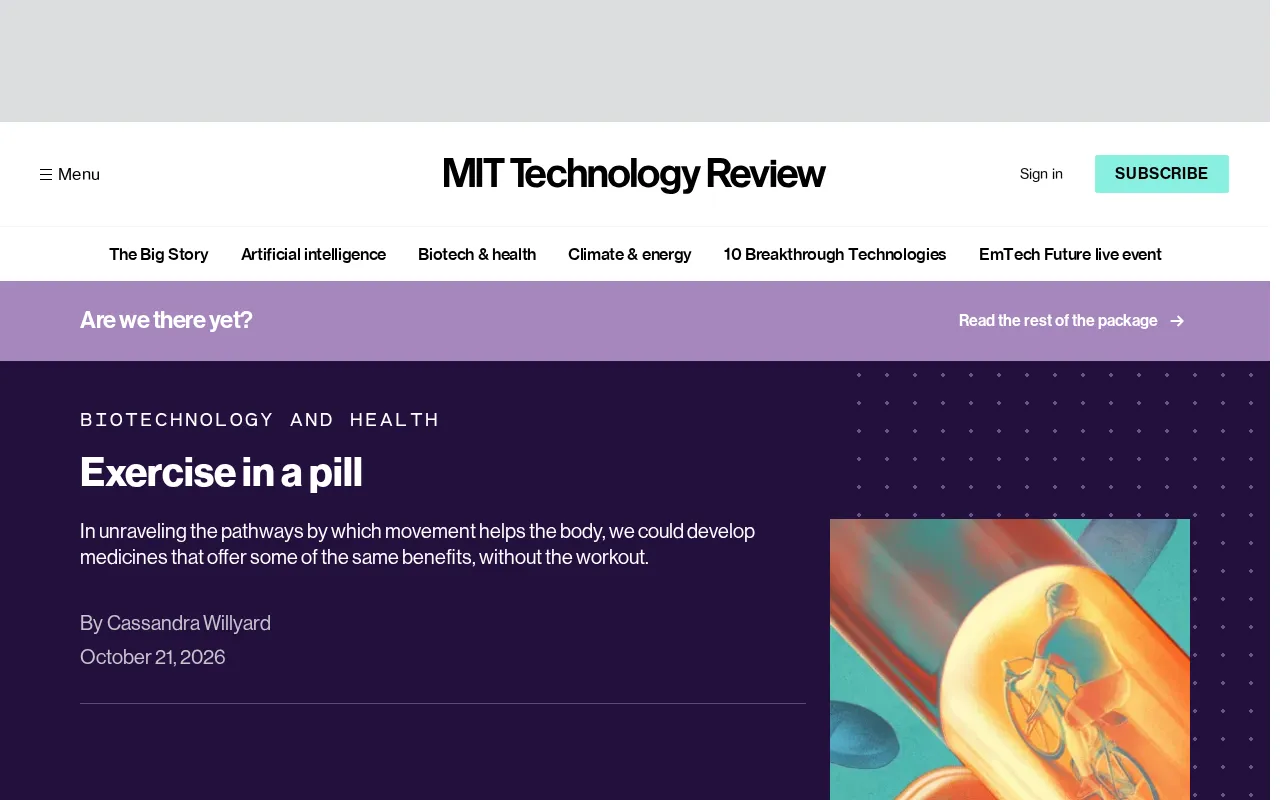
Scientists are decoding the molecular mechanisms of exercise benefits to develop drugs for people who can't work out—not to replace exercise.
The article explores the research concept and status of an "exercise pill." It's not about replacing exercise but providing some benefits to those who can't work out due to injury, aging, or chronic disease. The approach involves decoding how exercise benefits the body at the molecular level—signaling molecules from muscles, pathways affecting distant organs—and developing drugs targeting the same pathways. The field is still in early mechanism exploration with no specific candidates or clinical data. Exercise benefits result from multi-system coordination, hard for a single drug to replicate, and long-term safety needs verification. For healthy people, regular exercise remains irreplaceable; the research's value lies in deepening understanding of exercise biology and potentially yielding new therapies for metabolic diseases and muscle atrophy.
Exercise is good for your health—this has long been common knowledge: it builds muscle and bone, lowers blood pressure, and improves mood. But scientists are now exploring a bolder idea: could a drug simulate the benefits of exercise, allowing people who can't work out to gain these same advantages? According to a report from an RSS source, researchers are trying to decode the mechanisms behind "how exercise benefits the body" in order to develop drugs that produce some of the same effects.
The Core Idea of an Exercise Pill: Not Replacement, but Supplement
The starting point of this research is not to replace exercise, but to provide an alternative for people who cannot exercise due to physical limitations. The original article clearly states: "The idea isn't to replace exercise, but to bring its benefits to people who can't exercise." This positioning is important—it avoids the misinterpretation of "take a pill and you don't need to work out," and it aligns with the medical ethics principle of prioritizing vulnerable populations.
From a scientific perspective, the benefits of exercise on the human body involve multiple levels—muscles, bones, the cardiovascular system, and the nervous system. Developing a drug that can simulate these combined effects is extremely difficult. Researchers must first break down the molecular signals generated by exercise one by one, then look for compounds that can activate the same pathways.
Research Approach: From Mechanism to Drug
According to the original article, researchers are advancing drug development by "decoding how exercise benefits the body." This means they need to answer several key questions: What signaling molecules do muscles release during exercise? How do these molecules affect distant organs? Which pathways can be targeted by drugs?
Some exploratory directions already exist in this field, such as research into compounds targeting muscle metabolism, mitochondrial function, or inflammatory pathways. However, the original article does not disclose specific candidate drugs or clinical trial data, remaining at the conceptual level. This also indicates that the "exercise pill" is still in the early research stage, with a considerable distance to go before clinical application.
Exercise hormones (Exerkines) are a key concept for understanding the "exercise pill." During exercise, skeletal muscle, liver, adipose tissue, and other organs release various signaling molecules into the bloodstream, including interleukin-6 (IL-6), irisin, BDNF (brain-derived neurotrophic factor), and others—collectively known as exerkines. They act on distant organs in an endocrine manner, mediating the protective effects of exercise on metabolism, the cardiovascular system, and the nervous system. The core idea of drug development is precisely to screen for small molecules or biologics that can mimic specific exerkine signals. For example, IL-6 is released in large quantities by muscles after exercise and participates in the regulation of glucose and lipid metabolism; irisin is associated with the "browning" of white fat. However, the exerkine network is highly redundant and tissue-specific, making it difficult for a single target to reproduce the overall effect—this is also one of the main bottlenecks in the field.
Mitochondrial biogenesis is another core mechanism of exercise benefits. Endurance exercise promotes mitochondrial proliferation and functional enhancement by activating the AMPK-PGC-1α pathway, thereby enhancing muscle oxidative capacity and improving metabolic health. PGC-1α is known as the "master regulator of mitochondrial biogenesis," and its upstream AMPK senses cellular energy status (activated when the AMP/ATP ratio rises). Drug mimicry of this pathway faces challenges: compounds that directly activate AMPK (such as metformin and AICAR) can partially mimic the metabolic effects of exercise, but may interfere with the adaptive response to exercise itself and lack muscle selectivity. Therefore, research focus is shifting toward downstream or tissue-specific targets to balance efficacy and safety.
Potential Beneficiaries and Limitations
The most direct beneficiaries include people who cannot engage in effective exercise due to injury, aging, or chronic disease. For these individuals, if a drug can provide some of the benefits of exercise, it would significantly improve their quality of life.
But it is important to recognize clearly: the benefits of exercise are the result of multi-system coordination, and a single drug can hardly replicate them fully. The original article also emphasizes "some of the same perks," suggesting that the effects may be limited. In addition, any drug carries the risk of side effects, and long-term safety still needs to be verified.
Multi-system synergistic effects are the physiological basis for understanding the limitations of drugs. Exercise benefits are not a linear output of a single molecular pathway, but rather the result of coordination across multiple systems—muscle contraction, blood flow shear stress, neuroendocrine regulation, immune cell mobilization—in both time and space. For example, exercise improving insulin sensitivity depends both on increased muscle glucose uptake and on the inhibition of hepatic gluconeogenesis and the reduction of adipose tissue inflammation—these effects are intertwined and mutually conditional. Drugs typically can only target one or two of these pathways, making it difficult to reproduce the overall network effect. This is the deeper reason why the original article emphasizes "some of the same perks": even if a drug can improve a certain indicator (such as blood sugar or muscle mass), it may not simultaneously deliver comprehensive benefits such as cardiovascular protection, cognitive improvement, and mood regulation.
A Rational Perspective: Supplement, Not Panacea
The concept of an "exercise pill" easily leads to misunderstanding, making people think they can give up working out. But the scientific consensus is: drugs can at most serve as a supplementary means for specific populations. For healthy people, exercise remains an irreplaceable cornerstone of health.
The true value of this research lies in deepening our understanding of the biological mechanisms of exercise. Even if no "pill" ultimately emerges, these fundamental discoveries could lead to new therapies for metabolic diseases, muscle atrophy, and other conditions.
Conclusion
"Exercise pill" research represents a pragmatic scientific approach: not pursuing replacement of exercise, but helping those who cannot exercise. Currently, this direction is still in the mechanism exploration stage, far from practical application. For ordinary readers, maintaining regular exercise remains the most reliable health strategy; for researchers, decoding exercise signaling pathways will be an important topic in the coming years.
One-line Summary
Scientists are decoding the molecular mechanisms of exercise benefits to develop drugs that help people who cannot exercise—but not to replace exercise.
Paragraph Summary
The article explores the research concept and current status of the "exercise pill." The starting point of this research is not to replace exercise, but to provide some exercise benefits to people who cannot work out due to injury, aging, or chronic disease. The core approach is to decode how exercise benefits the body at the molecular level—including signaling molecules released by muscles and pathways affecting distant organs—and then develop drugs targeting the same pathways. Currently, the field is still in the early stage of mechanism exploration, with no specific candidate drugs or clinical data yet. The article emphasizes that exercise benefits are the result of multi-system coordination, difficult for a single drug to fully replicate, and long-term safety remains to be verified. For healthy populations, regular exercise remains irreplaceable; the true value of the research lies in deepening understanding of exercise biology and potentially leading to new therapies for metabolic diseases, muscle atrophy, and other conditions.
Related articles

Coinbase Engineer: How to Determine Whether an AI Agent Can Operate Unattended
Coinbase engineer Evan Kormos shares an engineering method for judging whether an AI agent can run unattended: model processes with DAG/DCG, replace output comparison with statistical evaluation, and hand over control in three phases—supervision, sampling, and exception handling.

WorkBuddy Beginner's Guide: How AI Agents Automate Office Tasks
WorkBuddy tutorial: learn how this desktop AI agent workbench automates files, organizes data, and generates documents, compared with LLMs and Codex, plus a beginner path and cost analysis.

Doubao Work in Practice: Three Modes That Let AI Actually Get Work Done
Doubao Work practical tutorial: from chat mode to Work Mode Lite and Pro, explaining the logic for choosing among three modes with real office task demonstrations. Even complete beginners can learn to use an AI agent to handle local files, organize materials, and generate documents.