Expeditione: Turning Encyclopedias into Explorable 3D Worlds

A solo-dev interactive 3D encyclopedia that turns knowledge into explorable browser-based worlds.
Expeditione is a browser-based interactive 3D encyclopedia that transforms traditional knowledge into handcrafted, explorable worlds. Built entirely by a single developer, it requires no downloads, no login, and features no ads or tracking. The product hit #2 on Product Hunt's daily chart with 131 upvotes. It offers the first three expeditions for free and provides educator resources for classroom use, representing a fresh approach to gamified learning.
When Learning Becomes an Expedition
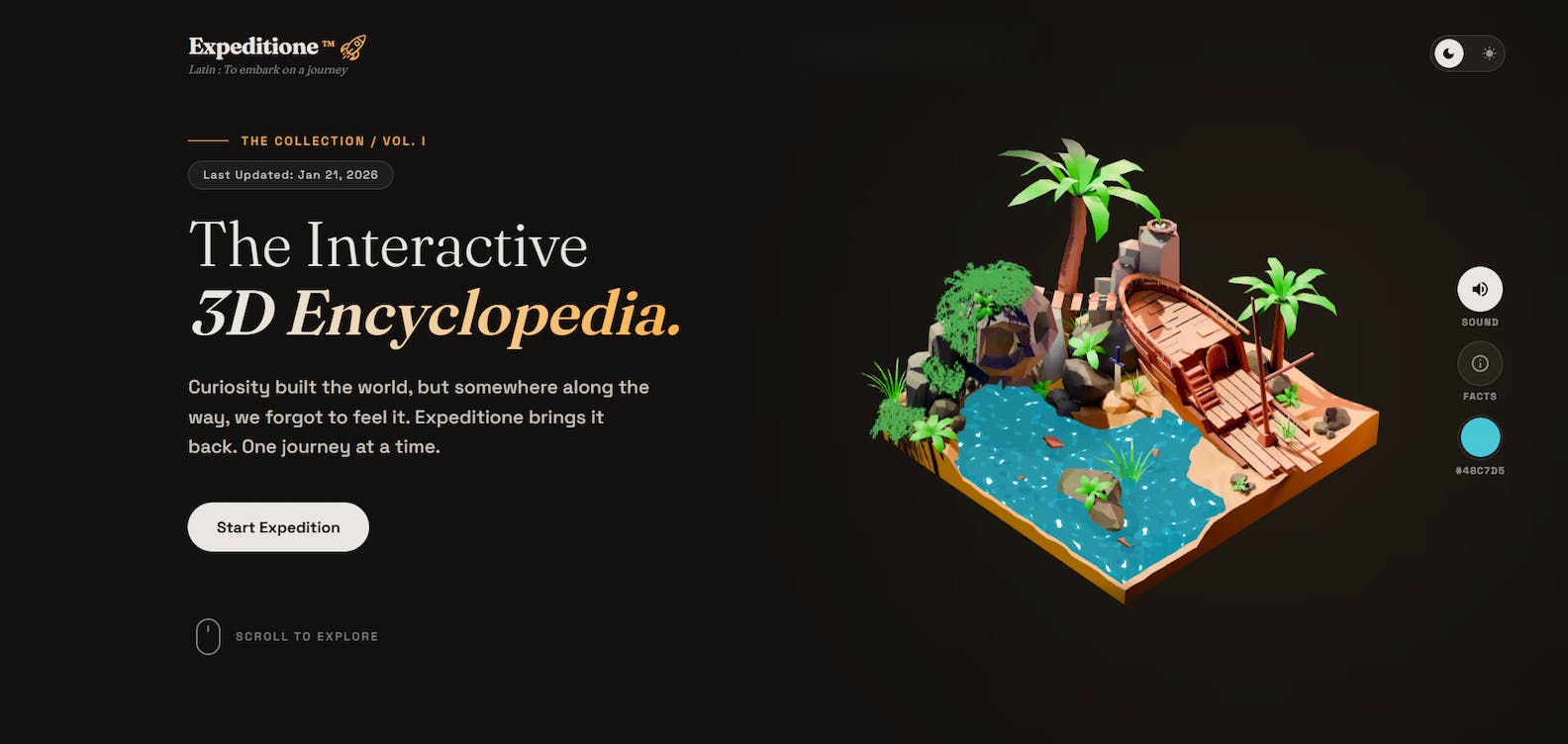
Traditional encyclopedias revolve around text and images, with readers passively absorbing information. A product called Expeditione is trying to upend this experience — it transforms knowledge into 3D worlds that you can step into and explore hands-on. Users no longer just "read" about a topic; they "walk into" it, discovering and understanding through interaction.
After launching on Product Hunt, the product quickly gained traction, earning 131 upvotes, 9 comments, and climbing to #2 on the daily leaderboard. It was categorized under Education, 3D Modeling, and Web Design. What's even more remarkable is that it was built entirely by a single developer.
Core Philosophy: Making Knowledge Unforgettable
Expeditione positions itself as "The Interactive 3D Encyclopedia," designed from the ground up to make learning fun and memorable.
Human memory naturally favors concrete, contextualized experiences. Decades of psychological research have shown that active exploration and situated learning create long-term memories far more effectively than passive reading. Expeditione taps into exactly this insight — rather than having students memorize a concept by rote, it lets them "step into" a carefully crafted world and build understanding naturally through exploration.
Handcrafted, Explorable Worlds
The product offers "handcrafted, explorable worlds." This means each Expedition isn't a template churned out by an algorithm, but a meticulously designed immersive scene. Users gradually uncover knowledge by interacting with elements within the scene — a design philosophy closer to gamified learning than traditional educational software.
Exceptionally Lightweight Technical Choices
On the technical side, Expeditione made several commendable decisions:
- Runs directly in the browser: No downloads or installations needed — just open a webpage and start exploring, dramatically lowering the barrier to entry.
- No login required: Skipping the registration process lets users jump straight into exploration.
- No ads, no tracking: In today's internet landscape dominated by data monetization, this is remarkably rare and demonstrates genuine respect for user privacy.
- Extremely lightweight: 3D content typically demands heavy resources, but Expeditione is specifically optimized for minimal footprint, ensuring smooth performance across devices.
For a browser-based 3D application, maintaining a lightweight profile while delivering rich interactive experiences is a serious engineering challenge. This speaks volumes about the solo developer's technical expertise.
An Education-Friendly Business Model
Expeditione employs a free-tier strategy that's friendly to education: the first three expeditions are permanently free, and free educator resources are available for classroom use.
The elegance of this model lies in establishing product value through free content before monetizing via paid expeditions. Meanwhile, opening free resources to educators helps the product penetrate real classroom environments — once adopted by schools and teachers, it can build a stable user base and generate word-of-mouth growth.
Lessons from a Solo Developer
It's worth emphasizing that this product was built by one person. From the 3D world art design and interaction logic development to web performance optimization and business model design — everything came from a single pair of hands.
This reflects how today's AI-assisted development tools, 3D modeling engines (such as WebGL frameworks like Three.js and Babylon.js), and various creative tools have matured to the point where they dramatically lower the barrier for building complex products. Individual creators now have the ability to independently complete projects that once required entire teams.
Conclusion: A New Possibility for Educational Products
Expeditione isn't trying to replace traditional encyclopedias — it offers an entirely new way to present knowledge. In an era of information overload and scarce attention, helping learners "remember what they learned and want to keep learning" is becoming the central challenge for educational products.
Through a series of design choices — 3D interaction, instant browser access, privacy-friendly practices, and educational accessibility — Expeditione showcases one independent developer's vision of the "future learning experience." While it's still in its early stages with only a limited number of free expeditions, the product philosophy behind it — replacing reading with exploration, deepening memory through interaction — undoubtedly deserves attention from the entire edtech industry.
Related articles

JobRunner MCP Server: AI Agents Can Now Fix Failed Java Jobs
JobRunner launches an open-source MCP server enabling AI agents to view cluster status, diagnose failures, and recover Java jobs—incident response from any cloud coding environment or existing agent.

MLAI Digital Launches 9 Security Agents: MCP Server Safeguards the Full Lifecycle of Agentic AI
MLAI Digital launches Security MCP Server with nine built-in specialized security agents covering vulnerability discovery, attack simulation, prompt injection detection, API and infrastructure assessment, and accelerated remediation—embedding security validation across the full Agentic AI lifecycle from development to production.

Running Isaac Lab on H100 GPUs: Exploring Better Approaches
Exploring optimization methods for running Isaac Lab on NVIDIA H100 GPUs, including MIG configuration, mixed precision, TensorRT acceleration, and community experience to improve robotics simulation and reinforcement learning efficiency.