Expertise AI: Packaging GTM Expert Methodologies into Pay-Per-Use AI Skills

Expertise AI turns GTM expert playbooks into pay-per-use AI skills with recurring revenue sharing.
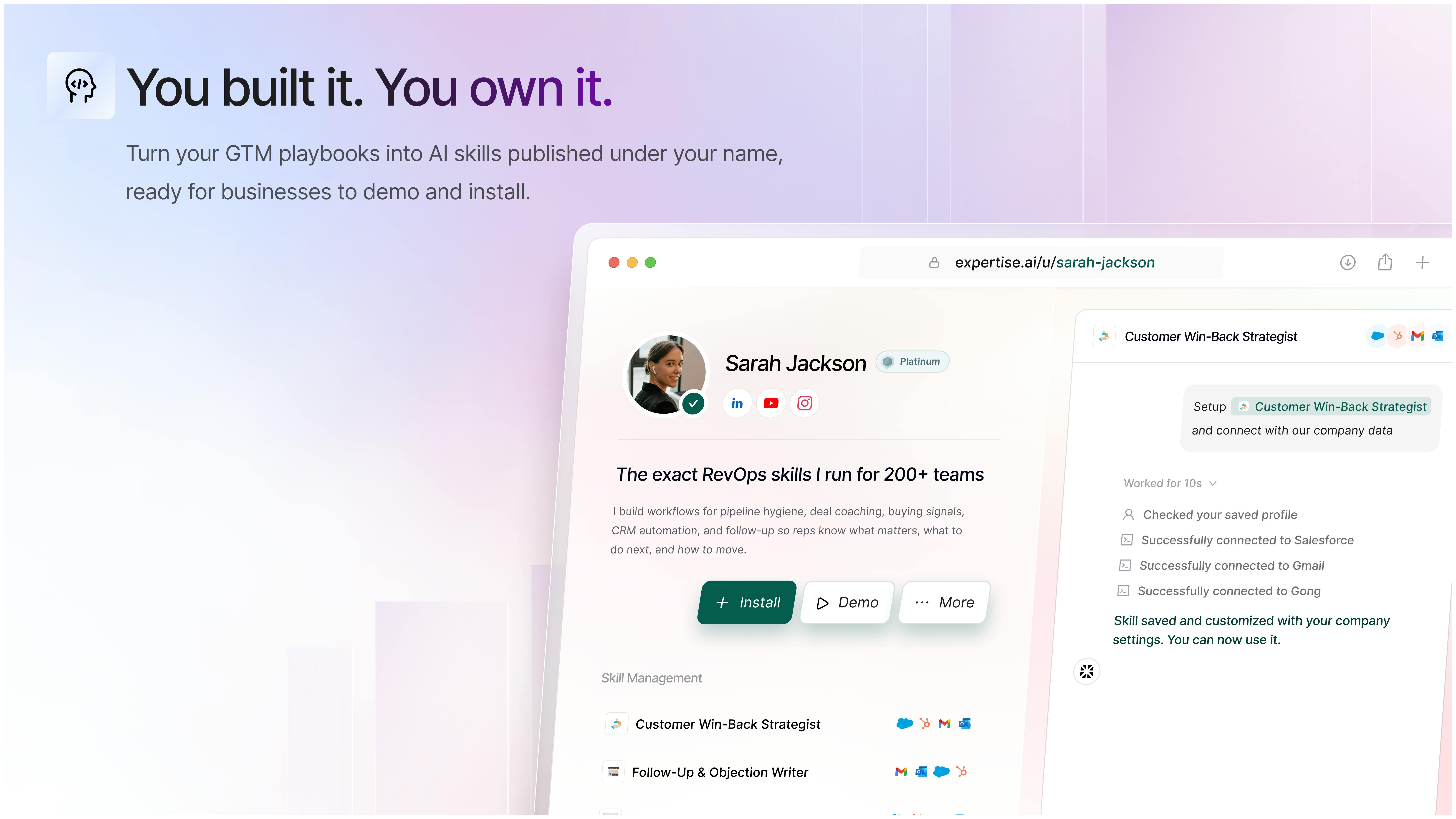
Expertise AI is a two-sided platform connecting GTM experts with businesses. Experts package their methodologies into protected AI skills sold via dedicated storefronts, earning revenue share each time a skill runs. Businesses subscribe to and install these skills for tasks like lead qualification and sales script generation. The model shifts knowledge monetization from one-time sales to usage-based recurring income, though challenges remain around methodology packagability, trust building, and cold-starting the marketplace.
When Professional Methodologies Meet AI: A New Knowledge Monetization Paradigm
In today's world flooded with SaaS and AI tools, an interesting product climbed to the #2 spot on Product Hunt—Expertise AI, earning 189 upvotes and 46 comments. Its positioning is crystal clear: "Turn your GTM (Go-To-Market) skills into recurring revenue."
This points to an emerging trend: experts' tacit knowledge is being packaged into reusable, distributable, and billable AI Skills. Expertise AI aims to become the "skill store" for this space.
Core Features and How Expertise AI Works
In simple terms, Expertise AI has built a two-sided platform connecting two groups of people:
Supply Side: How GTM Experts Package Their Methodologies
Seasoned practitioners who possess mature go-to-market strategies, growth playbooks, sales scripts, and channel operation methodologies can package their experience into protected AI skills. The platform provides each expert with a dedicated storefront, similar to a developer's page in an app store.
The keyword here is "protected"—the expert's core methodology runs within the AI skill rather than being delivered as a document or course that can be freely redistributed after a one-time purchase. This addresses a long-standing pain point in the knowledge economy: once content is delivered, creators lose control, and piracy and reselling are nearly impossible to prevent.
Demand Side: How Businesses Use AI Skills
Businesses can demo and install these AI skills from expert storefronts, paying through a subscription model. More importantly, the business model is designed so that every time a skill runs, the expert earns a revenue share.
This means experts' income is no longer a one-time transaction like "selling a course," but recurring revenue tied to actual usage frequency. The more a skill is used and the more effective it proves, the more the expert earns—a naturally aligned incentive structure.
Why This Knowledge Monetization Model Deserves Attention
Evolving from "Selling Knowledge" to "Selling Capability"
Traditional knowledge monetization takes several forms: writing books, recording courses, consulting, and running bootcamps. Their common problem is that knowledge and execution are disconnected. Users buy a course but may not learn it effectively; even if they learn it, they may not be able to execute it in practice.
Expertise AI's approach embeds the expert's methodology directly into an executable AI Agent. Businesses are no longer buying "knowledge" but a "capability unit" that can do the work for them. GTM scenarios are particularly well-suited for this kind of packaging: market research, lead qualification, email sequence writing, and sales script generation are all tasks that heavily rely on expert experience and can be automated.
The Embryonic Form of an AI Skill Store Ecosystem
As large model capabilities mature, the concept of an "AI skill store" is being validated repeatedly. From OpenAI's GPT Store to various Agent marketplaces, the industry is exploring how to make professional capabilities flow and be billed as standardized components.
Expertise AI's differentiator is that it vertically focuses on the GTM domain and makes "expert revenue sharing" a core mechanism. This makes it more like an "expert economy" platform rather than a pure tool marketplace. It's simultaneously categorized under Marketing, SaaS, and Artificial Intelligence—which perfectly illustrates its cross-domain nature.
Potential Challenges and Sober Reflections
While the model is novel, this type of platform faces several practical issues that warrant careful consideration:
First, the degree to which methodologies can be packaged. Top GTM experts' value often lies in their judgment of specific situations—and that's precisely the hardest part to codify into an AI skill. What can be packaged may only be standardized "70-point playbooks" rather than truly scarce, top-tier insights.
Second, validating effectiveness and building trust. Why would a business trust that an unknown expert's AI skill actually works? The demo mechanism is one step, but quantifying the actual business outcomes a skill delivers is a trust problem the platform must continuously solve.
Third, cold-starting both sides of the marketplace. Two-sided platforms always face the chicken-and-egg problem—without enough high-quality expert skills, businesses won't come; without paying businesses, experts have no incentive to join. The 189 upvotes are a promising start, but whether this can generate a flywheel effect remains to be proven over time.
Conclusion: The Next Growth Point for the Expert Economy
Expertise AI represents a clear direction: in the AI era, experts' value is migrating from "the person" to "reusable capability units." When a growth expert's methodology can serve countless businesses 24/7 on a pay-per-use basis, the ceiling on knowledge monetization is blown wide open.
This may not be the final answer, but it raises a question worth pondering for all professionals: Can your expertise be packaged, distributed, and run autonomously? For GTM practitioners, Expertise AI might be an opportunity to position yourself ahead of the curve.
Related articles

DeepCell: One-Click AI Generation of Documents, Spreadsheets, and Slides
DeepCell tops Product Hunt with one-click generation of documents, spreadsheets, and slides, using the .deepcell format for linked updates, designed for System 2 tasks like modeling and sales reviews.

Doneas: 15-Minute Daily Accountability Calls That Keep Indie Developers From Procrastinating
Doneas is a daily accountability tool for indie developers: plan tasks on Monday, join a 15-minute call with five builders each day, and log deliveries on a public progress page. This article analyzes its core mechanics, effectiveness, and potential issues around retention and matching.

Fastlane 2.0: Fully Automated AI Ad Campaigns, From Creative to Optimization
Fastlane 2.0 is an AI ad automation tool: enter your website and it learns your brand, generates video and image ads, and runs and optimizes them on Meta, TikTok, Instagram, and YouTube.