Explainable Hate Speech Detection: A DistilBERT-BiLSTM-Attention Framework Explained

A DistilBERT-BiLSTM-Attention framework with LIME explainability achieves up to 99.53% F1 on hate speech detection.
This arXiv paper addresses three key weaknesses in existing hate speech detection systems — binary-only classification, single-dataset validation, and lack of interpretability — with a three-component framework: DistilBERT for contextual embeddings, Bi-LSTM for bidirectional sequence modeling, and an attention mechanism to focus on key phrases. LIME is integrated to provide textual evidence behind each prediction. Evaluated on the Davidson and SMHS datasets across both binary and multi-class tasks, the framework achieves a peak F1 of 99.53%, with ablation studies confirming each component's independent contribution. Its combination of accuracy, generalizability, and deployment-friendly design makes it a strong candidate for production content moderation, though long-term adaptation to evolving online language remains to be proven.
The Content Moderation Dilemma
Hate speech on social media poses real threats to social cohesion, public mental health, and public safety. Detecting such content accurately and in a timely manner has long been a core challenge for content moderation systems. Yet existing detection approaches share three persistent weaknesses: most research frames the problem as binary classification (hate speech or not), validates on a single dataset, and offers little to no explanation of the model's decision-making logic.
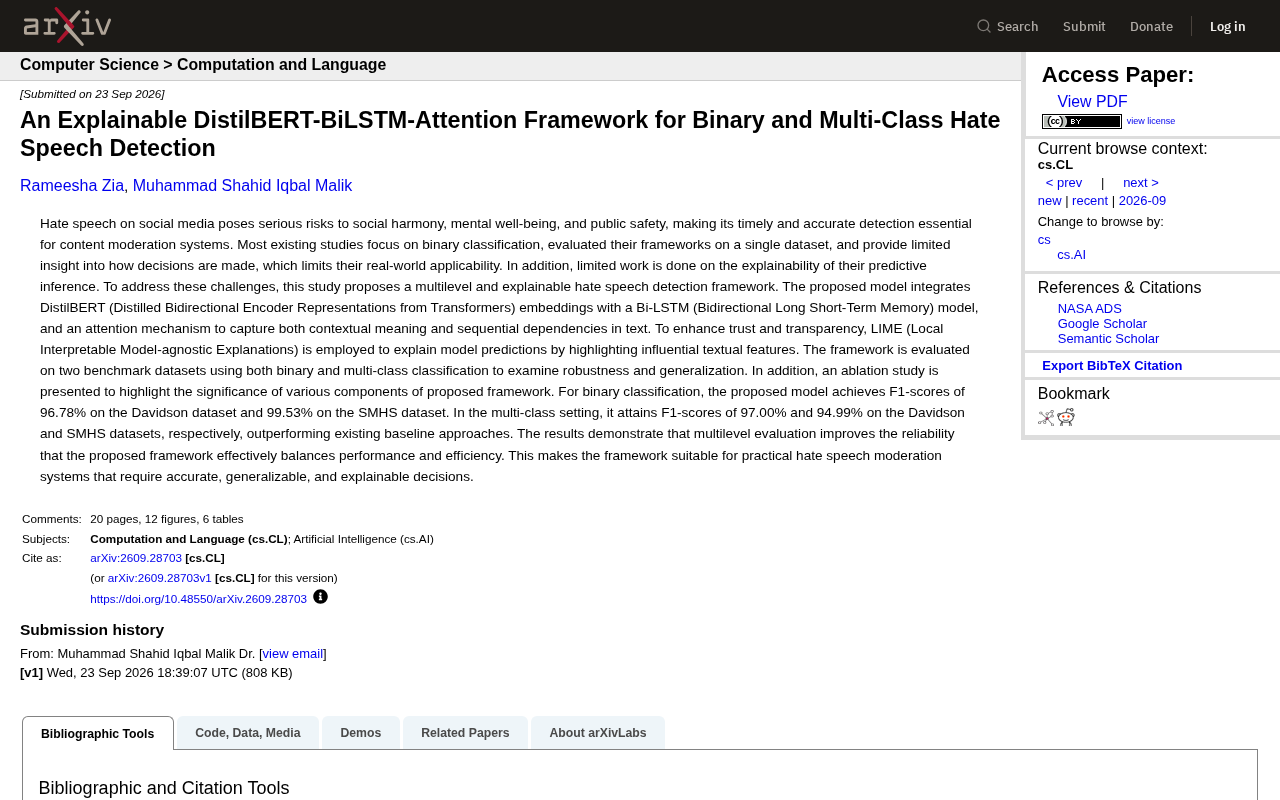
These limitations directly undermine real-world usability. A system that cannot explain why it flagged a piece of content as hate speech struggles to earn the trust of moderation teams and users, and is difficult to justify under regulatory scrutiny. A recent study published on arXiv (arXiv:2609.28703v1) targets these pain points with a detection framework that supports multi-level classification and interpretability.
How the Three-Layer Architecture Works Together
The framework's core is a combination of three components: DistilBERT, Bidirectional LSTM (Bi-LSTM), and an attention mechanism.
DistilBERT for Semantic Embeddings
DistilBERT is a distilled version of BERT that retains most of its language understanding capabilities while significantly reducing parameter count and computational cost. It transforms text into context-aware vector representations — the foundation for understanding a sentence's true meaning. This matters because hate speech is often context-dependent: the same word can be entirely benign or highly offensive depending on its surroundings.
Knowledge distillation — DistilBERT's core training strategy — uses the soft-label outputs of a large pretrained model (the teacher, i.e., the original BERT) to supervise a smaller model (the student), allowing the student to retain much of the teacher's generalization ability with far fewer parameters. Compared to BERT-base, DistilBERT reduces parameter count by roughly 40%, speeds up inference by about 60%, and still retains approximately 97% of performance on multiple NLP benchmarks. These properties make it an ideal choice for content moderation scenarios sensitive to inference latency and compute costs, without requiring significant trade-offs between semantic understanding quality and deployment feasibility.
Bi-LSTM for Sequential Dependencies
Built on top of the DistilBERT embeddings, the Bi-LSTM processes the text sequence in both forward and backward directions, capturing order-dependent relationships between words. This bidirectional modeling helps the model understand the complete structure of a sentence rather than treating individual words in isolation.
Attention Mechanism for Focusing on What Matters
The attention mechanism allows the model to assign different weights to different parts of the text, focusing on the words and phrases most influential to the classification decision. This layer not only improves accuracy but also lays the groundwork for the subsequent interpretability analysis.
Opening the Black Box with LIME
A standout feature of the framework is its use of LIME (Local Interpretable Model-agnostic Explanations) to explain model predictions. LIME highlights the textual features that most influenced a given prediction, showing users why the model made a particular judgment.
For high-stakes scenarios like content moderation, interpretability isn't a nice-to-have — it's a requirement. When a system flags content as hate speech, reviewers need to know which specific words or phrases triggered the decision in order to conduct reviews, handle appeals, and adjust policies. LIME's inclusion elevates the framework from "delivering verdicts" to "providing reasoning," substantially improving transparency and trustworthiness.
LIME works by introducing small perturbations to the input within the local neighborhood of the sample being explained (for example, randomly masking certain words), observing how the model's output changes in response, and then fitting a simple linear model to approximate this local behavior. The result presented to the user is a list of features with associated weights — positive weights indicate the word pushes the model toward a particular class, while negative weights indicate the opposite effect. "Model-agnostic" means LIME does not rely on the internal structure of the model being explained and can provide explanations for any black-box model, making it broadly applicable in engineering practice. It's worth noting that LIME provides local explanations, not global ones — it only guarantees reliability near the current sample and does not fully describe the model's decision logic across the entire feature space. For high-risk decisions, it should therefore be combined with human review.
Rigorous Validation Across Dual Datasets and Dual Tasks
Rather than settling for evaluation on a single dataset, the research tests on two benchmark datasets (Davidson and SMHS) across both binary and multi-class classification tasks, stress-testing the model's robustness and generalizability.
The reported results are impressive:
- Binary classification: F1 score of 96.78% on the Davidson dataset and 99.53% on the SMHS dataset
- Multi-class classification: 97.00% on Davidson and 94.99% on SMHS
All results surpass existing baseline methods. The research team also conducted ablation studies, systematically validating the contribution of each component and demonstrating that the combination of DistilBERT, Bi-LSTM, and attention is not redundant stacking — each element carries its own value.
Ablation studies are the standard approach in deep learning research for validating model design choices: each component is systematically removed or replaced, and the performance gap between the full model and the ablated version is measured to quantify each component's independent contribution. This method effectively guards against the "module stacking" trap — where multiple components coexist and overall performance improves, but some modules actually contribute nothing or are even harmful. In hate speech detection tasks, ablation study findings are valuable guidance for future researchers choosing model architectures: if removing the attention mechanism causes a significant drop in F1, it demonstrates that attention is not decorative but a genuinely critical module shaping the classification boundary.
Implications for Real-World Moderation Systems
The value of this research lies in simultaneously addressing three demands: accuracy, generalizability, and interpretability. The multilevel evaluation strengthens the reliability of the framework's conclusions and suggests a sound balance between performance and efficiency.
For moderation platforms handling massive volumes of content, a model that is accurate, can explain its decisions, and remains stable across different data distributions is exactly what production deployment requires. DistilBERT's lightweight nature also means the framework is relatively cost-friendly to deploy, making it more feasible to scale in production environments.
That said, as an academic study, its performance in the real world — with complex, ever-evolving online language — still requires broader validation. Hate speech evolves over time, and the model's ability to continuously adapt will be the key factor determining its long-term value.
Related articles

Felix Rieseberg Personal Homepage
Felix Rieseberg's personal homepage sparks attention on Hacker News. This article covers the Slack engineer's technical background, the rise and fall of nativefier, and the value of a developer homepage as a tech calling card.

@ai-sdk/vue 3.0.306 Patch Release Syncs with [email protected] Update
@ai-sdk/vue 3.0.306 released, synced with [email protected]. A routine patch release for the Vercel AI SDK ecosystem with no public API changes; the Vue adapter layer stays version-aligned with the core package.

Gemini 4 Argon API Launches: The Era of Million-Token Output Begins
Google launches Gemini 4 Argon with sparse MoE architecture, up to 1M output tokens, and a 68.90% Vals Index score, available across API, AI Studio, and the Gemini app.