Explainable Machine Learning Predicts Post-Mindfulness Depression Outcomes: Temporal and Disease-Specific Insights

Explainable ML reveals how depression predictors shift from clinical context to behavioral adherence after mindfulness intervention.
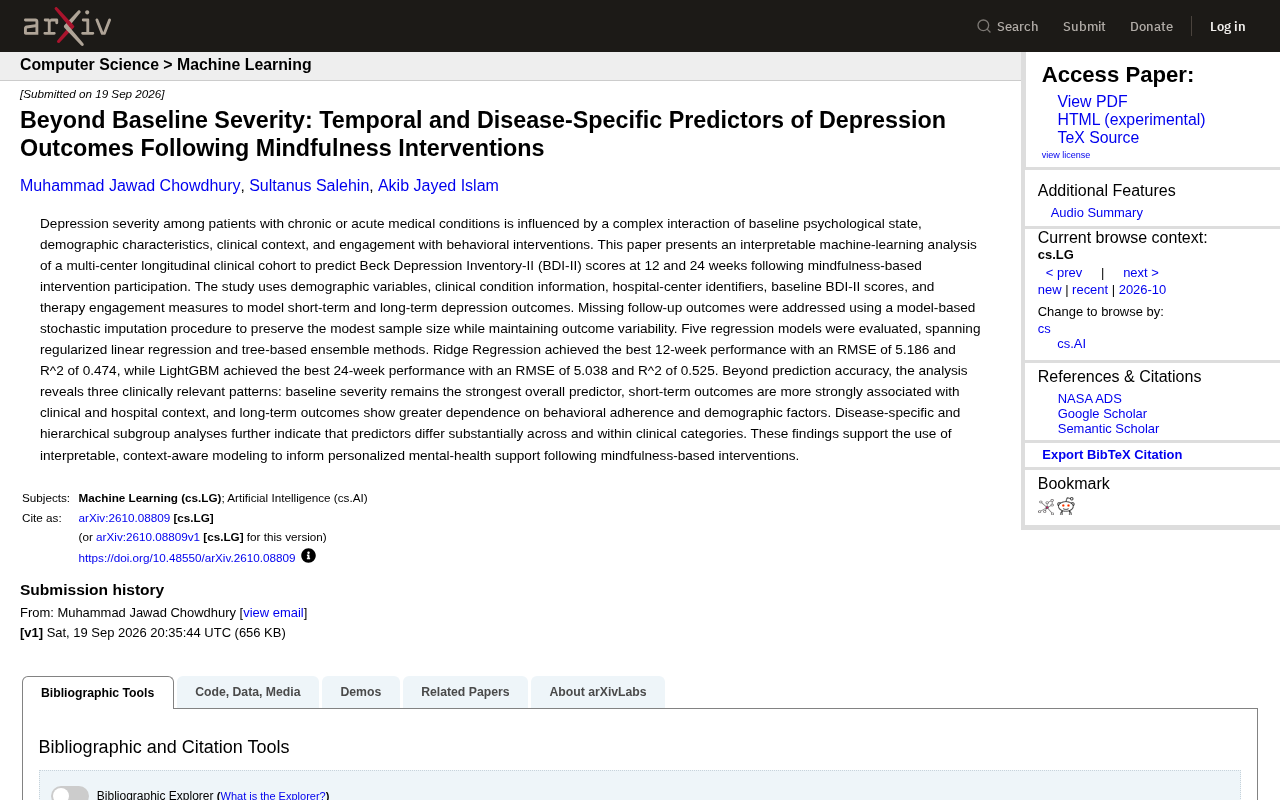
Using a multi-center clinical cohort, this study applies Ridge regression and LightGBM to predict BDI-II depression scores at 12 and 24 weeks post-mindfulness intervention. Explainability analysis yields three key findings: baseline severity is the strongest predictor at both timepoints; short-term outcomes are more influenced by treatment environment and clinical condition; and long-term outcomes depend more on behavioral adherence and demographics. Disease-specific variation across subgroups underscores the need for stratified, context-aware modeling in mental health prediction.
Mindfulness-Based Interventions (MBIs) have been widely studied as adjunctive treatments for depression, yet a critical question remains unanswered: which patients actually benefit? A newly published arXiv paper attempts to address this using explainable machine learning — not only predicting depression severity at 12 and 24 weeks post-intervention, but also uncovering the strikingly different drivers behind short-term and long-term prognosis.
Study Design: From Multi-Center Cohort to Explainable Modeling
The study draws on a multi-center longitudinal clinical cohort, with the goal of predicting patients' Beck Depression Inventory-II (BDI-II) scores at weeks 12 and 24 following a mindfulness intervention. The BDI-II is a widely used self-report tool for assessing depression severity, and the research team treated it as a continuous regression target.
Model inputs spanned multiple feature dimensions: demographic variables, clinical condition information, hospital center identifiers, baseline BDI-II scores, and therapy engagement indicators. Notably, the study population consisted of patients with chronic or acute somatic illnesses — a group whose depression is often intertwined with physical health status, making prognosis particularly difficult to predict.
Given the frequent missingness in clinical follow-up data, the researchers applied stochastic model-based imputation to handle missing outcome values. This approach preserved usable sample size while maintaining result variability — avoiding the variance collapse that deterministic imputation can introduce — which was especially important given the already limited sample.
The BDI-II consists of 21 items, each scored 0–3, for a total range of 0–63. Standard clinical cutoffs place scores of 0–13 as minimal, 14–19 as mild, 20–28 as moderate, and 29–63 as severe depression. As a self-report instrument, it enables efficient large-scale data collection but is inherently subject to self-reporting bias. Treating BDI-II as a continuous regression target — rather than dichotomizing patients into "improved/not improved" — preserves fine-grained prognostic information, allowing the model to capture the magnitude of intervention effects rather than just their direction.
Model Comparison: Ridge and LightGBM Each Excel in Their Domain
The study evaluated five regression models spanning regularized linear regression and tree-based ensemble methods. The results revealed an interesting temporal divergence:
- 12-week short-term prediction: Ridge regression performed best, with RMSE of 5.186 and R² of 0.474.
- 24-week long-term prediction: LightGBM performed best, with RMSE of 5.038 and R² of 0.525.
This suggests that short-term prognosis is better captured by simpler linear models, while long-term prognosis involves more prominent nonlinear interactions — giving gradient boosting trees the edge. Both models achieved R² values around 0.5, indicating that a substantial portion of depression outcome variance remains unexplained by the available features in this small clinical dataset. This is both an honest methodological acknowledgment and a signal that future work should incorporate additional behavioral and biological markers.
Ridge regression is a linear model that adds an L2 regularization term to ordinary least squares, penalizing large coefficient magnitudes to suppress overfitting — making it particularly stable in high-dimensional, small-sample settings. LightGBM is Microsoft's open-source gradient boosted decision tree framework, known for its leaf-wise tree growth strategy and histogram-based acceleration, enabling efficient capture of nonlinear feature interactions and higher-order relationships. The fact that each model type wins at a different time horizon is itself a modeling-level signal worth noting: as time progresses, the factors influencing depression outcomes shift from relatively linear associations with initial state to more complex interaction structures. This "model-fit drift over time" phenomenon is itself an indirect characterization of the intervention mechanism.
Three Clinically Relevant Patterns
Beyond predictive accuracy, the real value of this research lies in three patterns uncovered through its explainability analysis:
Baseline Severity Remains the Strongest Predictor
At both time points, the patient's baseline BDI-II score at enrollment was the single most influential predictor. This aligns with clinical intuition: a more severe starting point shifts the prognosis distribution toward worse outcomes. However, it also means that relying solely on baseline scores for decision-making risks overlooking other modifiable factors.
Short-Term Outcomes Are More Tied to Clinical and Hospital Context
Depression outcomes at 12 weeks were more strongly associated with clinical condition information and specific hospital centers. In other words, the patient's treatment environment and disease type play a larger role in the early phase of intervention. The presence of a hospital center effect suggests that differences in care standards or patient composition across institutions cannot be ignored.
Long-Term Outcomes Depend More on Behavioral Adherence and Demographics
By week 24, the predictive emphasis shifts — behavioral adherence and demographic characteristics gain greater weight. This aligns with the mechanism of behavioral interventions: the long-term benefits of mindfulness practice are highly dependent on sustained engagement. The contrast between "context matters short-term, commitment matters long-term" has direct implications for how clinical resources should be allocated.
Disease Specificity: No One-Size-Fits-All Prediction
The study further conducted disease-specific and stratified subgroup analyses, finding significant variation in predictive factors across clinical categories — and even within the same category. Put simply, the predictive logic built for patients with chronic illness may not apply to those with acute conditions, and a one-size-fits-all universal model risks masking critical subgroup heterogeneity.
This finding reinforces the necessity of context-aware modeling. For teams looking to deploy machine learning in mental health support, it means models need to be stratified by disease category rather than simply aggregating all features into a single model.
The core idea of context-aware modeling is to explicitly incorporate structural differences in the data-generating process into model design, rather than treating them as noise to be averaged away. In clinical prediction tasks, this typically means training or calibrating separate models for different disease categories, treatment institutions, or patient subgroups — or introducing interaction terms and hierarchical structures within a unified model. The alternative is a "universal model" strategy that mixes all samples and relies on the model to discover shared patterns automatically. While statistically efficient when samples are abundant, this approach often produces unfair or inaccurate predictions for minority subgroups in highly heterogeneous clinical populations. This study directly demonstrates the existence of such heterogeneity through subgroup analysis, providing empirical support for stratified modeling strategies.
Implications for Personalized Mental Health Support
The central claim of this work is that explainable, context-aware modeling can inform personalized mental health support following mindfulness interventions. Rather than chasing black-box high accuracy, the researchers chose to balance predictive performance with interpretability — enabling clinicians to understand why a model makes a given prediction.
To be clear-eyed about its limitations: the sample size is small, the R² levels indicate modest predictive power, and while the imputation approach is reasonable, it still introduces uncertainty. These constraints mean the current findings are better suited as hypothesis-generating tools and clinical decision-support references rather than direct treatment decision instruments. Nevertheless, the temporal divergence patterns and disease-specific structures it reveals point the way forward for larger-scale future research.
Related articles

Chain of Thought Isn't Just for AI: How Humans Can Use CoT to Improve Thinking Quality
Chain of Thought isn't just a prompt trick for large models. Starting from a Hacker News discussion, this article analyzes why CoT works for human thinking too, breaks down actionable ways to transfer it, and highlights the key differences between human CoT and machine CoT.
Cloudflare Teams Up with OpenAI: Closi…
Cloudflare Teams Up with OpenAI: Closing the Loop from Vulnerability Discovery to Defense with AI
Cloudflare uses OpenAI Daybreak to investigate security vulnerabilities and generate reviewable remediation plans, while developers use Codex to boost coding efficiency and quality.

Orca Multi-Agent Orchestration in Practice: A Guide to Parallel Collaboration with Claude and Codex
Orca is Stable AI's free open-source agent workbench supporting 34 agents like Claude Code and Codex in parallel. Learn its Git worktree isolation, multi-model orchestration, and mobile management.