Exploratory Midtraining: A New Paradigm for Robot Policy Behavioral Coverage

The paper proposes exploratory midtraining, using adversarial teleoperation to build β-Data and improve robot policy coverage and autonomous improvement.
To address the problem that traditional demonstration data covers only competent behavior and limits autonomous improvement, the paper proposes an "exploratory midtraining" paradigm. Researchers build the β-Data dataset via adversarial teleoperation: a human adversary perturbs the environment, an operator continues the task without resetting, and trajectory segments are relabeled in natural language with local outcomes. Fine-tuning an action-history-conditioned pretrained policy on this data yields better data scaling laws, zero-shot generalization, and online fine-tuning efficiency in simulation and on three real robot platforms. Midtraining enables policies to reach higher success rates with fewer rollouts, laying the foundation for continuous autonomous improvement. However, the method relies on human adversaries, data collection costs are relatively high, and the granularity and consistency of natural language relabeling still require validation.
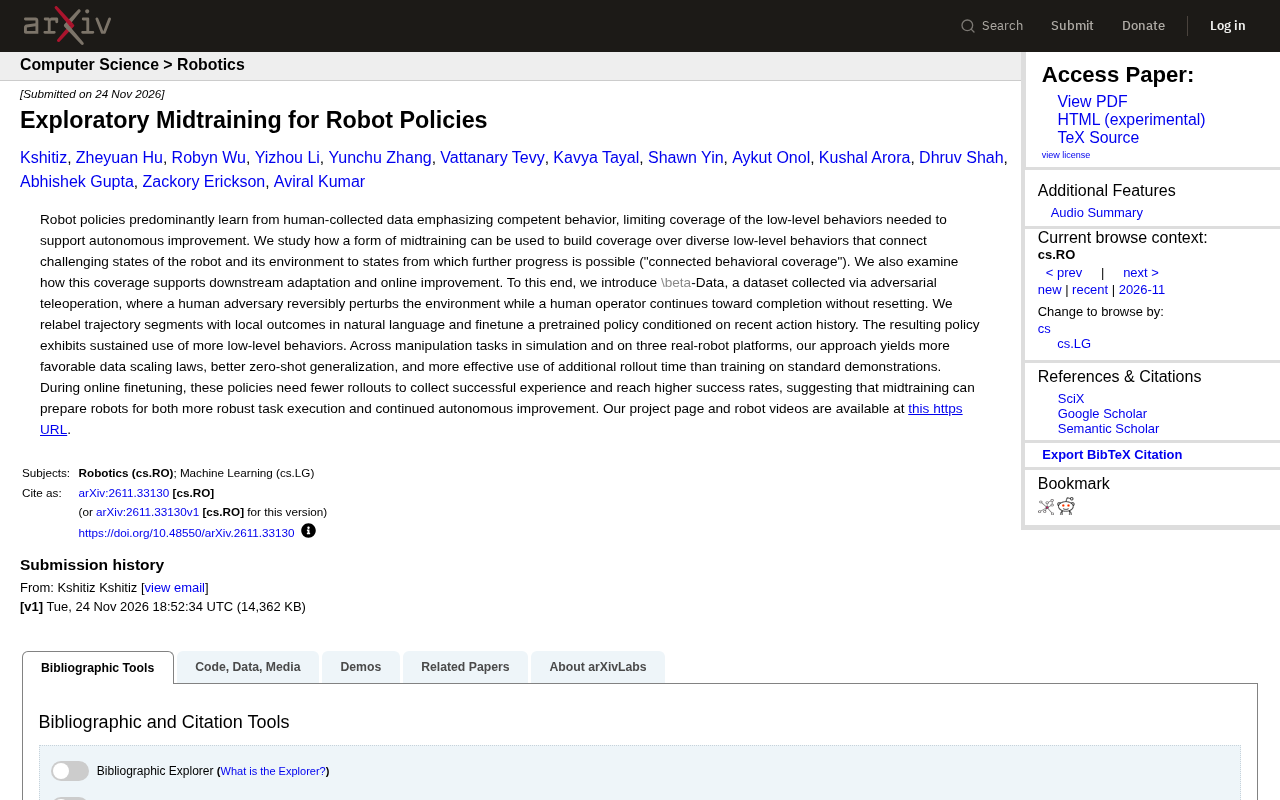
Robot policies typically learn from human-collected demonstration data, which emphasizes "competent" behavior but limits the policy's coverage of underlying behaviors, thereby hindering autonomous improvement. A recent arXiv paper, "Exploratory Midtraining for Robot Policies," proposes using a form of "midtraining" to build policies that cover diverse underlying behaviors—behaviors that can connect challenging states of the robot and its environment to states that can be further advanced, i.e., "connected behavioral coverage." The study also explores how this coverage supports downstream adaptation and online improvement.
Core Problem: The Limits of Demonstration Data
Traditional robot policy learning relies heavily on human-collected demonstration data. These data typically showcase behaviors humans consider "correct" or "efficient," i.e., so-called competent behavior. However, this data distribution has a fundamental flaw: it covers only the narrow paths required for task success and lacks exploration of the various underlying states the robot may encounter. When the robot is in a state not covered by the demonstration data, the policy often fails to generate effective recovery behaviors, leading to task failure or stagnation.
The paper points out that to support autonomous improvement, robots need "connected behavioral coverage"—that is, coverage of diverse underlying behaviors that can connect challenging states to states that can be further advanced. This coverage includes not only successful operations but also exploratory behaviors that sometimes appear "suboptimal" but can maintain the system's recoverability.
Behavioral Coverage and Connectivity: In robot learning, "behavioral coverage" refers to the range of regions in the state-action space that a policy can reach. Traditional demonstration data covers only the narrow trajectories required for task success, whereas "connected behavioral coverage" emphasizes that the policy can start from any challenging state, pass through a series of recoverable underlying behaviors, and ultimately connect to states that can advance the task. This connectivity ensures that the system does not fall into an unrecoverable deadlock when encountering perturbations or unexpected states, and is a prerequisite for autonomous improvement.
Method: Adversarial Teleoperation and the β-Data Dataset
To build this coverage, the researchers introduce the β-Data dataset. This dataset is collected through "adversarial teleoperation": one human adversary reversibly perturbs the environment, while another human operator continues attempting to complete the task without resetting. This setup forces the operator to demonstrate underlying behaviors that maintain task progress under interference, naturally producing diverse state-behavior pairs.
The key innovation of β-Data is that the researchers relabel trajectory segments with natural language descriptions of local outcomes, rather than merely labeling task success or failure. For example, a segment might be labeled as "the robotic arm approaches the object but is pushed away and then readjusts." This fine-grained language description captures the intent and outcome of underlying behaviors. They then fine-tune a pretrained policy conditioned on recent action history, enabling it to use historical information to infer the current state and select behaviors.
Adversarial Teleoperation: This is a data collection paradigm in which a human "adversary" actively applies reversible perturbations to the environment or robot (e.g., pushing objects away or changing obstacle positions), while another operator continues attempting to complete the task without resetting the environment. Compared with standard teleoperation, this setup forces the operator to demonstrate recovery behaviors that maintain task progress under interference, naturally producing diverse state-behavior pairs. This method directly injects exploration through human adversarial intervention, avoiding the complexity of reward design in reinforcement learning.
Action-History-Conditioned Policy: The pretrained policy fine-tuned in this study is conditioned on recent action history rather than relying solely on current observations. This design enables the policy to use historical information to infer the current state (e.g., distinguishing different dynamic contexts under similar observations) and choose more appropriate underlying behaviors. Action-history conditioning is particularly important in partially observable environments, helping the policy learn temporally correlated behavioral patterns from the recovery process after perturbations.
Experimental Results: Better Data Scaling and Generalization
In manipulation tasks in simulation and on three real robot platforms, the method demonstrates multiple advantages. Compared with standard demonstration-data training, policies midtrained with β-Data exhibit more favorable data scaling laws—that is, performance improves more significantly as data volume increases. In addition, the policies perform better in zero-shot generalization and can handle unseen new scenarios.
The study also finds that these policies can use additional rollout time more effectively. During online fine-tuning, they require fewer rollouts to collect successful experiences and achieve higher success rates. This indicates that midtraining not only improves the robustness of task execution but also lays the foundation for continuous autonomous improvement.
Data Scaling Laws: These refer to empirical regularities in which model performance improves as the amount of training data increases. In robot policy learning, favorable scaling laws mean that adding data consistently yields performance gains rather than rapidly saturating. The study finds that policies midtrained with β-Data exhibit better scaling laws, i.e., performance improves more significantly as data volume increases. This suggests that the diverse underlying behaviors covered by β-Data provide a more efficient learning signal, helping policies generalize to unseen new scenarios.
Multi-Source Perspectives and Limitations
The study is currently released as a preprint and has not yet undergone peer review. Its core contribution is proposing a new training paradigm—exploratory midtraining—and realizing this idea through the β-Data dataset and adversarial teleoperation. However, the method relies on the participation of human adversaries, and data collection costs may be relatively high; at the same time, the granularity and consistency of natural language relabeling require further validation.
From a broader perspective, this work echoes the classic trade-off between "exploration and exploitation" in robot learning. Unlike intrinsic-reward exploration in reinforcement learning, β-Data directly injects diversity through human adversarial intervention, avoiding the complexity of reward design. In the future, how to combine this midtraining with large-scale pretraining and how to automate the adversarial process are directions worth exploring.
The project page provides robot videos and more details: https://kshitiz-1225.github.io/exploratory-midtraining-robot-policies/
Related articles

Nightmare Mode: Engineering Practices for Simulating Disk Failures
Starting from the Hacker News Nightmare mode discussion, this article analyzes typical forms of simulated disk failures, fault injection implementation approaches, and how to integrate fault drills into the development process to improve distributed system fault tolerance.

Datasette-charts-pie Plugin Released: New Options for Pie and Sunburst Charts
Datasette-charts-pie 0.1a0 is released, adding pie, donut, sunburst, and rose charts to Datasette. The author dislikes pie charts but built the plugin to test the plugin architecture.

Diablo II: A Classic Retrospective That Changed Gaming History
From game history writing and tech community discussion, a retrospective on Diablo II's random drops, numerical systems, and multiplayer design—analyzing why this classic ARPG is still discussed by developers today.