Exploring Deterministic LLM Inference: Reflections Sparked by Low-Cost Gemma Deployment
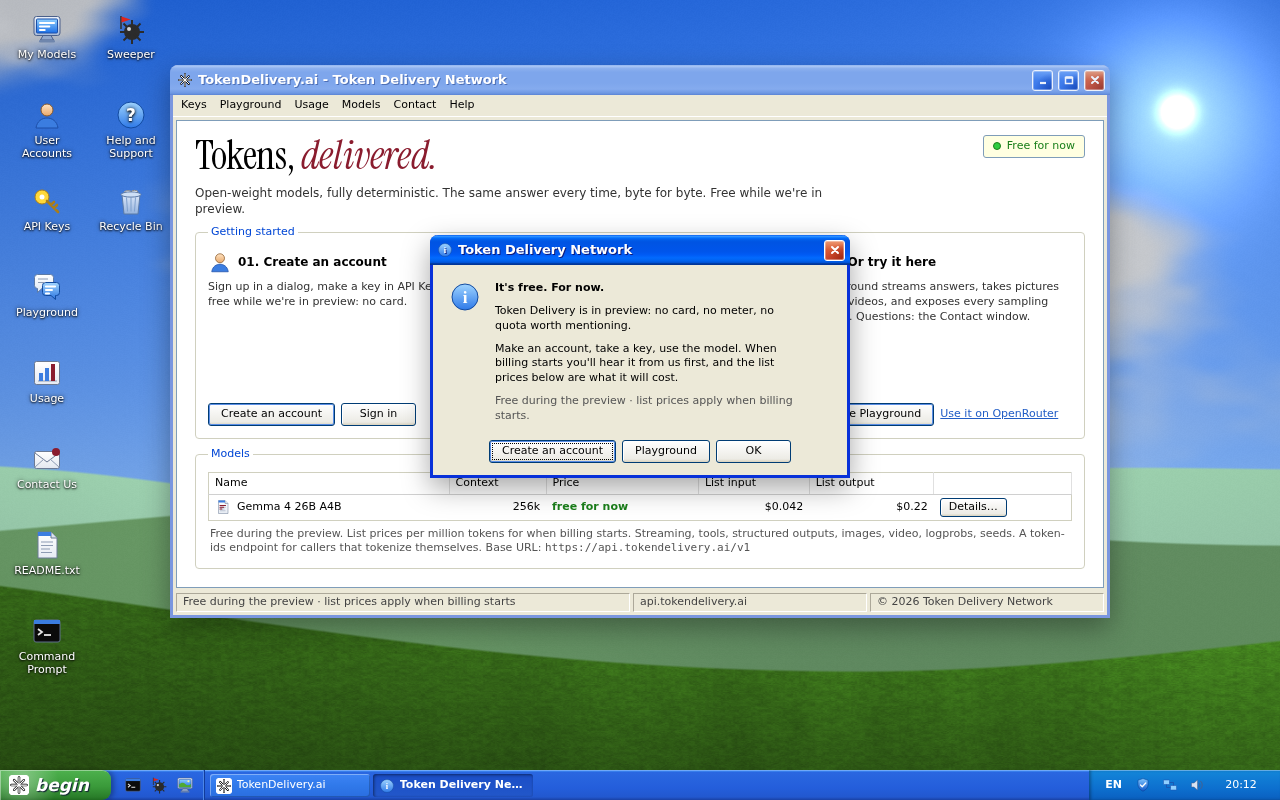
A HN post connects deterministic inference, low-cost deployment, and extreme-environment LLM engineering in one thread.
A Hacker News post about "deterministic LLM inference" — claiming to run Gemma at minimal cost and even on Windows XP — touches on three core AI engineering themes. Deterministic inference uses techniques like greedy decoding and fixed random seeds to ensure consistent outputs, valuable for testing and compliance. Lightweight open-source models like Gemma, paired with quantization, address the community's demand for lower inference costs. And deploying on Windows XP symbolizes how model lightweighting is gradually breaking free from dependence on high-end GPUs.
A "Show HN" post on Hacker News recently caught the attention of some developers, centered on "Deterministic LLM inference" and claiming to run Gemma models at minimal cost — even attempting deployment on a Windows XP environment. Although the post gained limited traction (3 points, 0 comments), the technical topics it touches on — determinism in large language model inference and cost control — are directions well worth exploring in today's AI engineering practice.
What Is Deterministic LLM Inference
The inference process of large language models is typically non-deterministic. Even with identical prompts, models often produce slightly different outputs due to sampling strategies (e.g., temperature, top-p), non-determinism in floating-point arithmetic, and differences in operation ordering during parallel computation. This randomness is an advantage in creative generation scenarios, but a significant pain point in engineering contexts that require reproducibility and auditability.
"Deterministic inference" refers to controlling these random factors so that the model always produces exactly the same output for the same input. Achieving this typically requires fixing random seeds, using greedy decoding, and addressing floating-point non-determinism at the hardware and library level. For testing, regression validation, and applications with high compliance requirements, deterministic inference has real practical value.
Greedy decoding is the most straightforward way to achieve deterministic output: at each step, select the highest-probability token and skip random sampling entirely. In contrast, the temperature parameter controls how "flat" the probability distribution is — as temperature approaches 0, the effect approximates greedy decoding; top-p (nucleus sampling) samples from the smallest set of tokens whose cumulative probability exceeds threshold p. Setting temperature to 0 and disabling top-p is the most common deterministic configuration, but even so, the order of parallel floating-point accumulation in underlying CUDA libraries may still produce subtle differences depending on hardware batch size — which is why true "bit-for-bit determinism" is difficult to fully guarantee on GPUs. Some inference frameworks (such as llama.cpp) offer a
--seedparameter and deterministic mode options specifically to address this issue.
The Significance of Low-Cost Gemma Deployment
Gemma is Google's series of open-source lightweight models, designed in part to run on limited hardware resources. The Show HN post's emphasis on running Gemma at "minimum cost" reflects the developer community's ongoing focus on reducing LLM inference costs.
In practice, inference costs are jointly determined by compute, memory footprint, and deployment environment. Choosing lightweight open-source models, optimizing inference engines, and reusing low-cost or legacy hardware are all common paths to cutting costs. This approach is especially important for individual developers, early-stage teams, or edge computing scenarios, as it lowers the barrier to deploying AI applications.
The Gemma series currently includes two main parameter-size variants — 2B and 7B — both trained on the same research foundation as Gemini and released as open weights. Quantization is a key enabler of low-cost deployment: compressing model weights from 32-bit floating point (FP32) to 8-bit integers (INT8) or even 4-bit (e.g., Q4_K_M quantization levels in GGUF format) can reduce memory footprint by 50–75% while significantly boosting inference throughput on CPUs. The llama.cpp project, thanks to its cross-platform CPU inference capabilities and rich quantization support, has become the go-to solution for running open-source models on consumer-grade or legacy hardware — and serves as the common technical foundation for these kinds of "extreme deployment" experiments.
The Symbolic Significance of Windows XP Deployment
The detail of running inference on Windows XP is particularly eye-catching. As an operating system that lost official support long ago, Windows XP presents a massive gap in both hardware and software ecosystems compared to modern AI frameworks. Attempting to run LLM inference in such a constrained environment is more of a technical boundary exploration — verifying just how far lightweight models and optimized inference solutions can be compressed.
While experiments like this lack direct production value, they carry a certain demonstrative and educational significance: they remind us that as model compression, quantization, and inference optimization techniques mature, large models are gradually shedding their absolute dependence on high-end GPU clusters and extending into a broader range of computing environments.
Windows XP was released in 2001 and reached end of official support in 2014. Its default runtime environment lacks much of the infrastructure that modern AI frameworks depend on: no CUDA support (Nvidia CUDA requires Windows Vista at minimum), outdated C++ runtime library versions, and limited kernel support for large memory addressing (the theoretical 32-bit system ceiling is 4 GB). Running LLM inference in this environment is almost entirely reliant on a pure CPU path, heavily quantized model weights, and inference libraries with strong compatibility for older toolchains. This falls into the same category of "extreme porting" as embedded or microcontroller scenarios (such as running tiny neural networks on Arduino) — its core value lies in verifying the minimum dependency boundary of the technology stack, rather than achieving production viability.
Technical Directions Worth Watching
Taken together, this Show HN post — though limited in information — connects three important themes in current AI engineering:
- Reproducibility: Deterministic inference makes model behavior predictable and testable, forming the foundation for AI systems to become more engineered and trustworthy.
- Cost efficiency: Running open-source models at minimal cost addresses the economic demands of large-scale deployment.
- Deployment universality: The attempt to run models in extremely constrained environments demonstrates the boundaries of model lightweighting.
For developers focused on AI deployment, all of these directions are worth tracking. Determinism and low cost are not mutually exclusive — they point together toward a more mature and controllable LLM application ecosystem.
Summary
Given the limited information in the original post, we cannot know the specific implementation details or performance data of the project. But from the signals conveyed by its title, we can identify several genuine pain points and exploratory directions in AI engineering practice. Deterministic inference, low-cost deployment, and validation in extreme environments together form engineering challenges that cannot be ignored as large models move toward mainstream adoption. We look forward to seeing more complete technical disclosures from this project in the future.
Related articles

Altman: Taking OpenAI Public This Year Would Be 'Ill-Advised'
OpenAI CEO Sam Altman says going public this year would be 'ill-advised,' even as the company has confidentially filed IPO paperwork. Here's what it means for AI.

An Open Letter to Dario: If AI Safety Is Real, Open the Model Weights
Developer Jacob's open letter to Anthropic CEO Dario Amodei went viral on Hacker News, challenging the contradiction between AI safety rhetoric and closed-source models: if safety truly matters, why not open the weights?
Ludwig: Building Custom LLMs and Neural Networks with Declarative Low-Code Configuration
Ludwig is an open-source low-code ML framework that builds custom LLMs and neural networks via declarative YAML config — no boilerplate training code required.