Exposing the '¥1 for Unlimited Full-Power GPT-6' Scheme: The Truth Behind the Gacha Mechanic

A viral scheme uses LLM arena gacha mechanics and risky third-party software to claim free GPT-6 access.
A viral Bilibili video claims that purchasing a ¥1/day third-party tool grants unlimited access to full-power GPT-6 by exploiting the anonymous battle mechanic of LLM arena platforms like Chatbot Arena. The bundled software bridges web-based models to local file systems and mouse/keyboard control, enabling a live demo of AI tackling the game "Yang Le Ge Yang" — though the run ultimately failed. The video raises three serious concerns: the "GPT-6" identity relies on subjective experience with no official verification; the "unlimited free quota" can vanish with any platform policy change; and the local-control permissions granted to an unknown third-party program pose significant, unaddressed security risks.
A video recently went viral on Bilibili claiming to offer "unlimited, full-power GPT-6 access for just ¥1 a day." The creator demonstrated a method that combines third-party software with a large model leaderboard platform to "game the system," even using the so-called GPT-6 to tackle the hit mobile game "Yang Le Ge Yang" (Sheep-a-Sheep) live on camera. The content looks enticing on the surface, but the technical logic and potential risks deserve a clear-headed breakdown.
How the So-Called "Free GPT-6" Actually Works
The core idea in the video revolves around a "LLM leaderboard/arena" type platform. The business model of these platforms inherently makes them free for regular users — model vendors actively provide their models to the platform for "anonymous battles" as a form of promotion and ranking, while users vote in blind tests on which response is better.
The creator exploits a loophole in this setup: the platform's "random mode" (battle mode) randomly selects an anonymous model, which might include high-tier models the creator refers to as "Astra" or "Astra Max." By repeatedly "rolling" and using specific prompts to probe the model's response style and capabilities, you can roughly guess whether you've landed on the so-called "GPT-6."
It's worth emphasizing: the "free" access here is built entirely on the platform's promotional nature. It has nothing to do with purchasing an official API with a stable quota. The "¥1 a day" charge is actually for the creator's third-party software — not the model service itself.
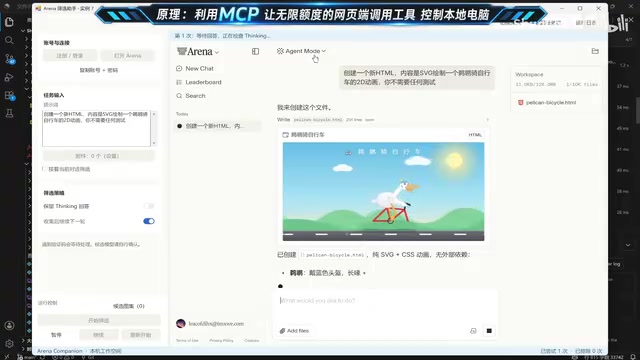
The most well-known example of this type of platform is Chatbot Arena (formerly LMSYS Arena), developed by the UC Berkeley team. Its core mechanic lets users chat with two anonymous models simultaneously and pick the better one, with the system dynamically updating model rankings using an Elo scoring system. Because the rankings carry independent academic and commercial credibility, major players like OpenAI, Google, and Anthropic are all willing to connect new models for free blind testing in exchange for real comparative user feedback. That's the fundamental reason the platform can remain free for ordinary users — model vendors trade free API access for promotion and evaluation data, forming a mutually beneficial commercial loop. What users "scavenge" within this framework is essentially the vendors' marketing budget, not charity from the platform.
The "Gacha" Process: Random, Unstable, and Experience-Dependent
From the demo, the whole "gacha" experience is highly uncertain. The creator's software automatically sends prompts, renames conversations, and judges model quality — but the results are highly random. The video is filled with instances of "terrible and useless" models — for example, generated images where "wheels are flying through the sky," instantly revealing they aren't high-tier models.
The creator admits that judging models relies on "experience" — for instance, if a response mentions "three days," it's definitely not the target model and gets automatically skipped. This means:
- You cannot reliably or consistently get the model you want
- Rolling requires repeated attempts, with significant time costs
- The judgment criteria are highly subjective and experience-dependent
In other words, even if this approach works, it's not "full-power anytime" — it's "full-power if you get lucky." The creator himself acknowledged during the game challenge that "the GPT-6 drawn that session was not the highest reasoning tier."
Third-Party Software: Giving a Web-Based Model Access to Your Local Files
The second key piece of software in the video — which the creator calls "Shun Kou" (phonetic) — is designed to break through a fundamental limitation of leaderboard platforms: web-based models cannot read or write local files.
Through this software, the creator claims web-based versions of GPT, Claude, and Gemini (models within the arena) can gain Codex-like capabilities: operating the computer, using a terminal, reading and writing local files, executing tasks, and even invoking "computer use" capabilities to automatically take screenshots, analyze images, and control the mouse.
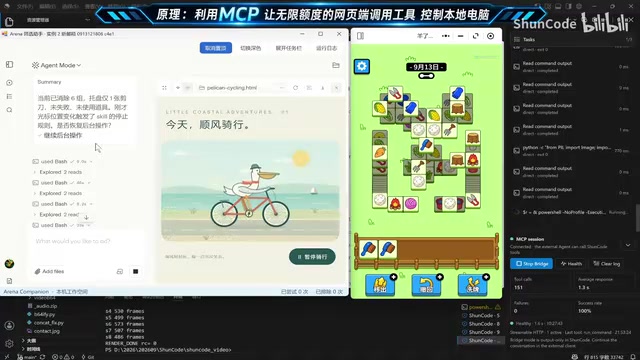
This presents an obvious security risk. Allowing an unknown third-party program to bridge a web model to your local files and control your mouse and keyboard is essentially handing over device-level permissions to an unknown program. If the software itself contains malicious behavior or vulnerabilities, your files and privacy face direct exposure — something the video never mentions at all.
The "computer use" capability described in the video refers to letting an AI model directly take over a computer's mouse, keyboard, and screen interface — not just generating text. Anthropic was the first to launch this feature for Claude in 2024, allowing the model to perceive screen state via screenshots and output click or input commands in the form of pixel coordinates. Implementing this type of capability typically requires a local "agent program" acting as a bridge: it periodically takes screenshots and uploads them to the model API, then converts the model's returned action instructions into system-level mouse and keyboard events. Because this agent program needs to request screenshot permissions, accessibility permissions, and even file system permissions, its security is directly tied to the developer's credibility. Third-party implementations from unknown sources are technically fully capable of stealing screen content, clipboard data, and local files while "playing a game for you."
Testing "Yang Le Ge Yang": What AI Gaming Actually Looks Like
The second half of the video's main attraction is watching the so-called GPT-6 automatically tackle Level 2 of "Yang Le Ge Yang." This section is actually the most valuable part to observe, because it reveals the real capability boundaries of current vision-plus-action AI agents.
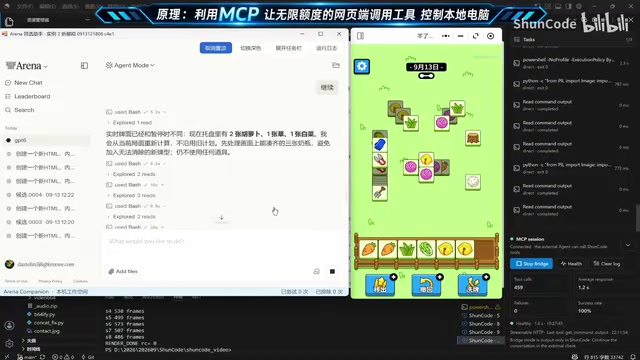
From the demo, the model could indeed: automatically take screenshots, recognize the tile layout, analyze layering relationships, plan triple-match elimination strategies, and control the mouse — all without hijacking the user's cursor. The creator noted its rhythm of "look once, click a few times, look again, click a few more" was similar to how a human player thinks, and it even prioritized clearing tiles in the bottom-left corner to expose hidden tiles underneath — earning praise for "having some intelligence."
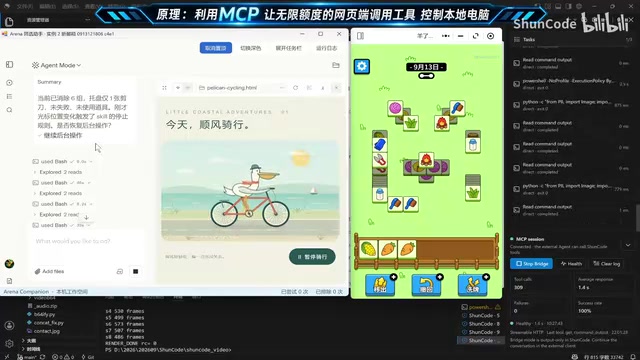
But the limitations were equally clear. The model perceives the game in "turns" and cannot think in real time the way a human can while playing. Faced with hidden tiles on the left and right sides it couldn't see, it was just as reliant on luck as anyone else. The run ultimately failed to clear the level — the creator attributed this to two factors: the model drawn that session wasn't the highest reasoning tier, and "Yang Le Ge Yang" inherently involves a luck component.
The creator also frankly stated that "models still have a long way to go" — a relatively fair assessment. AI agents are progressing rapidly on structured, fully observable tasks, but in scenarios with incomplete information, long-horizon planning, and luck-based decisions, they still struggle to win consistently.
Level 2 of "Yang Le Ge Yang" is infamous for its extremely low clear rate. The core challenge lies in the large number of tiles hidden under upper layers, forcing players to plan elimination sequences under conditions of incomplete information — one wrong move can fill the slot and end the run. This "partially observable" game environment is highly challenging for AI agents: the model can only read the currently visible state from each screenshot, unable to track previously revealed tiles through visual memory the way a human can, nor predict the content of hidden tiles. Current multimodal models are already quite impressive at recognizing visible information and short-step reasoning, but the limitations of a single context window are quickly exposed when faced with planning tasks that require maintaining hidden state across many steps. This is also the fundamental reason why AI agents perform excellently in perfect-information games (like Go) but still lag noticeably behind top human players in imperfect-information games.
Staying Clear-Headed: The Hype Far Outweighs the Practical Value
Taking it all together, this video is far more of a marketing piece than a technical one. A few key issues deserve a heads-up:
The "GPT-6" identity is questionable. The anonymous model codenames on leaderboard platforms (like "Astra") are not officially confirmed product names. The creator relies on "experience" to identify models, with no verifiable basis. Directly equating them to "full-power GPT-6" is a marketing tactic.
"Free" is relative. What's actually free is the leaderboard platform itself. What the creator is selling is the bundled software and the gacha process. The so-called "unlimited quota" depends entirely on the platform's promotional nature and could be cut off at any time due to policy changes.
Security risks are deliberately downplayed. Bridging a third-party program to a web-based model to control your local computer is the most critical risk in this entire scheme — and one that ordinary users have no real way to evaluate.
For users who genuinely need stable productivity tools, official channels cost money, but they deliver stability, compliance, and data security in return. This kind of "gacha farming" approach is better treated as a window into understanding LLM arena platforms and AI agent capabilities — not something to blindly invest in or install unknown software for.
Related articles

Hands-On with the Gemini 4 Argon API: Thinking Levels and Background Mode Explained
A Free Code Camp crash course on the Gemini 4 Argon API: from getting a key and sending your first request to controlling reasoning costs with thinking levels, enabling multi-turn chat with previous_interaction_id, and generating a Breakout game in background mode—plus a Google engineer's take on the model's capabilities.

Reinforcement Learning Takes On Getting Over It: Distributed Training Strategies Behind 63% Progress
A developer uses deep reinforcement learning to tackle Getting Over It. The agent climbs from the bottom to 63% progress but gets stuck at the anvil. The project is open-sourced, using divide-and-conquer training and CPU-only training, seeking community collaboration to break the bottleneck.

Sigma FP2 Released: The World's Smallest Full-Frame Camera Gets Sensor and Screen Upgrades
Sigma launches the FP2 full-frame camera, retaining its smallest-and-lightest design with three key upgrades: improved sensor, articulating LCD screen, and longer battery life—built for portable video creators.